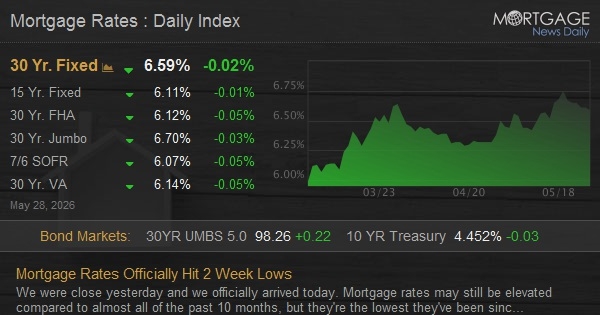
Mortgage rates have reached a two-week low. The average 30yr fixed rate fell to 6.59%, the lowest since May 14th. That marks a drop from 6.61% yesterday and from 6.75% last Tuesday. Two catalysts drove the move: news of a potential US/Iran peace deal and this morning's inflation data. Both helped the underlying bond market find its footing.
The simple read is that lower mortgage rates could revive housing demand and support rate-sensitive sectors. The better market read runs through the bond yield transmission mechanism. 30-year fixed mortgage rates track 10-year Treasury yields with a lag. Those yields dropped after the dual macro inputs. The US/Iran peace deal prospect reduces geopolitical risk premia, which tends to pull safe-haven demand away from Treasuries and push yields lower. The softer inflation data reduces the urgency for the Fed to tighten further, compressing term premiums across the yield curve. This is not a breakout. Instead, it is a confirmation that the recent rate spike is losing momentum.
The Bond Yield Transmission Path
The drop from 6.75% to 6.59% represents roughly 16 basis points of relief. For the housing market, every 0.1% change in mortgage rates shifts borrower affordability by about $15 per month per $300,000 loan. The larger point is that this move came in the absence of any Fed policy shift. It was entirely driven by geopolitical headlines and a single inflation print. That makes the transmission fragile. If the Iran deal stalls or inflation data reverses, the bond market could snap back, pushing mortgage rates back toward 6.75% or higher.
Two Supply-Side Catalysts
The first catalyst is the peace deal prospect. A US/Iran agreement would reduce oil supply risk and lower geopolitical uncertainty. That reduces the demand for safe-haven Treasuries and pushes yields down. The second catalyst is the inflation data. This morning's print showed softer price pressures, which reduces the need for the Fed to maintain a tight policy stance. Both factors contributed to the bond market's footing. The combination is unusual: geopolitics and inflation often pull yields in opposite directions. Together they provided a tailwind for fixed-income markets. For a deeper look at how softer US inflation reshapes global macro trades, see Why Softer US Inflation Reshapes Global Macro Trades.
What This Means for Housing and Risk Appetite
A two-week low is not a trend. It resets the baseline for refinance demand and new purchase applications. Borrowers who locked in at 7%+ earlier this year now see a window to refinance if rates hold. That would feed into consumer spending via lower monthly payments and potentially support retail and home improvement sectors. The risk is that the drop is an outlier, not the beginning of a sustained decline. The next inflation data release and the Fed's June meeting will be the immediate catalysts. If inflation confirms a softening trend, the bond market will push yields lower, dragging mortgage rates toward 6.50% or below. A hot print would reverse the entire move. The US/Iran peace deal timeline is also fluid: a breakdown in negotiations would reintroduce geopolitical risk premia, lifting Treasury yields and mortgage rates in sympathy. For more on how real yields and the dollar interact with this transmission, read Fed's War on Savings Reshapes Real Yields, Gold, Dollar. For now, the 6.59% level is a watchpoint, not a floor. Traders should treat this as a tactical signal for rate-sensitive sectors while waiting for confirmation from the next macro data point.