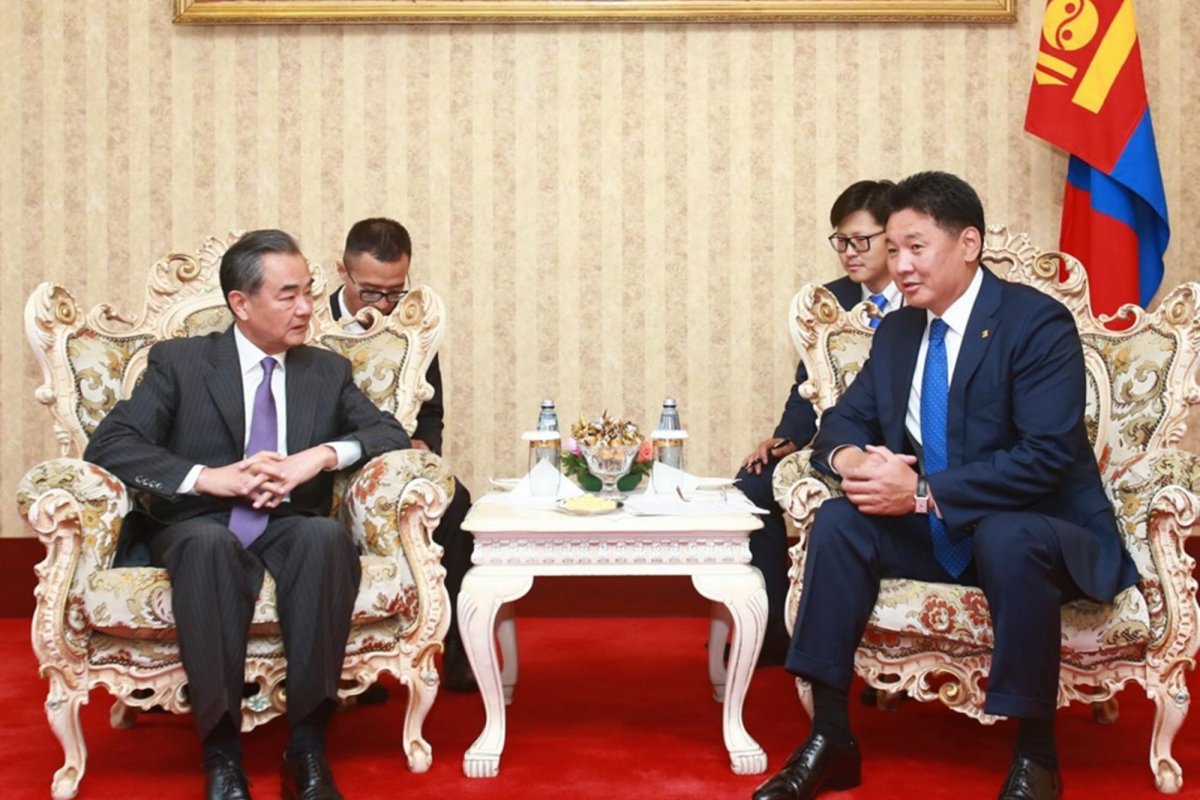
Khurelsukh said bilateral trade could hit $20 billion this year, nearly double 2023 levels, as he ruled out any support for Taiwanese independence.
Mongolian President Ukhnaa Khurelsukh told Chinese Foreign Minister Wang Yi on Saturday that Ulaanbaatar will not support any form of Taiwanese independence and will treat Hong Kong, Tibet, and Xinjiang as China's internal affairs. The meeting, held in the Mongolian capital, was Khurelsukh's strongest public reaffirmation of the one-China principle since taking office.
Khurelsukh said maintaining friendly relations with China was one of Mongolia's most important foreign policy priorities. He predicted bilateral trade would reach $20 billion this year, a figure that would nearly double the 2023 total. Mongolia shares a roughly 2,900-mile border with China, the longest land border China has with any neighbor.
“Mongolia understands and respects China's positions and concerns and firmly adheres to the one-China principle,” Khurelsukh was quoted as saying by Chinese state media. He added that Mongolia would not take any action that harmed China's interests because of its relations with other countries.
Wang arrived in Ulaanbaatar on Saturday after accompanying President Xi Jinping on his visit to North Korea on June 8 and 9. He said China was willing to serve as “a dependable neighbor, a trustworthy friend and a partner that helps accelerate Mongolia's development.” He also said Beijing highly valued Mongolia's decision to treat relations with China as a top foreign policy priority.
Mongolia has long balanced its diplomatic ties between its two immediate neighbors, China and Russia. The reaffirmation comes as Beijing seeks public support from neighboring countries for its positions on Taiwan, Tibet, and Xinjiang. Taiwan's government has consistently rejected the one-China principle, saying it is not a part of China.
For traders, the $20 billion trade target offers a concrete benchmark. Mongolia is a major exporter of coal, copper, and rare earths, all of which flow almost entirely to China. If the target holds, it would imply a sharp acceleration in cross-border resource flows, particularly in copper and coking coal. A miss would suggest either weaker Chinese demand or logistical bottlenecks along the shared border. The next quarterly trade data from China's General Administration of Customs, expected in July, will provide the first real check.
Prepared with AlphaScala editorial tooling from the source reporting linked above. Indexable analysis may include a cited Alpha Score value. Publishing checks screen each story before release. Educational coverage, not personalized advice.