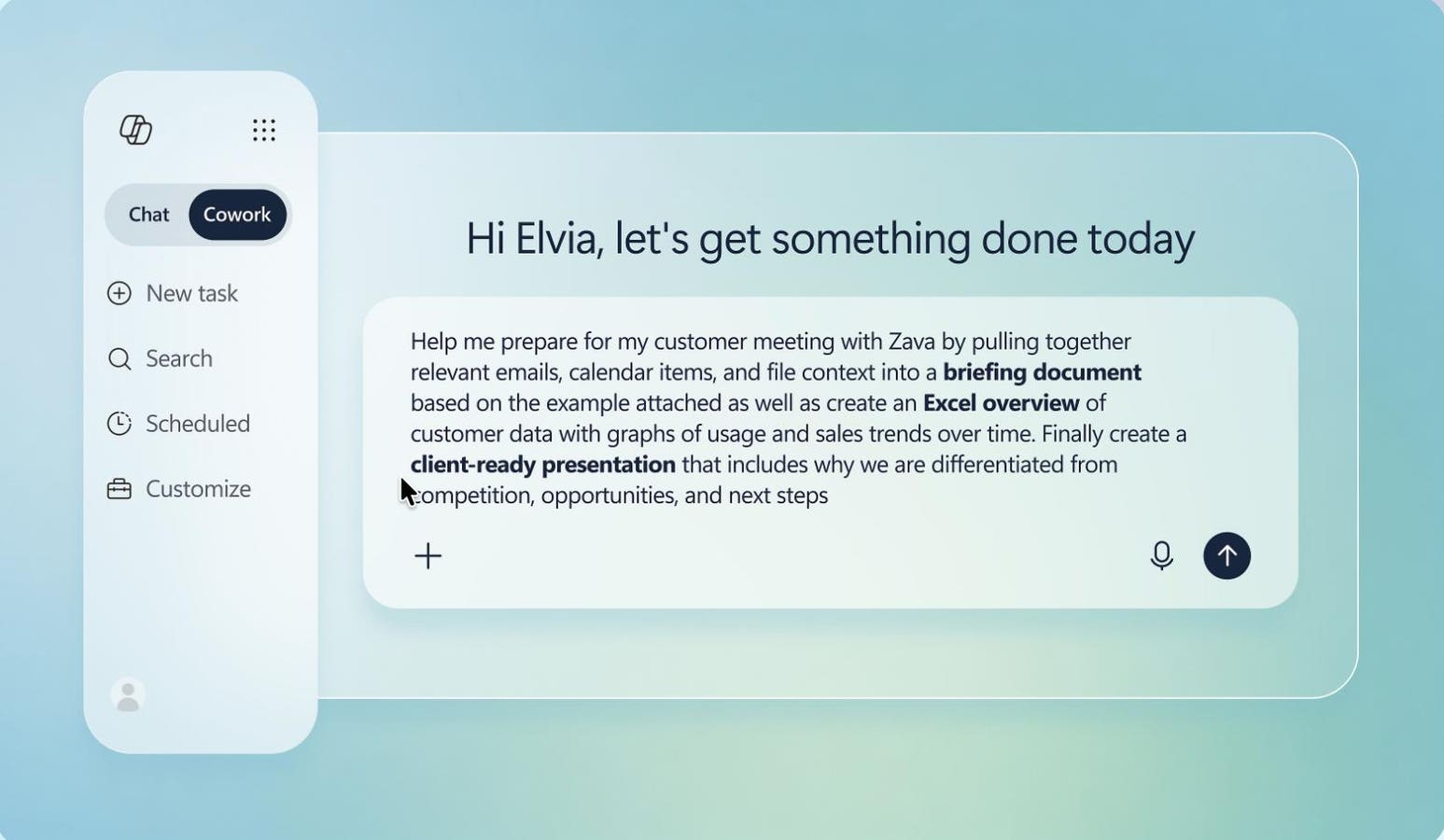
Microsoft and Amazon have both launched desktop AI agents aimed at knowledge workers who are not power users. The products, Copilot Cowork from Microsoft and Quick from Amazon, follow a template set by Anthropic's Claude Cowork. The idea is to bring agentic automation to a broader audience without the setup that Claude Cowork demands.
Moor Insights & Strategy, a tech industry research firm, published an analysis of the two entries. The firm's founder, Patrick Moorhead, tested the category through the spring. His read is that both companies have credible first products, yet the generation still shows real gaps.
Start with the benchmark. Claude Cowork gives users access to a local folder, custom MCP connectors, and a personal context store that functions like a second brain. That configurability is a superpower for power users. Most employees will never maintain it. The enterprise contenders are betting they can deliver most of the value with less setup and with the governance a CIO needs.
Moorhead laid out four capabilities that separate a serious enterprise assistant from a souped-up chatbot: centralized provisioning, robust memory and personal context stores, flexibility in model choice and connectors, and strong data protection. Measured against those criteria, Microsoft and Amazon come into focus.
Microsoft's Copilot Cowork, announced in March and made generally available in June, integrates with Microsoft 365. It offers real model choice, routing between Claude and OpenAI models depending on entitlement. Microsoft claims 30% to 40% consumption savings versus Claude when using the M365 connector. Moorhead called that plausible given Microsoft's stack ownership. He said he would want to see real-world customer numbers before treating it as fact. On data protection, Copilot Cowork delivers a provisioned, contained experience with security and governance controls. Provisioning runs through a backend platform called Agent 365 and Work IQ.
The trade-offs are clear. Copilot Cowork is cloud-only with no local file system. The pricing is layered, requiring a Microsoft 365 Copilot license plus consumption charges. For most enterprises that is a reasonable bargain. For the local-AI crowd it is a deal-breaker.
Amazon's Quick shipped in late 2025 and continues to extend. It is conceptually close to Copilot Cowork, though the philosophy differs. Where Microsoft leans on a backend platform, Amazon builds provisioning into the product itself. Quick also treats memory and the personal context store as two separate constructs. A personal knowledge graph learns the user's role, priorities, and relationships across sessions. Connected knowledge bases give users a curated store for their own files and external sources. Together they spare users from building their own second brains. Data protection was a major highlight of the launch, spanning security, sovereignty, and privacy controls.
Moorhead noted that he has spent hands-on time with Quick. He has not yet used Copilot Cowork, so he held off on comparative usability judgments. On flexibility, his hope is that Quick reaches parity with Amazon's more open AI offerings like Bedrock, with broader model choice and evaluations. The early enterprise commitments are significant. AWS cited deployments planned across more than 100,000 seats at some customers.
For all the momentum, this is a first generation. Moorhead identified five gaps. None of them are technology failures. They are a map of where the products stand today. The Claude-ification trend is a durable shift in how people will engage AI. For traditional software players to make it stick, they need to build management features for the 90% of employees who are not power users. They also need to use these assistants to showcase the best of their AI, not just email summaries and chat.
Microsoft and Amazon have both established credible starting points. Starting points are not finish lines. For investors tracking the enterprise AI race, the next markers are adoption numbers, pricing changes, and whether these tools expand beyond basic automation into deeper workflow integration. Microsoft's MSFT stock page shows an Alpha Score of 58/100, reflecting moderate sentiment. The broader stock market analysis context suggests that enterprise AI software remains a competitive battleground where first-mover advantage is not yet locked in.