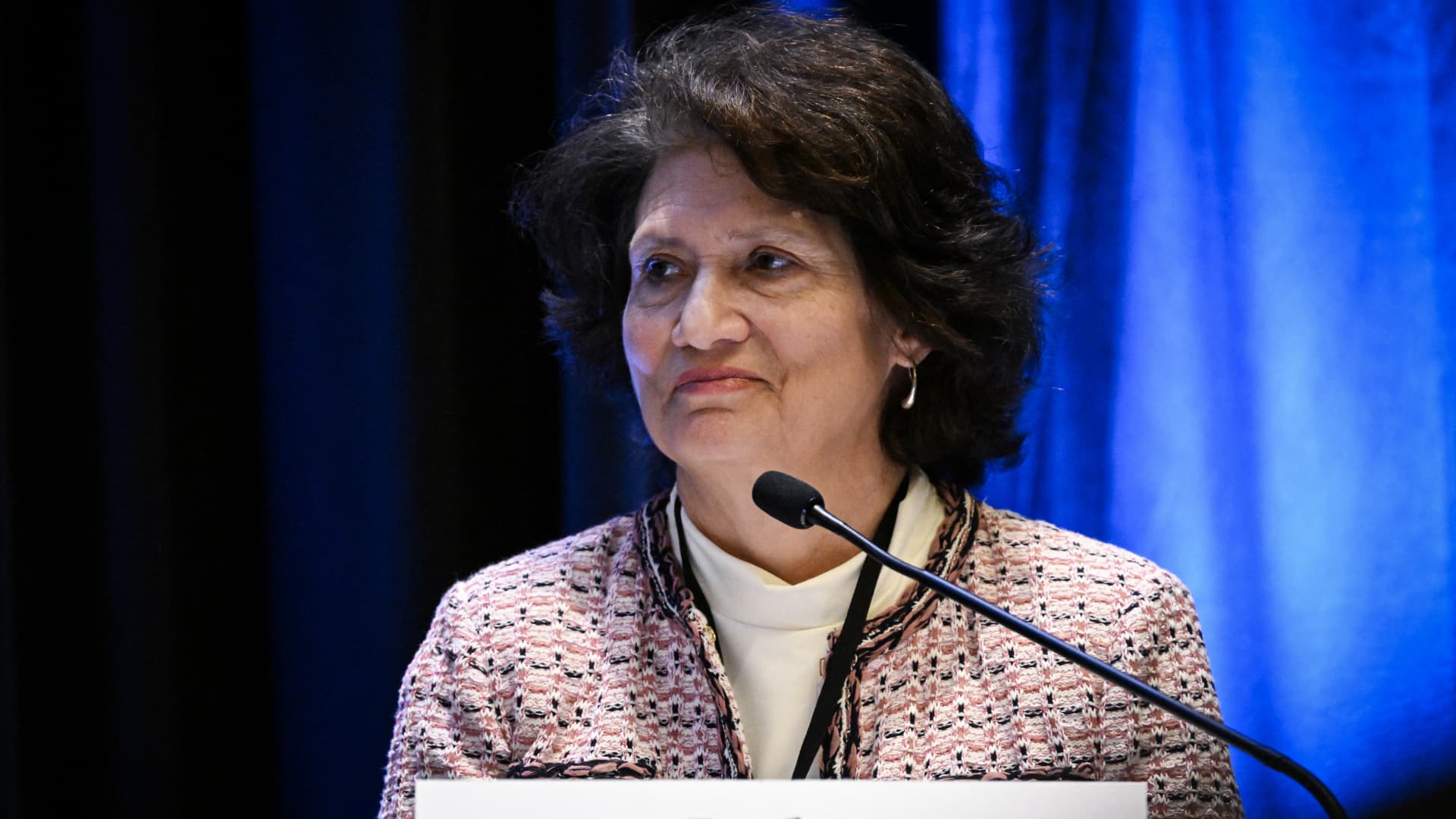
Yvonne Gonzalez Rogers has had a packed few months.
The Northern District of California judge spent late April and much of May in her downtown Oakland courtroom overseeing Elon Musk's lawsuit against Sam Altman. Now she is in week two of a trial that could reshape Meta's advertising business. California Attorney General Rob Bonta is leading a coalition of state AGs in what some are calling social media's "Big Tobacco moment."
Between the two trials, Gonzalez Rogers was named chief judge of the court, 15 years after President Barack Obama nominated her to the federal bench. She replaced Judge Richard Seeborg and takes over at a time when tech companies are bigger than ever and AI is driving more high-stakes fights into court. The district covers San Francisco, where OpenAI is headquartered, and all of Silicon Valley, home to Meta and most of its peers. For Gonzalez Rogers, the job caps a 35-year legal career in California. She began in private practice before then-Gov. Arnold Schwarzenegger appointed her to the Alameda County Superior Court in 2008.
Known to many as YGR, Gonzalez Rogers has a reputation for a no-nonsense style. "I would describe her as a pistol," said Steve Berman, a managing partner at Hagens Berman who served as co-lead counsel against Big Tobacco in the 1990s and has litigated against Apple before Gonzalez Rogers in several cases. "If lawyers give her bulls---, she just goes after them."
A Houston native, Gonzalez Rogers did her undergraduate work at Princeton and received her law degree from the University of Texas. She joined law firm Cooley in 1991, becoming the firm's first Latina associate. During her time as a state judge, she caught the attention of the late Sen. Dianne Feinstein, a California Democrat, who later recommended her nomination to President Obama.
Before the recent Meta and Musk cases, Gonzalez Rogers was well known to Apple watchers. In 2012, she inherited Pepper v. Apple, an early antitrust challenge to the App Store. iPhone owners alleged Apple forced them to buy apps through its store alone, letting the company charge a 30% commission. Gonzalez Rogers initially dismissed the case, though the Supreme Court later ruled consumers could sue. Around the same time, she oversaw an antitrust case alleging Apple unfairly blocked users from playing music from sources other than iTunes. Apple won that one.
Her most notable Apple trial came five years ago in the Epic Games case. In 2020, Epic activated its own payment option inside Fortnite, bypassing Apple's payment system and its 30% commission. Apple removed Fortnite from the App Store, and Epic sued. After a three-week bench trial in 2021, Gonzalez Rogers largely sided with Apple, finding Epic had failed to prove Apple was an illegal monopolist. She also determined Apple's "anti-steering" rules violated California competition law and ordered the company to allow developers to direct users to outside payment options.
Last year, Gonzalez Rogers said Apple willfully violated that injunction. She wrote in a court filing that Apple's vice president of finance "outright lied" to the court about when the company decided to levy a 27% fee on some purchases linked to its App Store. "Neither Apple, nor its counsel, corrected the, now obvious, lies," Rogers wrote, saying she considers Apple "to have adopted the lies and misrepresentations to this Court." She referred the matter to U.S. attorneys to investigate potential criminal contempt proceedings, though no prosecution emerged.
Gonzalez Rogers was back in the spotlight earlier this year as Musk and Altman took their long-running feud to court. In 2024, Musk sued Altman, OpenAI and co-founder Greg Brockman for allegedly "stealing a charity." After a three-week trial, the advisory jury ruled Musk had not filed his suit in time, ending the case without resolving his allegations. Musk called the verdict a "technicality" and vowed to appeal. Gonzalez Rogers said there's "a substantial amount of evidence to support the jury's finding." A spokesperson for Gonzalez Rogers told CNBC that the judge gives jurors a pocket constitution from the Supreme Court bookstore with a signed thank-you note for their service.
Like the Musk-Altman case, the Meta trial is a bench trial with an advisory jury. The jury hears evidence and reaches a verdict, the decision is not legally binding. Gonzalez Rogers retains the final say. "You only get an advisory jury where the parties do not have a right to a jury, and the judge could decide the matter on his or her own," said Steven Baicker-McKee, a law professor at Duquesne University. "An advisory jury allows the judge to gauge how the community feels about a certain event or certain conduct." Gonzalez Rogers wrote in a court filing: "The issues at play in this impact the daily lives of the public across the states involved. Thus, the Court deems it prudent to call an advisory jury to solicit the 'standard of the community.'"
This could be her most important case yet. Meta has estimated potential penalties from the states' lawsuit could be as high as $1.4 trillion. Bonta says the states are not demanding that much. Money is not Meta's biggest concern. The states allege Meta deliberately used features including infinite scroll, autoplay, likes, push notifications and disappearing content to hook young users despite knowing of the vulnerabilities. They also accuse Meta of collecting information from children without parental consent and misleading the public about the risks of its platforms. Meta has denied the claims.
Bonta and AGs from Colorado, New Jersey and Kentucky are co-leading the trial and represent a bipartisan group of 29 AGs seeking algorithm alterations that could force Meta to change how it designs and operates features for young users on Facebook and Instagram. Meta relies on its algorithms to target advertising, which accounts for 98% of its revenue. Opening arguments began on Tuesday. Bonta told reporters after the first day that the trial centers around "civil penalties, restitution and distortion," not primarily money.
The trial is expected to last six to seven weeks. It is the centerpiece of a larger judicial assignment: Gonzalez Rogers is overseeing the broader multidistrict litigation consolidating nearly 3,000 pending lawsuits against Meta, TikTok, Snap and YouTube over alleged harms to children and teens. "She's super smart, and I think thrives on challenging cases," Berman said. "I haven't always agreed with her in cases I didn't win. I know that she's smart."