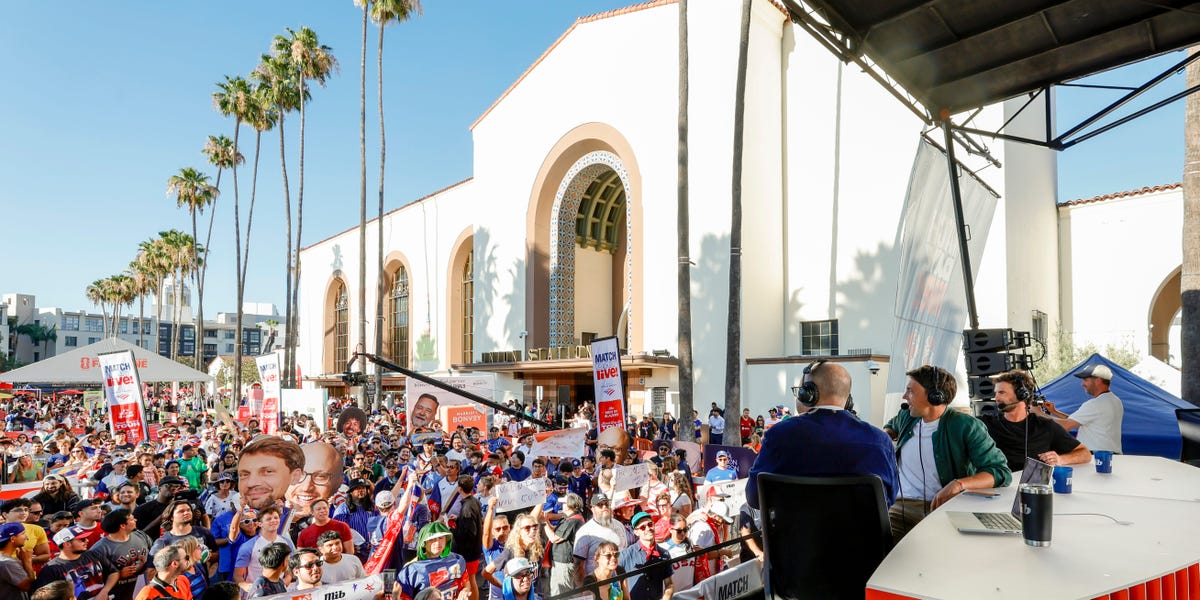
Men in Blazers pulled off a trick bigger media companies have tried and failed: it built a World Cup audience without owning the broadcast rights. The podcast and video brand, founded by Roger Bennett and Michael Davies, drew thousands of fans to a live stage in Seattle on a June morning, hours before the US men's national team kicked off. No network deal. No exclusive streaming package. Just a stage, a crowd, and a brand that has spent a decade cultivating a specific kind of soccer fan.
The company does not bid for tournament rights. It does not try to compete with Fox or Telemundo for the live game feed. Instead, it produces companion content – pregame shows, postgame analysis, live audience events – that runs alongside the official broadcast. The audience comes for the personalities and the community, not for the match itself. That distinction changes the economics. Men in Blazers does not need to amortize a billion-dollar rights fee across its content slate. Its cost structure is light: talent, production, and a venue.
The Seattle event was a test. Thousands showed up. The company sold tickets, merchandise, and sponsorships tied to the live show. The margin on that kind of event is far higher than what a traditional broadcaster earns on a game telecast, where the rights fee eats most of the revenue. Men in Blazers does not disclose financials, people familiar with the company’s operations said a single live show in one city can generate more profit than a season of ad-supported podcast episodes.
The risk is that the model depends entirely on the brand’s cultural relevance. Men in Blazers is not a utility. It is a taste. If the audience ages out or the hosts lose their chemistry, the companion-content strategy collapses. There is no exclusive content to fall back on. The company has no library of games, no archive of highlights that competitors cannot replicate. It owns only the relationship with its audience.
That relationship has been durable. The brand started as a podcast in 2010, grew through social media, and expanded into television with a show on NBCSN. When NBC lost the Premier League rights to Peacock, Men in Blazers followed its audience to the new platform. The World Cup companion strategy is the next logical step: find the audience where it already watches the games, and give it something extra.
The question is whether the model can scale beyond soccer. Men in Blazers has tried other sports. It produced a show about the English Premier League, still soccer. The brand is synonymous with the sport. Expanding into American football or basketball would require a different kind of credibility, and the company has shown no signs of trying. For now, the strategy is to deepen the soccer audience, not broaden it.
The World Cup cycle gives Men in Blazers a recurring catalyst every four years. The 2026 tournament, co-hosted by the US, Canada, and Mexico, will be the biggest test. If the company can replicate the Seattle model in a dozen cities across three countries, it will prove that the companion-content business is not a one-off. If it cannot, the brand remains a niche player in a market dominated by rights holders. Either way, the company has found a path that does not require a billion-dollar check.