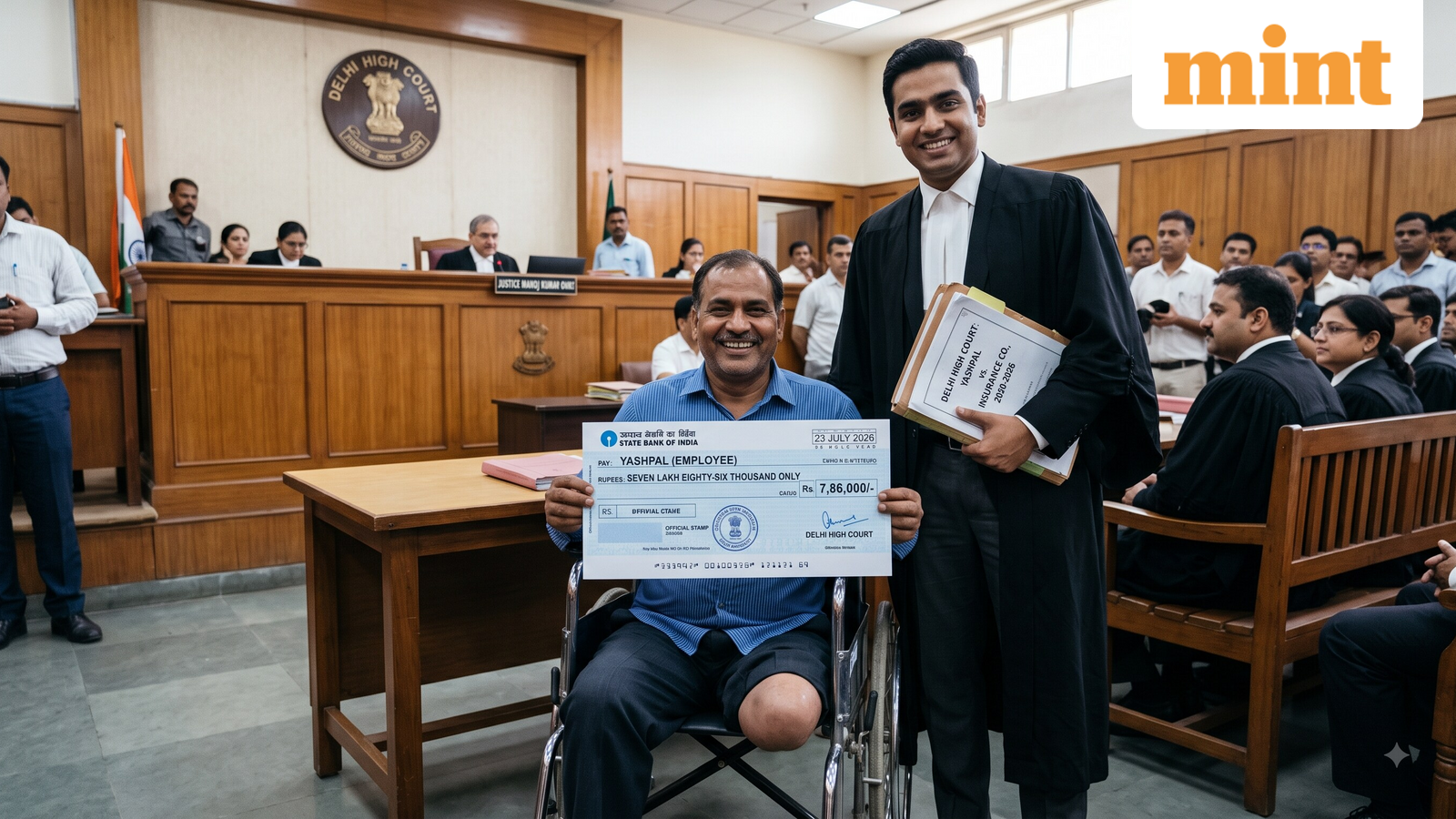
The Delhi High Court last month ordered an insurance company to pay ₹7.86 lakh in compensation to a construction supervisor who lost his leg in a lunch-break accident 16 years ago. The ruling, delivered by Justice Manoj Kumar Ohri on July 23, 2026, affirmed that a workplace injury during a meal break falls under the Employees' Compensation Act, 1923.
Yashpal, the supervisor, worked for a construction company in Delhi's Bhalswa area. On June 22, 2010, an iron rod fell on him from a mobile crane during his lunch break at the work site. The accident forced doctors to amputate his left leg.
He filed for compensation under the Act. In 2016, the Commissioner of Employees' Compensation, Delhi, directed the insurer to pay ₹7.86 lakh with 12% annual interest from July 22, 2010. The insurance company appealed, arguing that the accident did not occur "in the course of employment" because Yashpal was on break. It also contested his 75% disability assessment and the monthly wage calculation used to arrive at the payout.
Justice Ohri rejected every objection. "A temporary break for taking meals does not, by itself, sever the nexus between employment and the accident," the court said in its order. He noted that Yashpal was on the construction site when the accident happened, which kept the event within the scope of his employment.
The court also dismissed the insurer's argument that Yashpal's title of "supervisor" excluded him from coverage under the Act. "Mere 'Supervisor' designation is not conclusive to exclude Yashpal from employees," the judge ruled. The actual nature of his work, not the job title, mattered.
On the disability claim, the high court upheld the commissioner's reliance on medical evidence. Yashpal's left leg was amputated, resulting in a permanent 75% loss of earning capacity. The insurer could not produce contrary evidence.
Advocate Mayank Parashar of Clasis Law, who represented Yashpal, said the ruling clarifies that the construction site itself is the workplace, regardless of the precise moment of injury. "The court held that the lunch break is a reasonable interval within work hours. The employee was still on the employer's premises, performing activity incidental to employment," he told ET.
The case offers a clear precedent for similar claims across sectors where work sites double as rest areas – factories, warehouses, plantations, and offshore rigs. Industries with high physical risk and on-site meal arrangements are the most exposed.
Insurance companies underwriting employer liability policies will need to factor in this ruling when pricing coverage for such environments. The 12% interest rate on delayed compensation, which ran for 16 years, also signals the cost of contesting claims without strong evidence. The insurer in this case may end up paying close to ₹30 lakh once interest through July 2026 is added.
Parashar also pointed to the newer Occupational Safety, Health and Working Conditions Code, 2020, which strengthens preventive safety duties. "The law places a greater emphasis on employers proactively ensuring safe working conditions, which may reduce the frequency of such claims over time," he said.
For employers, the key takeaway is documentary. Attendance logs, CCTV footage, and incident reports during break periods matter more after this ruling. For workers, the decision closes the loophole that insurers have used to deny on-site lunch break injuries.
The case took 16 years to settle – from accident to high court order. That timeline itself is a factor for claimants and insurers assessing the real cost of litigation.