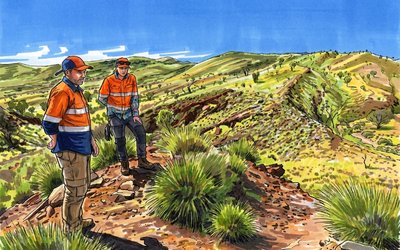
Litchfield Minerals has reframed the Harts Range corridor from a collection of separate prospects into a district-scale mineral system after June quarter technical work integrated data from the BHP Xplor program. The company said high-resolution magnetotelluric, seismic reflection, gravity, structural and isotopic datasets linked a deep conductor beneath Blackadder-Baldrick with wider regional structures and mineralising pathways.
At Oonagalabi, 11 reverse circulation holes totalling 1,772 metres and three diamond holes totalling 1,218 metres confirmed broad copper-zinc mineralisation in the Main Zone despite weather, access and personnel disruptions. Phase 3 drilling returned a standout interval of 68.26 metres at 0.62% copper, 1.44% zinc and 4.3 grams per tonne silver from 10 metres, including 19.66 metres at 0.66% copper, 2.58% zinc and 5.6 grams per tonne silver from the same depth.
The program also produced 120 metres at 0.35% copper, 0.92% zinc and 4.1 grams per tonne silver from 52 metres, including 60 metres at 0.52% copper, 1.26% zinc and 6.3 grams per tonne silver. Another interval returned 39 metres at 0.69% copper, 1.14% zinc and 5.3 grams per tonne silver from 60 metres.
At Bomb Diggity, a diamond hole intersected an unusual hydrothermal molybdenite-iron sulphide-quartz-carbonate vein at 617.2 metres containing an unconfirmed nickel-bearing sulphide mineral. The company said it may represent a previously unrecognised mineralising event in the Oonagalabi region.
Drilling at VT1 encountered disseminated sulphides but did not fully explain the strength of a modelled 3,000-Siemens electromagnetic conductor. Two VT2 holes returned no significant copper or zinc mineralisation, leaving that target requiring further assessment.
Reinterpretation of MT and seismic reflection data identified the deep C2 conductivity anomaly beneath Blackadder-Baldrick. Its absence from broader regional MT datasets supports the possibility that other deep conductors remain undetected without higher-resolution coverage, the company said.
Litchfield has planned two approximately 50-kilometre long MT and gravity survey lines across the Harts Range corridor using 1-kilometre MT station spacing and 500-metre gravity spacing to test for additional C2-style anomalies. A separate combined MT and gravity survey near Oonagalabi will test a conductivity anomaly at about 2.5 kilometres depth over an estimated 40 to 50 days. Completion is anticipated in mid-to-late August, supported by up to $100,000 in Northern Territory Geological Survey co-funding.
Rock chip sampling at Silver Valley returned up to 378 grams per tonne silver, 0.91 grams per tonne gold, 5.04% copper and 44.9% lead, supporting the interpretation of a structurally controlled polymetallic system that may extend at depth and beneath shallow cover. An induced polarisation survey contracted for Silver Valley was scheduled to start in early July to identify sulphide-bearing extensions beneath cover and generate drill-ready targets.
Litchfield spent $1.116 million on exploration during the quarter, including $1.032 million at Oonagalabi, $70,000 at Silver Valley and $14,000 on general exploration activities. The cash flow position equated to an estimated 5.09 quarters of funding based on total available funding of $4.603 million and relevant quarterly outgoings of $904,000. BHP (Alpha Score 71/100, Moderate) is a partner in the BHP Xplor program.