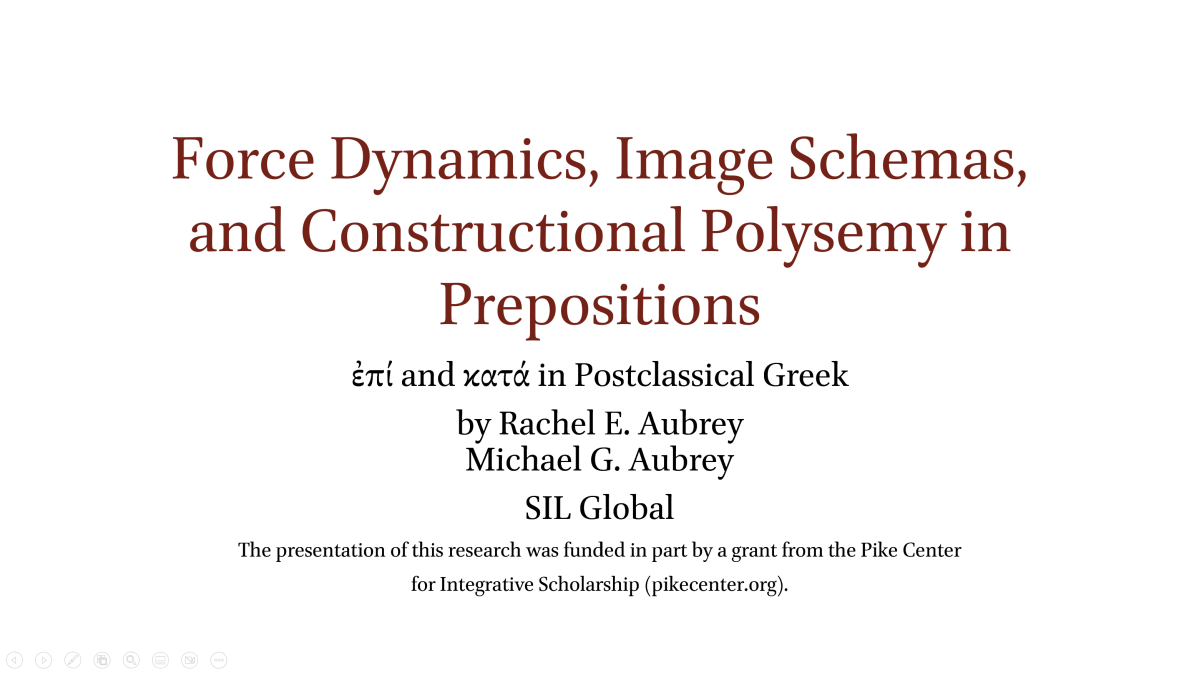
Rachel and Mike Aubrey presented new research on the semantic mechanics of Greek prepositions at the Society of Biblical Literature Annual Meeting in Boston this November. The presentation centers on the application of Force Dynamics to the prepositions ἐπί and κατά, offering a rigorous framework for how these terms function within the cognitive architecture of the Greek language.
Rethinking Ancient Semantics
The duo focuses on how these specific prepositions serve as vectors for force and spatial orientation. By applying Force Dynamics, the Aubreys argue that these terms are not merely static markers of location but are instead dynamic indicators of interaction. This shift in perspective moves the analysis away from traditional, often rigid, lexical definitions toward a more fluid model of how ancient speakers conceptualized physical and abstract constraints.
For those analyzing historical texts, this approach provides a more precise lens for translating nuances that standard dictionaries often flatten. The research suggests that the interplay between these prepositions is governed by consistent cognitive patterns that remain stable across different literary contexts.
Market Implications for Digital Humanities and AI
While this research sits in the academic sphere, the development of sophisticated linguistic models has direct consequences for the tech sector. Firms are increasingly investing in market analysis tools that require high-fidelity natural language processing. Models that can correctly identify the force-dynamic intent behind prepositions like ἐπί or κατά improve the accuracy of machine translation and sentiment analysis for complex, non-standard datasets.
Traders and developers should consider the following:
- Enhanced NLP Accuracy: Improved semantic parsing reduces errors in automated document classification, a key component for hedge funds using alternative data.
- Competitive Moats: Companies that own proprietary linguistic models capable of handling archaic or high-context syntax gain an advantage in the burgeoning AI-driven research market.
- Sector Rotation: Expect increased capital allocation toward AI infrastructure firms that prioritize structural linguistics over mere statistical probability in their LLM development.
What to Watch
Watch for the integration of these linguistic frameworks into broader AI benchmarks. If researchers can prove that Force Dynamics models outperform traditional transformer-based approaches in high-context environments, we may see a shift in how major tech players allocate R&D budgets toward specialized linguistic AI. Investors tracking the tech space should monitor whether these findings influence future updates to foundational models, as superior syntax handling often correlates with better long-term performance in specialized search and data retrieval tools.
The Aubreys have provided a clear path for moving beyond surface-level translation, suggesting that the future of text analysis lies in mapping the underlying cognitive forces that drive human communication.