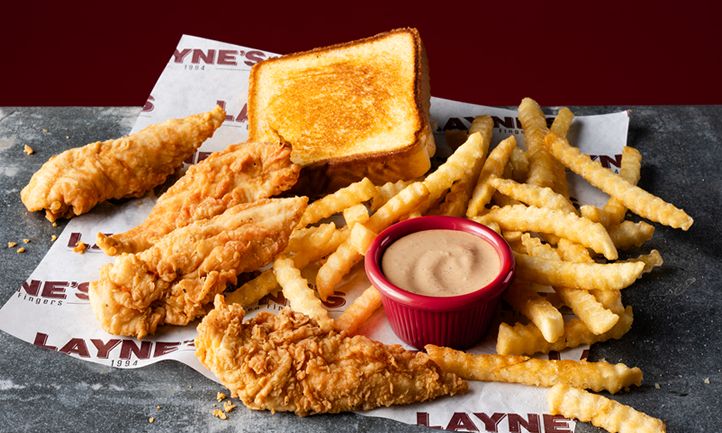
Layne's Chicken Fingers will open its 50th restaurant on June 13 at 7902 University Ave. in Lubbock, Texas. The milestone comes as the privately held chain accelerates franchise signings, awarding more than 50 future restaurants in the first quarter of 2026 alone. For operators and investors tracking the fast-casual chicken segment, the rate of development commitments offers a concrete signal about growth economics in a category that has largely held up against broader restaurant headwinds.
50th Restaurant as Franchise Inflection Point
The Lubbock opening marks a shift from regional cult brand to a scalable franchise system. Layne's started in College Station, Texas, in 1994 and operated as a local favorite for two decades. Only after Garrett Reed took over as CEO did the brand begin franchising in earnest. Now the system has crossed 50 units, and the pace of new commitments suggests the model is replicable outside its home market.
The restaurant will be the first Layne's in Lubbock and the 50th nationwide. The company plans more than 30 additional openings in 2026, pushing the total above 80 by year-end.
Franchise Velocity in Q1 2026
In the first quarter of 2026, Layne's awarded over 50 future restaurants across the country and signed 16 new leases. The forward pipeline now exceeds 100 units when combined with existing commitments. The brand also earned its first appearance on the Franchise 500 list earlier this year, a signal that its unit-level economics meet thresholds required for national franchisor rankings.
Key growth metrics from Q1 2026:
- Franchise awards: 50+ future restaurants
- Leases signed: 16 new locations
- Average unit volumes: Not disclosed
- Total open units: 50+
- Planned 2026 openings: 30+
C5 Restaurants' 55-Unit Pipeline
The Lubbock location is operated by C5 Restaurants, a multi-brand QSR group led by Eli Cohen. C5 already runs four Layne's locations in Arkansas. This is its first Texas site, yet the group holds a 55-unit development pipeline across Texas and Arkansas, the largest commitment in Layne's franchise history.
A 55-unit commitment from an experienced multi-unit operator is a material vote of confidence. It suggests the unit-level returns and brand support infrastructure justify multi-year capital deployment across two states.
Practical rule: A single franchisee committing 55 units signals that the chain's store-level economics are strong enough to absorb scaling risk.
How Chicken Finger Segment Defies Broader Restaurant Pressure
U.S. restaurant traffic has softened since mid-2025, with consumers pulling back on discretionary dining. The chicken finger subsegment has held up better than the broader fast-casual category. Layne's, Raising Cane's, and Zaxby's all continue adding units, while full-service chains trim store counts.
Cost Structure Advantage
Hand-breaded chicken fingers use a narrow ingredient set: chicken breast, breading, oil, sauces, and Texas toast. That simplicity keeps supply chain complexity low and food cost more predictable than pizza or burger concepts that rely on multiple protein and produce inputs. Layne's also positions its menu price below full-service chicken restaurants, making it a trade-down option for consumers who still want a sit-down-quality experience.
Menu Stickiness and Repeat Traffic
The brand's signature sauces (house, jalapeño ranch, honey mustard, BBQ, gravy) are a retention tool. The "How You Layne's" social media contest encourages customers to share custom orders, reinforcing habit formation. For a franchise investor, high average check and repeat frequency directly improve store-level cash flow.
Commodity Input Risks for the Supply Chain
Chicken finger expansion at this pace creates measurable demand for boneless chicken breast and breadcrumbs. Each Layne's location uses roughly 1,000–1,200 pounds of chicken per week based on industry averages. With 30 additional openings planned in 2026 beyond the existing 50, the chain will be sourcing from a larger base of processors.
Protein Procurement Risk
The chain does not contract directly with growers. It relies on broadline distributors like Sysco or US Foods. As volume grows, Layne's may need to lock in forward contracts for chicken breast to avoid margin compression during price spikes. Boneless chicken breast prices have been volatile, trading in a $1.50–$2.50 per pound range over the past year. A sustained move toward the upper end would pressure store-level EBITDA.
Frying Oil and Energy Correlation
Frying oil costs (typically soybean or canola oil) track energy prices. Traders watching the crude oil profile should note that a spike in crude can raise input costs across all fast-casual chicken operators. The commodities analysis desk tracks these input correlations regularly.
Benchmarking Against Public QSR Peers
Layne's is private. Its growth rates can still be benchmarked against public quick-service restaurant companies. Restaurant Brands International (QSR), owner of Popeyes and Burger King, reported 4% net unit growth in 2025. Yum! Brands (YUM) added about 3% systemwide. Layne's 50% unit growth rate (from 50 to over 80 planned by year-end) is multiples higher, though from a much smaller base.
| Metric | Layne's (2026 YTD) | Public QSR Peers (2025) |
|---|
| New restaurant openings | 50 awarded in Q1, 16 leases signed | 3–5% net unit growth |
| Development pipeline | 55 units from C5 alone | 1–2 year pipeline visible |
| Franchise 500 ranking | First appearance in 2026 | Long-established rankings |
| Average unit volume | Not disclosed | $1.5M–$2.0M (Popeyes) |
AlphaScala data note: Restaurant Brands International (QSR) currently holds an Alpha Score of 43/100 (Mixed), reflecting neutral momentum in the broader QSR space as of the latest update.
The Decision Point: Confirming or Weakening the Setup
The rapid franchise signings at Layne's are a useful microcosm for investors evaluating the health of the restaurant franchising model. The key question is whether this momentum reflects brand-specific appeal or a broader reopening of franchise finance.
What Confirms the Thesis
If Layne's opens the planned 30+ locations in 2026 without material delays and same-store sales at those units hold at or above system averages, the model will be validated. Strong performance would likely attract more multi-unit franchisees and could eventually trigger an IPO or sale to a larger QSR holding company.
What Weakens the Setup
The most immediate risk is chicken breast cost inflation. If boneless breast prices rise above $2.50 per pound for a sustained quarter, store-level EBITDA could shrink enough to slow new franchisee interest. A second risk is labor availability in the Texas expansion markets. The Lubbock opening relies on C5's operational discipline, replicating that in smaller markets is harder.
How to Track This Story
- Monitor USDA chicken breast wholesale prices weekly via commodities analysis.
- Watch for additional Franchise 500 listings or franchise disclosure document updates from Layne's.
- Look for comparable openings by Raising Cane's and Zaxby's to gauge segment saturation.
Private companies do not report earnings. The franchise development pipeline is a real-time indicator of investor confidence. Layne's crossed 50 units in a segment that still has room for national players. The question is whether the brand can maintain the pace without sacrificing quality or margin. The Lubbock opening is the first test of that scale.