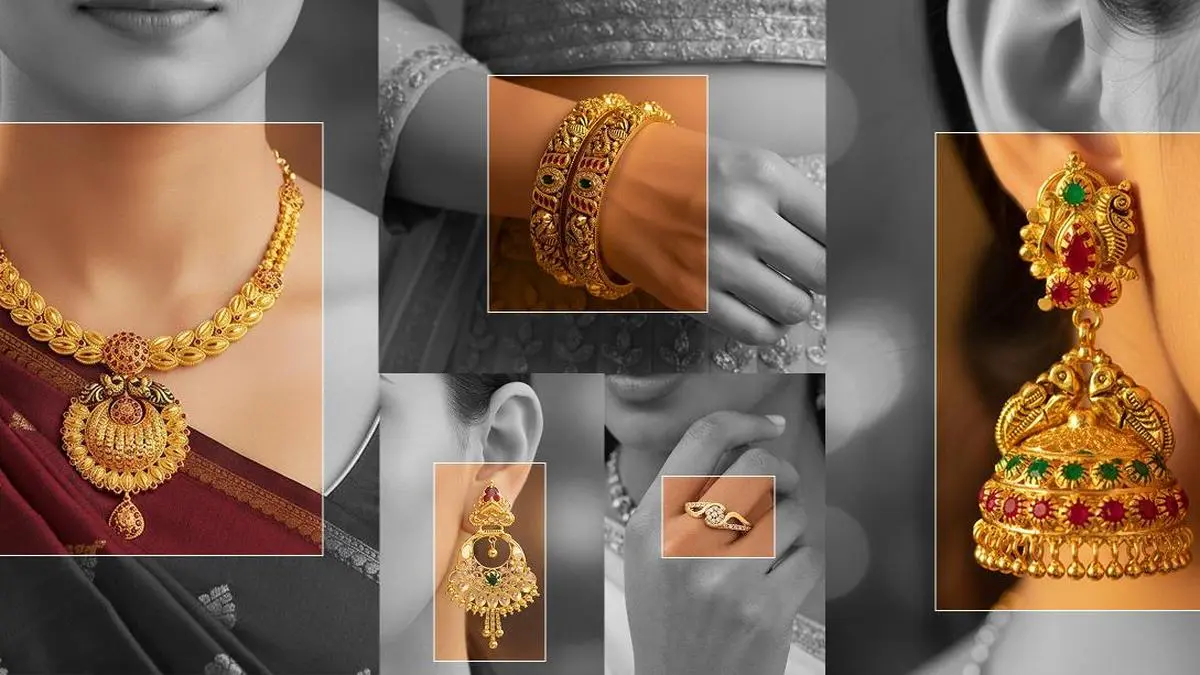
Lalithaa Jewellery Mart, a South India-focused jewellery retailer, opens its ₹1,700-crore IPO on August 17. The price band is ₹190-201 per share. The offer includes a fresh issue of ₹1,200 crore and an offer for sale of ₹500 crore. About ₹1,033 crore from the fresh portion will fund 10 new stores, the prospectus said.
At the upper end of the band, the company commands a market capitalisation of roughly ₹11,500 crore, or 11.3 times its reported FY26 earnings on post-issue shares. Promoters will hold about 82.85% after the offer.
The company targets the mass market in southern India, selling gold, silver and diamond jewellery through 61 company-operated stores across 51 cities in Tamil Nadu, Andhra Pradesh, Telangana, Karnataka and Puducherry. Gold jewellery contributed 92.33% of FY26 revenue. Revenue per store ran at about ₹410 crore and revenue per square foot at ₹3.84 lakh, among the highest in the organised jewellery segment, the company said.
The headline financials look strong. Revenue grew at a 22.1% CAGR between FY24 and FY26 to ₹25,024 crore. Operating EBITDA rose from ₹680 crore to ₹1,674 crore, with the margin expanding from 4.05% to 6.69%. Net profit climbed from ₹360 crore to ₹1,010 crore, pushing the net margin from 2.14% to 4.04%.
Those figures rest heavily on gold prices. Average gold realisation jumped from ₹59.6 lakh per kg in FY24 to ₹1.06 crore in FY26. The volume of gold sold actually declined 16.6% over the same period to 21,691 kg. With the store count rising from 53 to 61, average volume per store fell about 28%. Revenue was almost flat in FY25 before the 48% leap in FY26 that coincided with the surge in gold. The prospectus cautions that FY26 margins and return ratios may not be sustainable, particularly in the event of a decline in gold price.
Studded jewellery – higher-margin pieces embedded with diamonds or other stones – generated only 1.04% of FY26 revenue, down from 2.16% in FY24. Studded revenue declined 28% over that stretch even as total revenue grew 48%.
Operating cash flow was negative ₹398 crore in FY26 despite net profit of ₹1,010 crore, as inventory purchases consumed ₹3,944 crore. Inventory ballooned from ₹4,292 crore to ₹9,816 crore, with inventory days rising from 93 to 143.
Lalithaa does not hedge its gold price exposure through metal loans or derivatives. That leaves roughly ₹1,000 crore of new IPO proceeds that the company plans to deploy into inventory carrying price, timing and markdown risk – particularly acute if gold corrects after such a strong run. Customer jewellery schemes, which encourage repeat purchases and fund working capital, carry discount obligations in value-addition charges. In FY26 the company wrote down inventory by ₹273 crore because the realisable value under scheme commitments fell below the carrying value.
Borrowings rose 69% to ₹1,604 crore in FY26 before dropping nearly 23% to ₹1,238 crore as of June 2026.
The largest supplier accounted for 50.44% of FY26 purchases. The company generates no e-commerce revenue.
At 11.3 times reported FY26 earnings, the IPO price looks inexpensive – until the gold-price adjustment is made. Based on average net profit across FY24 to FY26, the trailing P/E stands around 20 times. Among listed competitors, Senco Gold trades at about 10 times trailing earnings. PN Gadgil Jewellers sits at 20 times. Kalyan Jewellers and Thanga Mayil Jewellery trade at around 40 times. Senco, PN Gadgil and Lalithaa all posted negative operating cash flow in FY26; Kalyan and Thanga Mayil reported positive operating cash flow.
The IPO closes August 19.