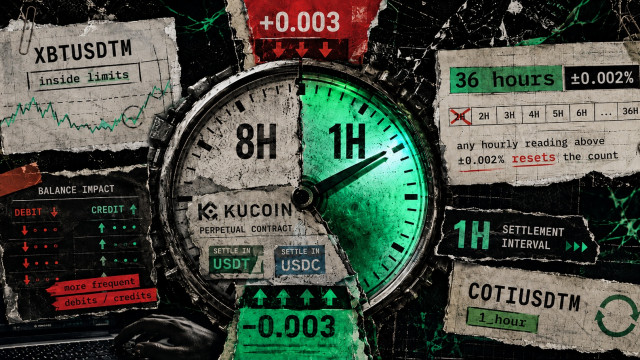
KuCoin activated a rule after 08:00 UTC on Aug. 17 that moves USDT- and USDC-margined perpetual contracts to hourly funding settlement once their contract-specific funding cap or floor is reached.
The change applies starting with the next funding period and will happen without a separate announcement, shortening the time between potential funding debits and credits for traders who keep positions open.
Under the mechanism, the trigger is the funding rate at a scheduled settlement. If that rate is at or above the contract's upper limit, or at or below its lower limit, KuCoin switches the contract to a one-hour interval unless it is already settling hourly.
KuCoin said the interval adjustment changes settlement frequency but leaves its funding calculations, funding limits, and users' positions unchanged. Funding may be debited or credited more often. The cumulative cost still depends on the realized rates, the side and size of the position, and how long it remains open.
The exchange requires 36 consecutive one-hour settlements with an absolute funding rate no greater than 0.002%. A reading above that threshold resets the count. Once all 36 periods qualify, the post-trigger schedule moves from hourly to four-hour settlement starting with the 37th period, again without separate notice.
KuCoin does not apply a universal cap or starting interval. Its announcement uses a Bitcoin perpetual with upper and lower limits of plus and minus 0.3% as an example.
At 20:15 UTC on Aug. 17, KuCoin's live XBT USDT M contract data showed a 0.003 cap, a minus 0.003 floor and an eight-hour interval. Its current funding rate fell within those limits, so the contract had not entered the mechanism's hourly phase.
KuCoin's broader active-contract data at the same time showed only COTI USDTM on an hourly interval. That cycle began July 28 under a separate KuCoin notice, before the automatic rule took effect. The first-day reading did not identify a contract newly in an automatic hourly state, although it cannot rule out a brief activation earlier in the day.
For traders, the change is about timing. Reaching a contract's limit can turn the next funding period into an hourly balance sheet event. Returning to a slower schedule requires at least 36 consecutive qualifying hours. The realized rate still determines each transfer.
Also known as "Akiba," Liam Wright is a reporter, podcast producer, and Editor-in-Chief at CryptoSlate. He believes that decentralized technology has the potential to make widespread positive change.
Explore related reporting by asset, place, or topic.
Small positive offshore funding exposes longs on a drop. CME leveraged funds' net short creates an upside squeeze channel.