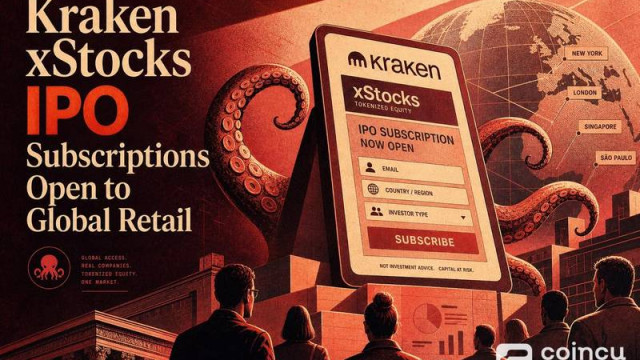
Kraken is opening US IPO subscriptions to global retail investors through its xStocks product. The move lets crypto-native users subscribe to traditional equity listings without a conventional brokerage account. The platform positions the service as a cross-border solution for non-US investors who have historically been locked out of the IPO allocation process.
The announcement signals a deeper push by the exchange into multi-asset offerings beyond spot crypto trading. Practical risks – jurisdictional friction, allocation uncertainty, and evolving regulatory oversight – deserve closer attention than the headline suggests.
Kraken xStocks IPO Subscriptions: What Changed
Simple read: Kraken is using its xStocks product layer to distribute pre-listing shares of upcoming US public offerings to eligible retail users outside the United States. The product targets a gap in the market: retail investors in jurisdictions where access to US IPOs is restricted or prohibitively expensive through traditional channels.
Better market read: Kraken is leveraging its existing tokenized equities infrastructure – xStocks already supports trading of tokenized versions of listed stocks – to bridge the gap between digital asset custody and legacy equity capital markets. This is not a simple listing of more tokenized stocks. IPO subscriptions involve pre-listing access, which has historically been controlled by investment bank syndicates and full-service brokerages serving high-net-worth clients.
By routing subscriptions through a crypto exchange with a global user base, Kraken can offer a direct pipe from a user's crypto wallet to an IPO allocation queue. The product layer functions as the wrapper, while Kraken operates as the platform and distribution channel.
Retail IPO Access: Barriers and Bypass
The core shift is structural. Non-US retail investors typically face multiple barriers to IPO participation:
- Geographic gatekeeping: Underwriter syndicates prioritize US-based institutional accounts and large brokerage clients.
- Account minimums: Many traditional brokerages require substantial balances to join IPO pools.
- Cross-border documentation: Foreign investors often need complex certifications or custodial arrangements.
Kraken's xStocks subscription service bypasses these by onboarding users through a single crypto account. The service is aimed at global retail participants, not institutional allocations. This approach mirrors a broader trend in which crypto exchanges expand into traditional capital markets products – a move that, if successful, could erode the monopoly banks and legacy brokers hold on primary equity access.
Geographic Gatekeeping
Pricing and allocation in US IPOs have long favored institutional buyers and wealthy brokerage clients. Most IPO shares flow through underwriter networks that rarely open allocations to foreign retail investors. Kraken's platform sidesteps that network entirely by using its own user base and custody infrastructure.
Structural Bypass
Practical rule: A retail investor in Southeast Asia or Latin America could subscribe to a US IPO from the same interface they use to trade Bitcoin. That reduces friction dramatically. It also introduces an entirely new set of exposures.
Regulatory and Jurisdictional Exposure
The biggest risk event here is not technical but legal. Offering access to US securities to a global audience means navigating securities laws in dozens of countries simultaneously. Different jurisdictions have different rules on:
- Whether foreign residents can subscribe to US IPOs at all
- Whether crypto platforms are eligible distributors under local securities codes
- Whether tokenized representations of pre-IPO shares constitute a separate security
Jurisdictional Traps
Some regions may prohibit residents from participating in US IPOs through crypto-adjacent platforms regardless of the underlying product structure. The compliance burden falls on Kraken to enforce geographic restrictions per user jurisdiction. Overly aggressive rollout could invite enforcement actions from regulators like the SEC or foreign equivalents.
SEC Oversight Risk
The product also raises questions about how US regulators classify the subscription mechanism. If the SEC determines that Kraken's xStocks IPO channel constitutes an unregistered offering or distribution without proper broker-dealer licenses, the service could face legal challenges. The evolving regulatory landscape for cross-border securities distribution makes this a live risk.
Risk to watch: Regulatory scrutiny of crypto firms bridging digital and traditional assets has intensified. Any enforcement action targeting Kraken's equity product could set a precedent that affects the entire sector.
Allocation Risk and User Expectations
Subscribing to an IPO does not guarantee receiving shares. Oversubscribed offerings routinely leave retail participants with partial fills or no allocation at all. Kraken's xStocks subscription service is an indication of interest, not a confirmed order.
For users unfamiliar with traditional IPO mechanics, this distinction matters. A retail investor who expects to receive the full requested allocation may be disappointed when an offering is 10x oversubscribed. The platform must communicate clearly that access to the subscription queue is not equivalent to guaranteed investment outcome.
Moreover, the allocation process itself creates reputational risk. If Kraken's allocation algorithm is perceived as opaque or favoring certain users, trust in the broader platform could erode. Transparency around allocation policy – pro-rata, lottery, or priority tiers – will determine whether the product builds confidence or generates friction.
Key insight: The product's success depends less on technical execution and more on managing user expectations around scarcity. IPO shares are a limited resource, and retail access has historically meant tiny fills.
Sector Read-Through: Crypto Exchanges as Multi-Asset Brokers
Kraken's move fits a pattern. Major crypto exchanges are expanding beyond spot digital asset trading into tokenized real-world assets (RWAs), equities, and structured products. The motivation is clear: spot trading fee compression is squeezing margins, and diversified product lines create additional revenue streams and user engagement surfaces.
- Kraken now offers IPO subscriptions alongside spot crypto, tokenized equities, derivatives, and staking.
- Competitors like Coinbase and Binance have launched similar equity-linked or IPO access products in select jurisdictions.
- The structural trend points toward super-app models where a single platform combines digital asset custody with traditional capital markets access.
For investors watching the sector, the expansion raises two questions. First, which platforms have the regulatory infrastructure to sustain this across multiple jurisdictions? Second, does adding IPO access materially improve user acquisition and retention, or is it a marginal feature in a crowded product suite?
Competitive Context
Kraken's announcement echoes broader infrastructure plays. Projects building compliance-first infrastructure for real-world asset tokenization are pursuing similar goals of bridging traditional and digital asset markets. The xStocks platform already powers Nasdaq's gateway connecting permissioned and permissionless tokenized equities markets, suggesting deep integration with legacy financial infrastructure.
Revenue Diversification
For Kraken, equity-linked products diversify platform revenue beyond trading fees. IPO subscriptions could generate service fees, custody revenue, or subscription tiers. The economics will depend on volume and allocation success rates.
What Confirms or Weakens the Setup
Confirms the opportunity:
- Strong subscription demand in initial offerings, particularly from Asia-Pacific and Latin America.
- Clear partnership or integration with a major IPO underwriter or clearinghouse.
- Regulatory clarity from a key jurisdiction that explicitly permits the product structure.
Weakens the thesis:
- A regulatory fine or cease-and-desist order from the SEC or a foreign regulator.
- Technical issues with xStocks settlement or tokenization that delay allocations.
- Poor user experience around allocation disappointment that generates negative community feedback.
The most immediate catalyst is the first wave of IPO subscriptions. If Kraken can demonstrate consistent allocation fills and regulatory compliance, the product could become a durable revenue line. If not, it may remain a niche offering with limited scale.
Bottom line for traders: This event changes the competitive landscape for crypto exchanges. It introduces real legal and operational risk. Watch for regulatory signals from the SEC and key international regulators over the next 90 to 180 days. The product's survival depends on how regulators classify cross-border, crypto-to-equity subscription channels.
This article is for informational purposes only and does not constitute financial or investment advice. Cryptocurrency and digital asset markets carry significant risk. Always do your own research before making decisions.