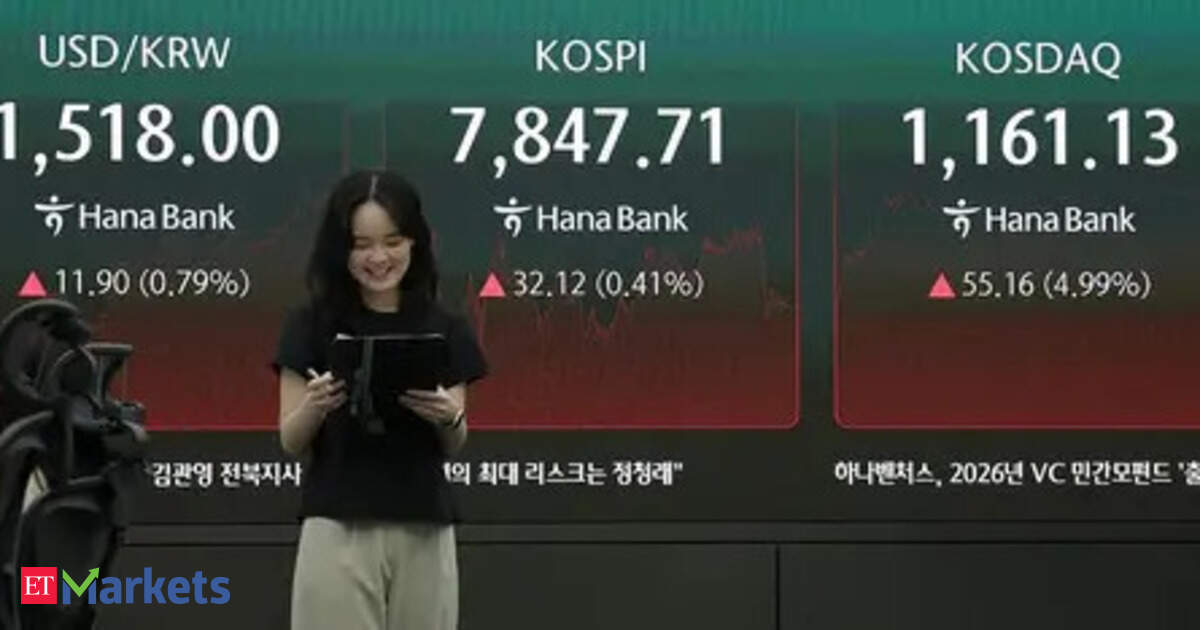
The Kospi surged 5% in a single session, snapping a three-day losing streak that erased 15% of the index's value. The bounce is the largest single-day gain in over a year. The question for watchlist construction is whether this is a positioning squeeze or the start of a mean-reversion trade with room to run.
The 15% drawdown came from a mix of domestic political uncertainty and a global risk-off rotation. South Korea's currency weakened roughly 2% against the dollar during that window, amplifying losses for foreign holders. The 5% snapback lacked an obvious catalyst – no rate decision, no fiscal announcement, no corporate earnings beat. That fact alone marks the move as a pure positioning event.
The Won Feedback Loop and the Kospi 5% Bounce
The simple read is that a cheap index attracted dip buyers. The better market read begins with the USD/KRW exchange rate. Foreign investors holding Kospi stocks saw their losses doubled by the currency leg. When the won stabilised on the bounce session, the double-hit reversed and foreign flows returned.
South Korea's equity market has a foreign ownership share near 30%. When those investors pull capital, the won weakens further, creating a feedback loop. The 5% surge broke that loop, at least temporarily. Open interest on Kospi 200 futures spiked, suggesting short covering rather than fresh long accumulation. Short-covering rallies tend to exhaust faster than rallies driven by new institutional buying.
Sector Transmission: Memory Chips, Batteries, and the Dollar Link
The Kospi's sector composition amplifies the dollar sensitivity. Samsung Electronics and SK Hynix together account for about 25% of the index's market cap. Both are memory-chip exporters with dollar-denominated revenues and won-denominated costs. A weaker won improves their margins mechanically. When the won stabilises, that tailwind pauses and the stocks trade on end-demand signals instead.
The battery sector – led by LG Energy Solution and Samsung SDI – has a different exposure. These companies face US Inflation Reduction Act policy risk and Chinese overcapacity. The 15% rout hit them hardest. The 5% bounce lifted them proportionally, the structural headwinds remain intact. The dollar link is weaker here; the catalyst path depends on US EV policy and Chinese export data, not currency alone.
What the Kospi Move Means for Emerging Market Rotation
South Korea is classified as an emerging market in most index frameworks. Its MSCI EM weight is about 12%, making it the second-largest EM after China. A 5% Kospi move shifts the entire EM complex. The bounce coincided with a broader EM currency stabilisation, suggesting the move was part of a risk-on rotation into beaten-down markets rather than a Korea-specific story.
Practical rule: A 5% single-day surge in a major EM index after a 15% drawdown is a signal to check positioning data, not to chase the move. If the won weakens again in the next two sessions, the rally was a short-covering event. If the won holds, the mean-reversion trade has legs.
The Asian session context matters. The Kospi bounce came alongside a general recovery in regional risk appetite, as covered in our analysis of the Asian rally on Iran de-escalation and AI rotation. That broader backdrop supports the case that the move is part of a positioning unwind across EM markets, not a standalone Korea phenomenon.
The Next Decision Point: Export Data and the Won Level
The next scheduled data is South Korea's monthly export figure, released on the first business day of the following month. Memory-chip export prices and volumes will be the key sub-component. A sequential decline would confirm that the 15% rout was fundamentally justified. A beat would support the case that the selloff overshot.
For traders watching the Kospi, the USD/KRW level at 1,450 is the line in the sand. A break above that level signals renewed won weakness and likely triggers another leg down in the index. A move below 1,420 confirms the stabilisation and opens the door for a retest of pre-selloff highs.
Among stocks in the AlphaScala coverage universe with indirect EM exposure, HDFC Bank Ltd (HDB stock page, Alpha Score 37/100) is a proxy for EM financial flows that correlate with Kospi direction. Infosys Ltd (INFY stock page, Alpha Score 57/100) and Wipro Ltd (WIT stock page, Alpha Score 46/100) are IT exporters whose dollar-revenue mix gives them a currency-sensitivity profile similar to Korean memory-chip makers. A sustained won recovery would be a modest tailwind for these names through the EM currency channel, the direct linkage is weaker than for Korea-listed stocks.
The Kospi's 5% surge is a reminder that 15% drawdowns in liquid, foreign-owned markets create mechanical squeeze potential. The durability of the move depends on whether the won holds its ground. Watch the currency, not the index headlines.