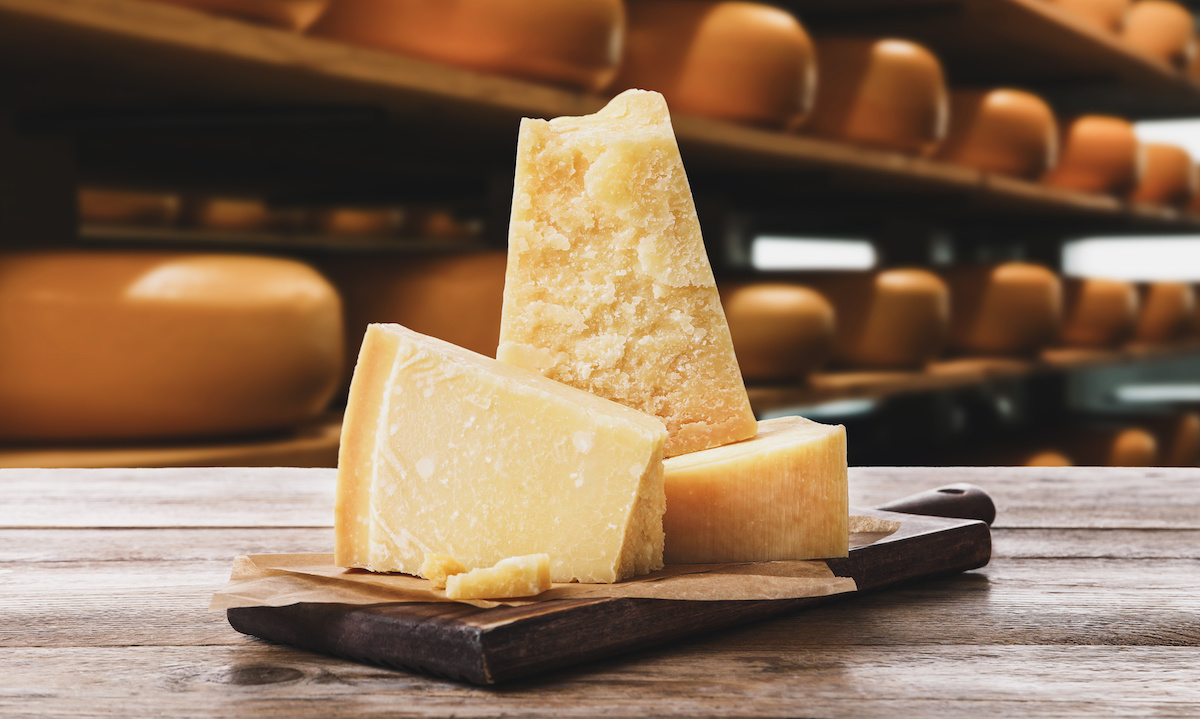
Wall Street slang calls money "cheese." In Italy, they took that literally.
Deep inside climate-controlled warehouses in Emilia-Romagna, hundreds of thousands of wheels of Parmigiano-Reggiano sit on shelves while securing loans from Credito Emiliano, Fortune reported Monday.
The arrangement is worth revisiting because an eccentric bit of regional finance has become a tidy lesson for anyone tracking digital assets. A centuries-old product supports working capital loans. Blockchain monitors the collateral. Extreme heat raises the cost of protecting it. Along the way, a cheese vault became a case study in tokenized assets and climate risk.
Credito Emiliano, known as Credem, has accepted Parmigiano-Reggiano as collateral since 1953. Its subsidiary, Magazzini Generali delle Tagliate, operates warehouses in Reggio Emilia and Modena that collectively hold more than 500,000 wheels worth over 300 million euros, according to the Fortune report.
These are not decorative wheels placed beside safe-deposit boxes. They are productive assets.
Parmigiano-Reggiano must mature for at least 12 months, according to the official cheese consortium, and much of it ages for 24 to 36 months. That creates a cash flow problem for producers. They have already paid for cows, feed, labor and production, the finished inventory cannot be sold for months or years.
Credem closes that gap. Producers generally borrow against 60% to 80% of a wheel's expected mature value, the Fortune report said. The bank stores and ages the cheese, monitors its quality and can sell it if the borrower defaults. A Harvard Business School case study described the model as financing built around the operational reality of a highly specialized industry.
The longer the cheese ages, the more valuable it becomes. Few commercial borrowers can say the same about their office furniture.
The model has also acquired a digital layer. Credem introduced a blockchain platform that records pledged wheels and allows their condition and location to be monitored in real time. The technology expands the collateral pool because some cheese can remain at producers' facilities rather than traveling immediately to a bank-owned warehouse, according to the Fortune report.
This is blockchain performing a useful job. It is not creating a Parmesan-themed cryptocurrency or offering consumers fractional ownership of Tuesday night's carbonara. It is maintaining a shared record of which physical goods secure which loans.
In its 2023 sustainability report, Credem said it had more than 291 million euros in operational credit lines tied to the cheese program, including more than 93 million euros managed through its blockchain platform. The program supported 137 businesses.
Now the collateral is feeling the heat. The wheels have not begun turning into fondue. The documented threat is to the economics surrounding them.
During peak heat waves this summer, daily energy use at Credem's cheese warehouses rose about 30% as cooling systems worked harder, Reuters reported July 13. On nearby farms, cows ate less and produced as much as 10% less milk during periods of extreme heat. Producers have added fans and water-misting equipment. Credem has upgraded cooling systems, insulation and renewable-energy capacity.
The climate debate can continue outside. Inside the warehouse, the electricity meter is already delivering its verdict.
The broader data points in the same direction. The European Union's Copernicus Climate Change Service said western Europe experienced its hottest June on record in 2026, with average temperatures 3.06 degrees Celsius above the 1991-2020 norm. A European Central Bank analysis explained how extreme weather can reduce labor supply, interrupt production and add costs that work their way through the economy.
For Credem, the chain is unusually easy to see. Heat affects cows. Cows affect milk. Milk affects cheese. Cheese secures loans. The weather has effectively entered the credit department.
Consumers in the United States should resist feeling too superior about Italy's edible balance sheet. In 1981, the U.S. government's Commodity Credit Corporation held nearly 486 million pounds of surplus cheese, according to a Government Accountability Office report. Italy simply chose the more market-oriented approach of lending against the cheese rather than buying the surplus.
Credito Emiliano's vault remains one of finance's more charming spectacles. The lesson is serious. Good collateral depends on more than its market price. It depends on energy, logistics, data and the physical conditions required to preserve it.
The cheese may still stand alone. Its risk profile no longer does.
For readers tracking tokenized real-world assets, Credem's program offers a working template. The Mastercard test of single-audit stablecoin compliance addresses a similar problem: how to trust that off-chain collateral maintains its value when the on-chain record says it does. Credem's answer is warehouse sensors, blockchain records and a bank that can sell the cheese if the loan goes bad. The technology is not the point. The trust is.