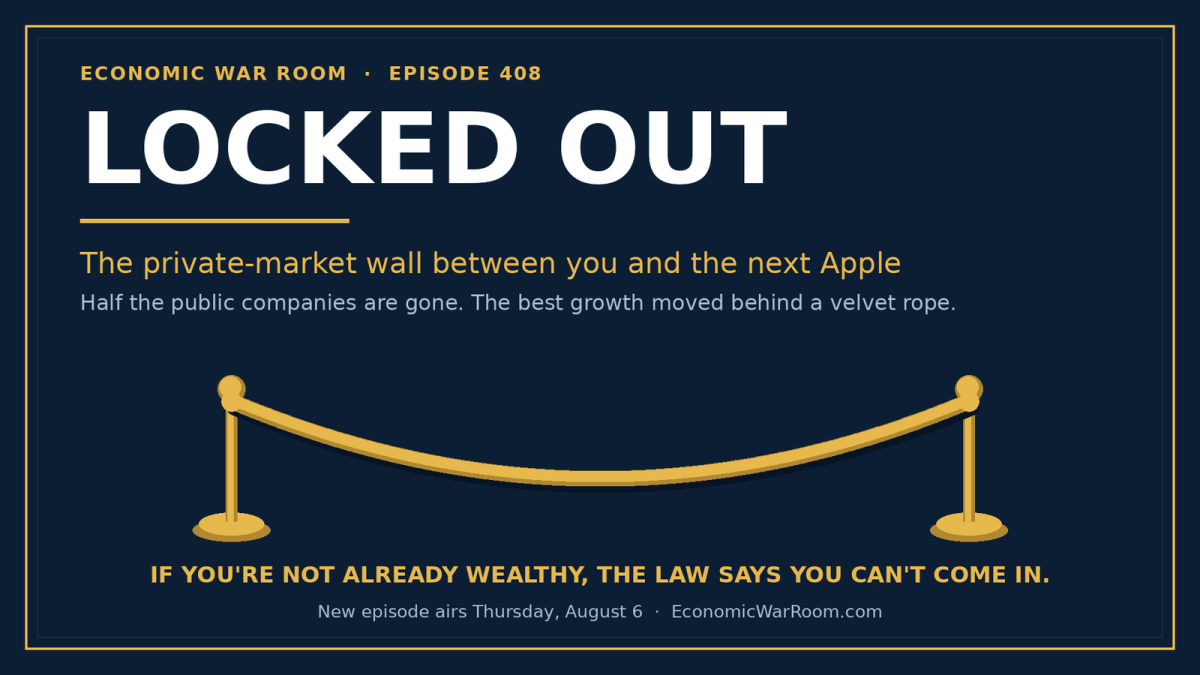
A bill introduced in the House this month would let ordinary investors buy into private companies that have long been off-limits, provided they work with a registered investment adviser. The Informed Investor Access Act, H.R. 9574, takes aim at a rule that critics say has locked the middle class out of the fastest-growing part of the economy.
Kevin D. Freeman, a Chartered Financial Analyst and host of the Economic War Room, laid out the case in a July 2 post. The number of public companies has fallen by roughly half over the past three decades, to about 4,200 from 8,000 in 1996, he wrote, citing research by finance professors Craig Doidge, G. Andrew Karolyi, and René Stulz. The decline is unusual by global standards; economists call it the American listing gap.
At the heart of the debate is the Securities and Exchange Commission's accredited investor rule. To buy into private placements under Regulation D, an individual generally needs a net worth above $1 million, excluding the primary residence, or an annual income of $200,000 ($300,000 for a couple). Freeman called the standard a "paywall built by law" that reserves the best deals for the already wealthy.
The Downing bill would create a new exemption. Instead of meeting a wealth test, an investor could rely on a registered investment adviser or a broker-dealer acting in their best interest. The adviser would be bound by fiduciary duty. The broker-dealer would follow the SEC's Regulation Best Interest. The bill amends Section 2(a)(15) of the Securities Act of 1933.
The legislation drew support from groups including the American Securities Association, the U.S. Chamber of Commerce, and the Financial Services Institute. Representative Troy Downing of Montana, a former state securities commissioner, introduced the bill July 2. Representatives Mike Lawler of New York and Tim Moore of North Carolina signed on as original cosponsors.
The push follows a trend where more companies stay private longer. By one estimate Freeman cited, there are more than 17,000 private U.S. companies with revenue over $100 million, against fewer than 4,000 public ones. Venture capital and private equity have funded a generation of unicorns. SpaceX, which went public this June after 24 years in private hands, was valued at roughly $2 trillion on its first trading day. Freeman called that ride "the cream" that ordinary investors missed.
If the bill becomes law, it could shift the investment environment for retail investors. Private equity has outperformed the S&P 500 over the past 25 years, Freeman said, citing the gap as a measure of what has been off-limits. The Federal Reserve's Distributional Financial Accounts show the top 1% of households hold about a third of all wealth; the bottom half holds about 2.5%. The top 10% own roughly 90% of equities and virtually all private equity. The public market still offers names like Microsoft, which has an Alpha Score of 70 and trades at $489.50, up 5.33% on the day.
Private markets carry real risks. They are less liquid, less transparent, and can lose money. Freeman stressed that the bill is not a blanket endorsement of private investing but a way to let qualified professionals guide small allocations. The bill has been referred to the House Financial Services Committee. No hearing date has been set.
The bill's fate is uncertain. The question of who gets to own the next Apple is now in Congress.