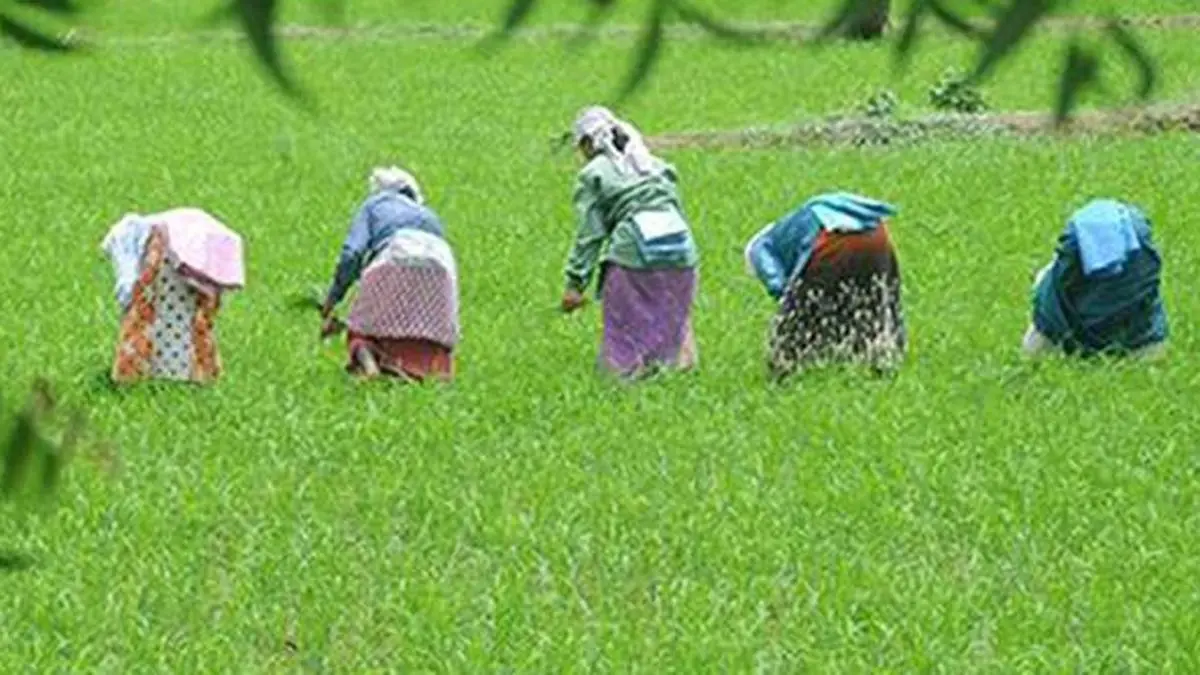
India's kharif sowing is off to its weakest start in years. Total acreage stood at 182.72 lakh hectares as of June 25, down 23% from 236.46 lakh hectares a year earlier, agriculture ministry data showed. The delay follows a sluggish southwest monsoon that has delivered 42% less rain than normal through June 24, according to the India Meteorological Department.
Paddy, the main kharif crop, covered 25.75 lakh hectares, a 25% drop from last year's 34.41 lakh hectares. Pulses fell 30% to 14.92 lakh hectares. Oilseeds took the biggest hit, with acreage plunging 53% to 16.99 lakh hectares from 36.41 lakh hectares. Groundnut area shrank to 8.87 lakh hectares from 15.29 lakh hectares. Soybean, the key summer oilseed, dropped to 6.92 lakh hectares from 19.97 lakh hectares – a 65% decline. Cotton sowing fell 35% to 29.66 lakh hectares from 45.36 lakh hectares. Coarse cereals declined to 31.84 lakh hectares from 36.07 lakh hectares. Sugarcane was the lone bright spot, rising marginally to 57.31 lakh hectares from 56.64 lakh hectares. Jute and mesta acreage also edged up.
The monsoon deficit is uneven. Central India has seen 59% less rain than normal. East and Northeast India are 41% below normal. South Peninsula is 28% below. Northwest India is 22% below. El Nino conditions are present over the equatorial Pacific and are expected to strengthen through the June-September season, the IMD said.
Reservoir levels add to the concern. The Central Water Commission monitors 166 major reservoirs. Total live storage as of June 25 was 48.405 billion cubic metres, or 26.37% of full capacity. That is 73% of last year's storage but 106% of the normal level. Of the 166 reservoirs, 55 are at 80% or below normal storage, and 29 of those are at 50% or less.
The acreage numbers carry direct implications for edible oil imports. India imports roughly 55% of its edible oil consumption. A smaller domestic soybean crop means higher reliance on imported palm oil from Indonesia and Malaysia, and on soybean oil from Argentina and Brazil. The soybean shortfall is the most striking. At 6.92 lakh hectares, area is at its lowest for this point in the season in at least five years. Madhya Pradesh and Maharashtra, the top two soybean states, have both seen delayed planting. If rains normalise by the second week of July, some of that ground can still be planted. If not, the 2025 soybean crop will be meaningfully smaller than the 2024 harvest.
For the broader market, the data reinforces a watchful stance on edible oil prices, on rural demand indicators tied to kharif income, and on the government's policy response. A weak kharif season would push up food inflation and could prompt the government to extend duty-free import windows for pulses and edible oils. The next two weekly sowing reports, due July 4 and July 11, will show whether the monsoon catch-up is real.