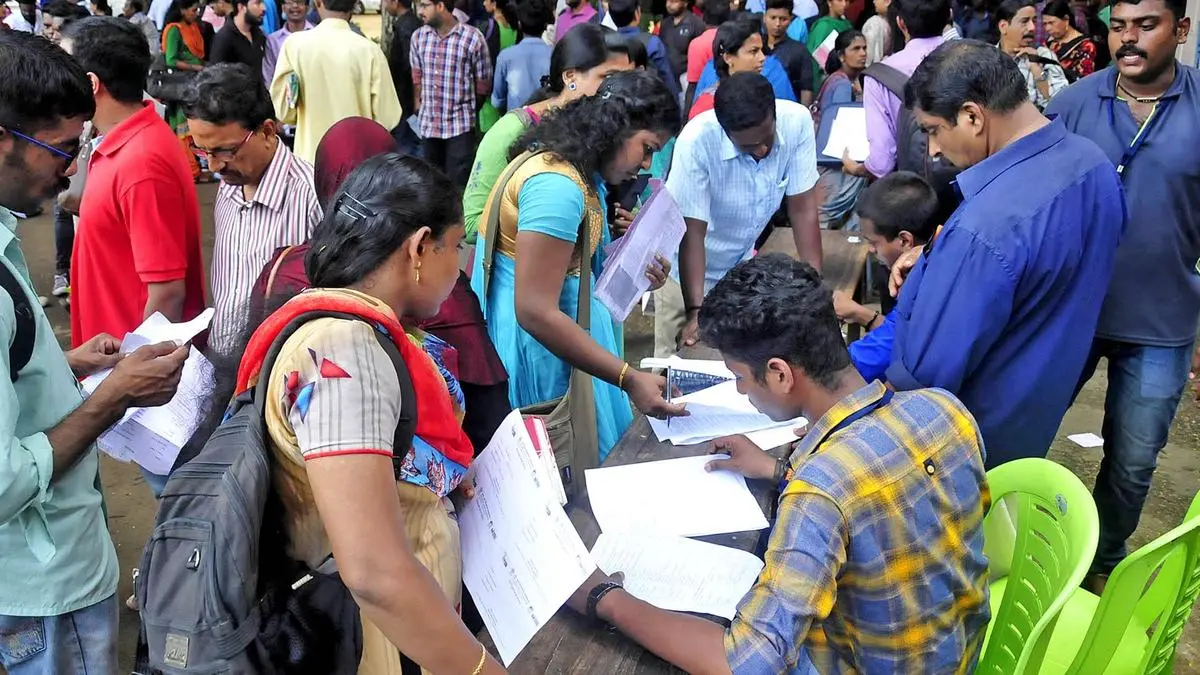
A new PLFS survey shows unemployment below 2.5% in Ahmedabad and Kolkata, above 20% in Prayagraj and Patna. Regular jobs and wages are higher in million-plus cities.
India's million-plus cities show a stark unemployment divide. Prayagraj and Patna have jobless rates above 20%. Ahmedabad and Kolkata report rates below 2.5%. The gap is not a statistical outlier. It reflects deep differences in industry mix and population composition, a new Statistics Ministry survey shows.
The report, prepared from Periodic Labour Force Survey data collected between January and December 2025, covered more than 46 cities with populations of 10 lakh or more. The survey visited over 19,000 households with roughly 60,000 residents aged 15 years and older. The average unemployment rate across these cities was 6.8%, roughly in line with urban India as a whole.
Gender breakdowns reveal the scale. Under the current weekly status approach, women in Prayagraj faced a 31% unemployment rate, men 23%. Patna's female unemployment hit 36%, with male joblessness at 18%. The report does not assign causes for the high rates. Local observers point to the large student populations in both cities, many preparing for competitive exams. A person is counted as unemployed if they did not work even one hour during the survey week but sought or were available for work. In Ahmedabad and Kolkata, diversified industry and IT services absorb workers.
Employment patterns sharpen the picture. Regular wage and salary employment accounts for 58.5% of jobs in million-plus cities. That compares with 47.6% in urban India. Casual work is nearly half the share: 6.3% against 12%. Women in these cities hold regular jobs at a higher rate than men do: 65.1% versus 56.4%. The national urban figure for women is 50.9%. This inversion of the usual pattern suggests that larger cities offer more structured employment for women.
Labour force participation rates show a familiar gender gap. Male LFPR in million-plus cities was 75.3%, close to the urban average. Female LFPR was 25.8%, slightly below the urban figure. Among men not in the labour force, 53.5% cited education as the primary reason. Among women, childcare and homemaking accounted for 68.7% of non-participation.
Wages and earnings tell a clearer story of advantage. Self-employed workers in million-plus cities earned ₹30,858 per month and regular wage employees ₹28,808. In urban India, the equivalent figures were ₹23,013 and ₹26,258. Casual labourers in these cities earned ₹624 per day, against ₹550. The premium exists across all categories, suggesting that urban agglomeration itself lifts earnings, not just the job type.
The January–December 2025 survey captures a labour market where geography and industry structure determine opportunity. Cities with a strong industrial or services base absorb workers into regular jobs with higher pay. Cities dominated by education-seeking populations show high measured unemployment but also reflect a different life-cycle stage. The data offers a baseline for local labour policy, not a single national fix.
Prepared with AlphaScala editorial tooling from the source reporting linked above. Indexable analysis may include a cited Alpha Score value. Publishing checks screen each story before release. Educational coverage, not personalized advice.