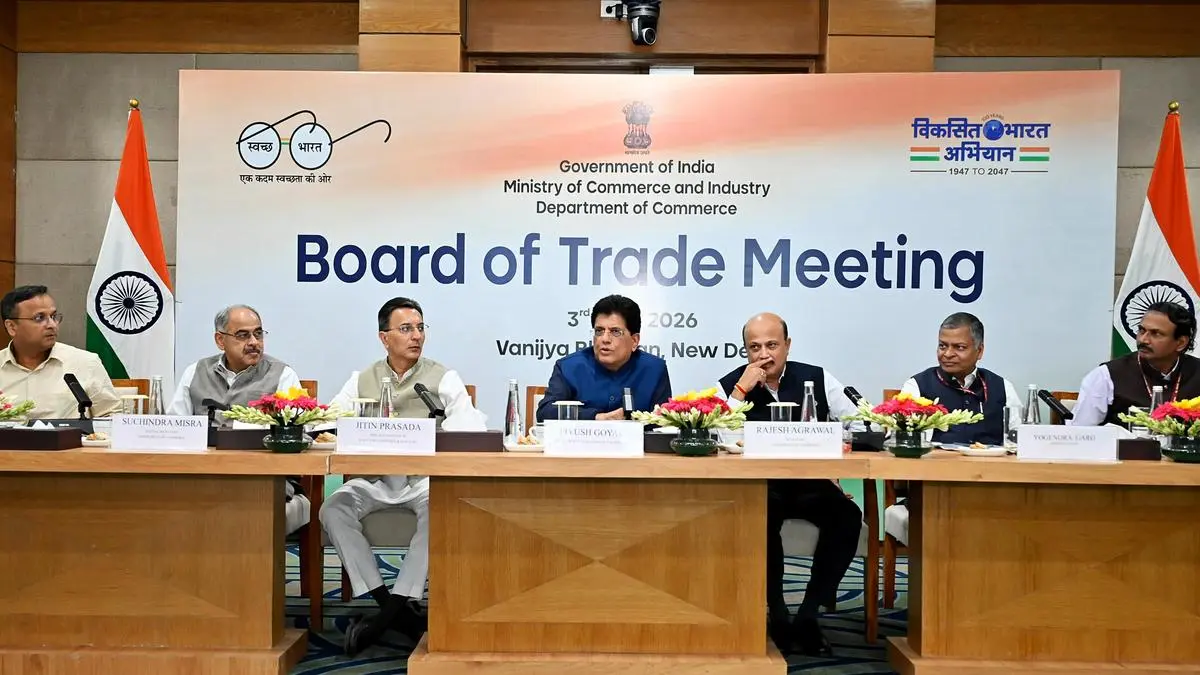
Commerce Minister Piyush Goyal put a number on the table that changes the growth math for a swath of Indian industries. India is on track to hit $1 trillion in combined goods and services exports by the fiscal year ending March 2027, he said at a Board of Trade meeting on Friday. Goods exports would need to rise about 16-17% to $530 billion. Services would climb roughly 11% to $470 billion.
The April-June quarter already showed a 15% gain in goods exports and 11% in services, Goyal noted. The pace puts the target within reach, he said. Achieving it would require "everyone's collective effort."
The $90 billion jump in goods exports in a single year does not happen without ripple effects. Export-oriented manufacturing – textiles, engineering goods, chemicals, pharmaceuticals – accounts for the bulk of India's merchandise export basket. A 16-17% growth rate means higher capacity utilisation, more factory orders, and a longer tail for working capital demand. Logistics and shipping stand to gain as well. Container freight volumes out of Indian ports would need to expand to handle the incremental $90 billion. Warehousing, inland transport, and port operators see first-order volume growth. Trade finance desks at banks also get a lift: more letters of credit, more export credit, more hedging for currency exposure.
Goyal pointed to free trade agreements signed with 38 developed nations as the opening play. "The FTAs have opened up markets across 38 developed nations for Indian goods," he said. The government is sending official and business delegations to deepen commercial ties. The minister urged industry to move beyond "cosy comfort" and reach global buyers, focusing on cost control, quality, and on-time delivery.
A seven-point action agenda came out of the Board of Trade meeting. It includes state-level notification of labor rules to resolve land and labor bottlenecks, 100% government funding for testing facilities to cut exporter costs, and prioritisation of export-oriented businesses by states. Those measures, if implemented, would lower the friction costs that currently cap India's export competitiveness.
The $1 trillion figure is ambitious. India's total exports in the prior fiscal year stood at $863 billion. The gap is $137 billion. The trajectory – 15% goods growth in the first quarter – suggests the runway exists, at least on paper. The question is whether global demand holds up and whether domestic infrastructure keeps pace. Goyal's tone was confident. "Everyone has taken an oath that this year we will do an export of $1 trillion," he said.
For traders and analysts, the readthrough is not about a single number. It is about which sub-sectors see the earliest demand signal. Textile exporters with strong order books, pharma companies with approved products in developed markets, and logistics firms with port-side exposure are the first places to look. The next check points are the monthly export data prints and the government's progress on the seven-point agenda.