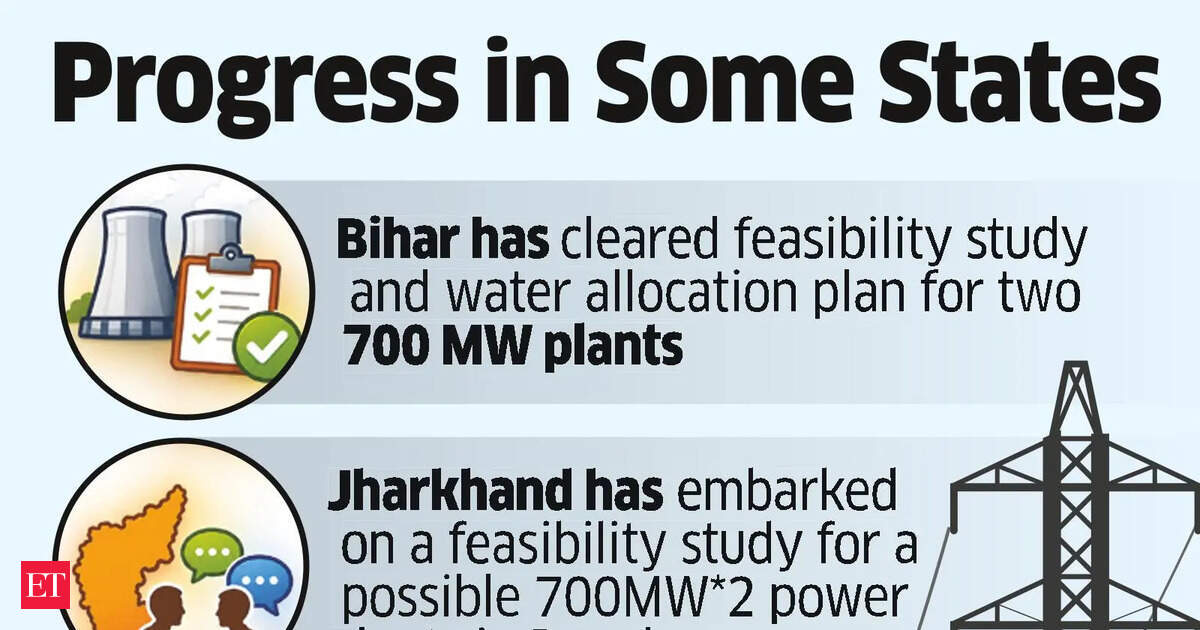
India's central government is pressing states to fast-track approvals for nuclear power plants and battery storage projects, a move aimed at securing round-the-clock electricity for data centers and AI computing. Clearances remain pending in 12 states for 32 proposed nuclear sites, according to an ET Bureau report. Battery storage plans are delayed in four states.
State-run Nuclear Power Corp. of India Ltd. stands to benefit from faster project timelines. Equipment suppliers such as Bharat Heavy Electricals Ltd., which makes turbines and reactor components, could see order books thicken if the clearances come through. Storage companies like Amara Raja Batteries and Exide Industries, both expanding into grid-scale batteries, would gain from quicker revenue recognition.
The delays in four states for storage signal uneven regional progress. States with advanced renewable targets, Gujarat and Rajasthan for example, may clear projects faster than those with weaker grids or political friction. The first approvals will set the valuation benchmark for the rest.
Data center operators are the ultimate end-users. CtrlS and Yotta have struggled to secure power for new facilities. A faster nuclear and storage pipeline would reduce their reliance on coal-fired backup, lowering both costs and carbon exposure. That could improve margins for operators listed on Indian exchanges.
The government's urgency reflects a widening peak power deficit. Industry estimates project India's AI workloads will add 10-15 gigawatts of demand by 2030. Nuclear and storage are the only baseload options that can fill the gap without adding coal capacity.
One risk: nuclear projects in India have historically faced cost overruns and local opposition. The 32 pending sites show that even with central pressure, state-level clearance remains a bottleneck. Specific state government announcements matter more than central directives.
The battery storage delays are more tractable. Land acquisition and grid connectivity are the main holdups. If the four states resolve those issues within the next two quarters, a wave of project starts could follow.
The market has priced in the policy intent but execution remains unproven. Nuclear and storage stocks have rallied on the news. The real test will come when the first batch of clearances is actually granted. The ET report did not specify a timeline for the state-level decisions.