Puri says three excise duty cuts absorbed Rs 10/litre; OMCs losing Rs 1,000 crore daily on Strait of Hormuz tensions. Fuel prices could ease once cheaper crude reaches refiners.
Union Petroleum Minister Hardeep Singh Puri said Saturday that petrol and diesel prices in India have not effectively increased, even as global crude markets swung. Speaking in Sonbhadra, Uttar Pradesh, Puri pointed to three central excise duty cuts – November 2021, May 2022, and a recent reduction – that he said left the government absorbing roughly Rs 10 per litre on each fuel.
“If we look at the situation in real terms, there has been no increase in petrol and diesel prices in the country,” Puri said.
He was asked whether domestic fuel prices would fall given softer international crude. Puri replied that among 193 UN member states, only Japan had seen a smaller increase in petroleum prices than India. The overall rise in petrol and diesel prices had been limited to Rs 7.60, he said, and compared with levels during the Russia-Ukraine conflict that began in 2022, “there has actually been no increase.”
Puri acknowledged that oil marketing companies were losing about Rs 1,000 crore per day because of tensions around the Strait of Hormuz. The government chose not to pass that burden to consumers, he said.
“If compared with 2022 prices, the rates are actually lower,” he added.
The minister said refiners were still working through crude inventories bought at higher prices. Once lower-priced crude reaches them, fuel prices could soften.
“At present, companies have stocks of crude oil bought at higher prices. When crude purchased at lower prices reaches them, there is a possibility of a reduction in fuel prices,” he said.
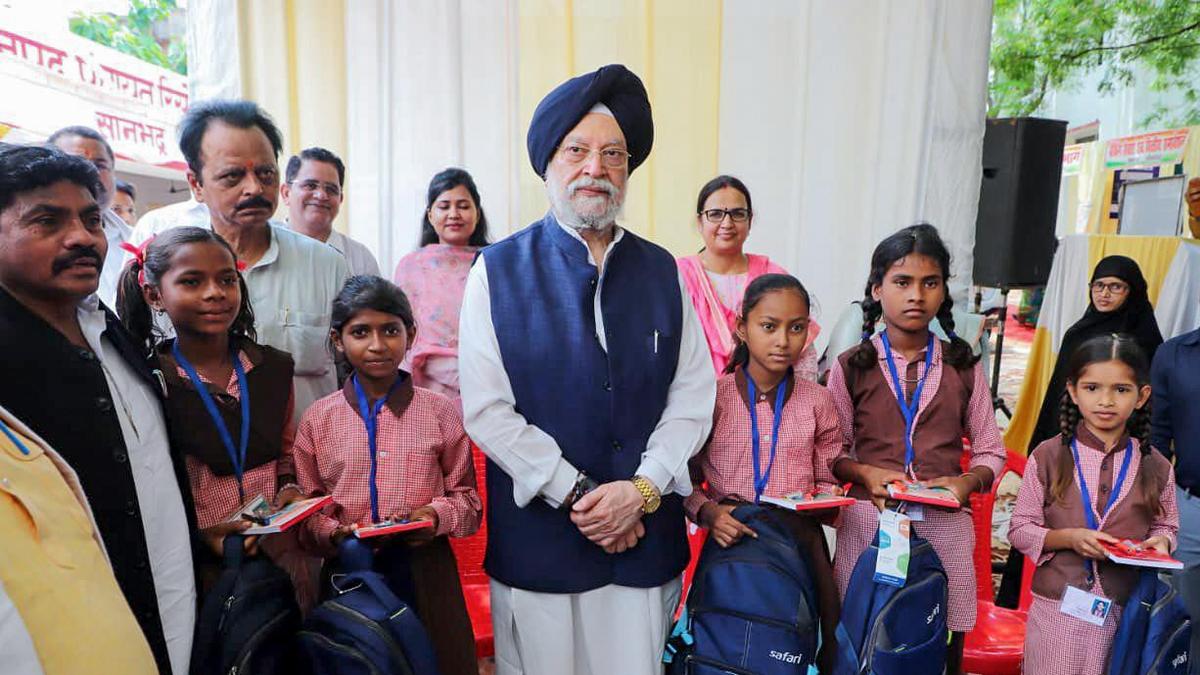
Puri was in Sonbhadra as part of a campaign marking 12 years of the Narendra Modi government. He said the district had taken the top spot in the government’s Delta Ranking programme and was shedding its image as a backward region. Sonbhadra’s per capita income had risen from Rs 43,000 in 2018 to about Rs 1.2 lakh now, he said.
Uttar Pradesh’s gross state domestic product had climbed from roughly Rs 13 lakh crore in 2016-17 to nearly Rs 36 lakh crore, Puri said. More than 23,000 startups, over nine lakh government jobs through transparent recruitment, and the One District One Product scheme had turned the state into a growth engine, he added.
“Ayodhya, Kashi and Prayagraj are emerging as world-class spiritual and tourism centres,” Puri said, citing the Ram Temple, Kashi Vishwanath Corridor and Mahakumbh infrastructure as drivers of tourism and local employment.
India had become a USD 4-trillion economy from the world’s 11th largest in 2014, he said, and was advancing rapidly toward becoming the third-largest economy globally.
Prepared with AlphaScala research tooling and grounded in primary market data: live prices, fundamentals, SEC filings, hedge-fund holdings, and insider activity. Each story is checked against AlphaScala publishing rules before release. Educational coverage, not personalized advice.