Back to Markets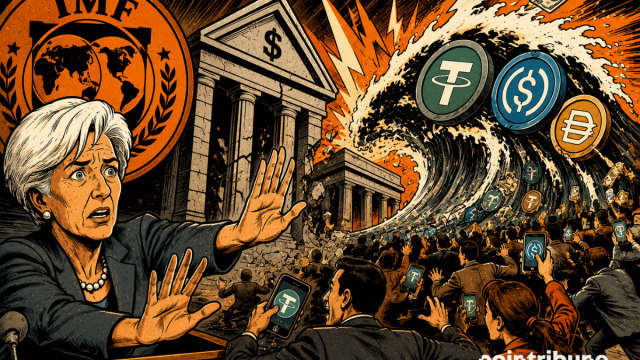
Crypto▼ Bearish
IMF Paper Warns Stablecoins Can Amplify Currency Crises
An IMF working paper says dollar stablecoins coordinate capital flight in managed-exchange-rate economies, removing the time lag that once contained banking panics.
Continue with
Stablecoins are big enough now to destabilize national currencies, the International Monetary Fund said in a working paper published July 11. The analysis, led by IMF economist Brandon Joel Tan, broke ground by naming the mechanism explicitly: in economies with managed exchange rates, crypto-dollar tokens act as accelerators of capital flight, not just substitutes for scarce official dollars.
The paper focuses on jurisdictions where central banks ration access to U.S. dollars. In those settings, a stablecoin pegged to the greenback becomes a real-time price signal. When the official exchange rate diverges from market reality, the crypto price on exchanges shows the true scarcity of dollars. That visible, high-frequency price is available to anyone with a mobile app. The result, Tan wrote, is that stablecoins can "help coordinate local currency exits during exchange rate crisis periods" and "amplify currency panics when pressure on the national currency becomes severe."
Instead of a slow, diffuse flight from the local currency, the single transparent price triggers a coordinated rush. The paper models how that changes the dynamics of a classic currency crisis. In a traditional banking panic, information is fragmented and slow. On-chain data removes the lag. Everyone sees the same price at the same time, and everyone acts on it at the same time. That turns a manageable outflow into a sudden drain on foreign-exchange reserves.