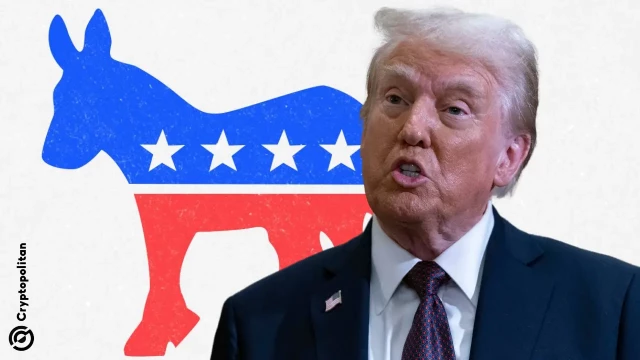
A Democratic takeover of the House in November’s midterms would push subpoenas over President Donald Trump’s crypto earnings ahead of the CLARITY Act, a market-structure bill the crypto industry has spent the year pushing.
Maryland Representative Jamie Raskin, the ranking Democrat on the House Judiciary Committee, would take the gavel under that scenario. He has called the corruption around the presidency “a civic emergency” and said a Democratic majority would let his party “call hearings, conduct depositions, use subpoenas to compel the appearance of witnesses.”
Raskin’s target list includes Attorney General Pam Bondi, whom he has threatened to subpoena over the Justice Department’s handling of the Jeffrey Epstein files, as well as a $1.8 billion “anti-weaponization” fund for Trump allies and alleged foreign emoluments clause violations.
The president’s 927-page financial disclosure filed with the U.S. Office of Government Ethics shows he earned roughly $635 million in royalties from “Celebration Coins,” tied to his $TRUMP memecoin business. Another $500 million came from sales by World Liberty Financial, a crypto company co-founded by members of his family.
Arizona Representative Yassamin Ansari has already asked the House Oversight Committee to subpoena Barron Trump, the president’s 20-year-old son, over the family’s ties to jailed influencers Andrew and Tristan Tate. Barron is a co-founder of World Liberty Financial, with crypto holdings estimated at about $150 million. The subpoena request is frozen while Republicans hold the gavel, Ansari said on a podcast.
The CLARITY Act would split oversight of crypto tokens between the SEC and the CFTC, moving most tokens beyond the SEC’s reach. Senate Majority Leader John Thune confirmed the chamber would not vote on the bill before the August recess, pushing action to September 14 at the earliest, according to Cryptopolitan.
Republicans hold 53 Senate seats, short of the 60 needed to break a filibuster. About a dozen Senate Democrats have signaled conditional support, but they want an ethics provision restricting Trump’s ability to profit from his family’s crypto businesses. Senator Thom Tillis, a retiring North Carolina Republican, and Senator Ruben Gallego, a Democrat from Arizona, offered a counterproposal including a divestment requirement for Trump. It is unclear whether the White House and other Republicans will accept it.
Senators Elizabeth Warren and Richard Blumenthal asked the SEC in early August to investigate whether the $TRUMP memecoin amounted to an “illegal scam” and a possible “rug pull,” noting that nearly one million investors lost north of $3.8 billion on the coin while Trump himself made $636 million. The SEC’s 2025 guidance classifying memecoins as non-securities may limit its authority, according to Cryptopolitan.
Polymarket pegs the odds of the CLARITY Act passing within the year at about 38%, down from above 80%. On Kalshi, the chance of passage in 2026 sits at about 20%.
Trump’s crypto dealings are not the only focus. AI, crypto, and Big Tech companies together spent $294 million on this election cycle’s races, more than half of all corporate outside spending, according to Data for Progress.