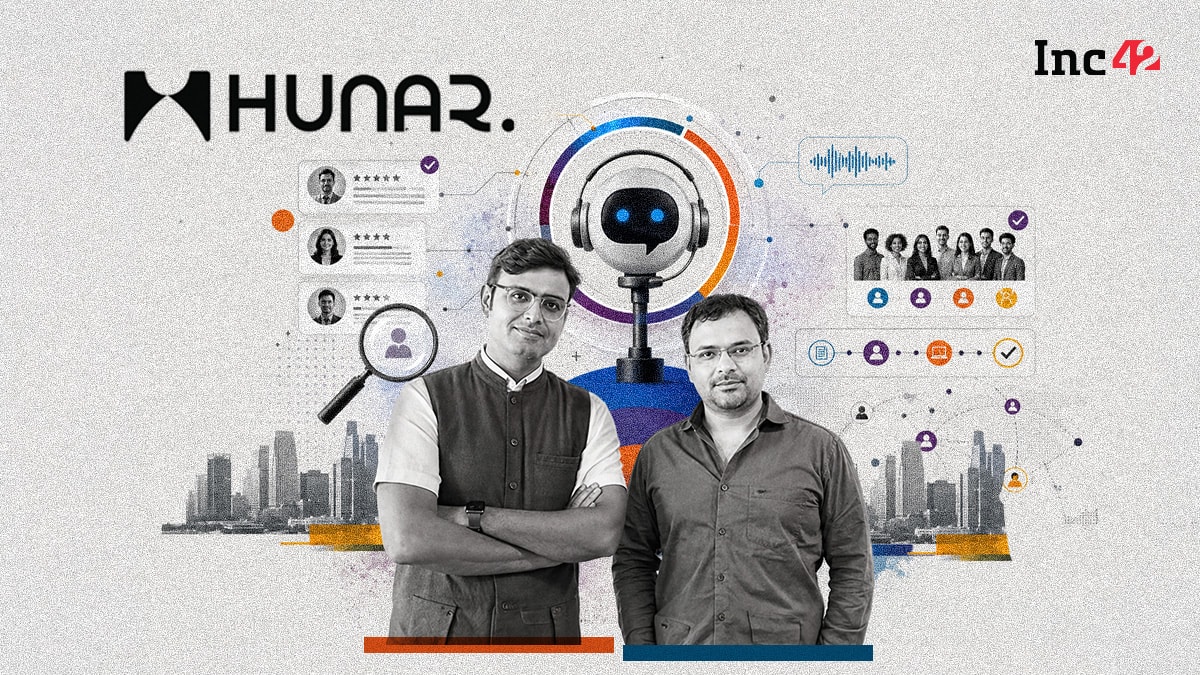
Bengaluru-based Hunar.AI is building voice AI agents for frontline workforce management. The startup powers over 5 lakh calls daily across hiring, onboarding, training and retention workflows for enterprises including Swiggy, Zepto, Croma and Starbucks.
Founded in 2022 by Krishna Khandelwal and Shantanu Bhattacharyya, the company spent nearly two years running an actual recruitment agency before building its AI infrastructure. The founders wanted to understand why frontline attrition remained high and where communication breakdowns occurred.
During that period, Hunar.AI recorded roughly 40 lakh to 50 lakh minutes of workforce-related conversations. Those included recruitment calls, onboarding interactions, assessment conversations and retention-related discussions. That dataset became the foundation of its conversational AI stack.
"80% of the job of an HR is calling. These are high-fidelity conversations like evaluating somebody's skills, convincing someone to join, understanding what's happening on the ground or training someone," Khandelwal said. He previously served as chief business officer at logistics platform Locus.
The startup formally pivoted deeper into voice-native AI infrastructure in 2024 after real-time audio models from companies like OpenAI became commercially viable. Its average call duration exceeds three minutes, significantly higher than typical Indian voice AI deployments that focus on low-intelligence transactional use cases like EMI reminders or payment notifications.
Hunar.AI built what it calls a hybrid voice architecture. Instead of immediately converting speech into text, the startup first processes raw audio inputs through a proprietary "Dynamic Config Generator" layer. The system filters irrelevant acknowledgements, detects contextual pauses and identifies language-specific filler words before sending relevant signals into the inference engine.
The architecture preserves voice properties like tonality, speed, interruptions and voice modulation. These become important in hiring or assessment conversations where intent is often reflected through delivery rather than just words.
The company also built an "Audio Regenerative Model" to handle interruptions dynamically during conversations. Instead of restarting interactions after interruptions, the system reconstructs conversational context in real time.
Another differentiator is multilingual adaptability. Rather than depending on a single text-to-speech provider, Hunar.AI dynamically switches between providers like ElevenLabs, Cartesia and others depending on regional language performance. The startup says this flexibility helped it gain stronger adoption across South India, especially for Telugu, Kannada and Tamil workflows.
Hunar.AI positions itself as an autonomous workforce operations platform rather than a generic voice AI infrastructure company. Its products are structured around specific job functions rather than generic conversational APIs.
"On day zero, a recruiter and telecaller might not be different. On day 30, they become massively different," Khandelwal said.
Companies can create AI HR agents through Hunar.AI's platform within minutes by defining workflows, job descriptions and knowledge bases. Enterprises can also deploy fully autonomous hiring systems where agents screen candidates, conduct evaluations and schedule interviews with minimal human intervention.
The startup additionally uses conversational agents for workforce analytics and employee engagement monitoring. These systems continuously interact with employees to identify attrition patterns, operational issues or workplace dissatisfaction signals.
Hunar.AI currently operates across six major sectors: quick commerce, logistics, retail, BFSI, healthcare and food and beverage. Quick commerce contributes the largest share of call volumes, though the company claims revenue contribution remains relatively balanced across sectors.
Instead of charging for raw voice AI usage, enterprises pay for operational workflows such as screening, onboarding or assessments. Pricing varies by use case, with screening calls typically priced between ₹15 to ₹20, while assessments or onboarding workflows can range between ₹75 to ₹100.
Hunar.AI says it currently operates at an annual recurring revenue of $3 million to $4 million. The startup has raised multiple funding rounds, including pre-seed and seed capital from tier-one Indian investors, though it has not publicly disclosed details yet. The company is also in the process of closing another funding round that it plans to announce formally later.
Under the hood, Hunar.AI currently relies on models from Google and OpenAI, while also experimenting with deploying open-source models trained on proprietary workforce conversation data. The company claims it is storing millions of minutes of multilingual workforce interactions every month, which could eventually reduce dependence on third-party inference models over time.