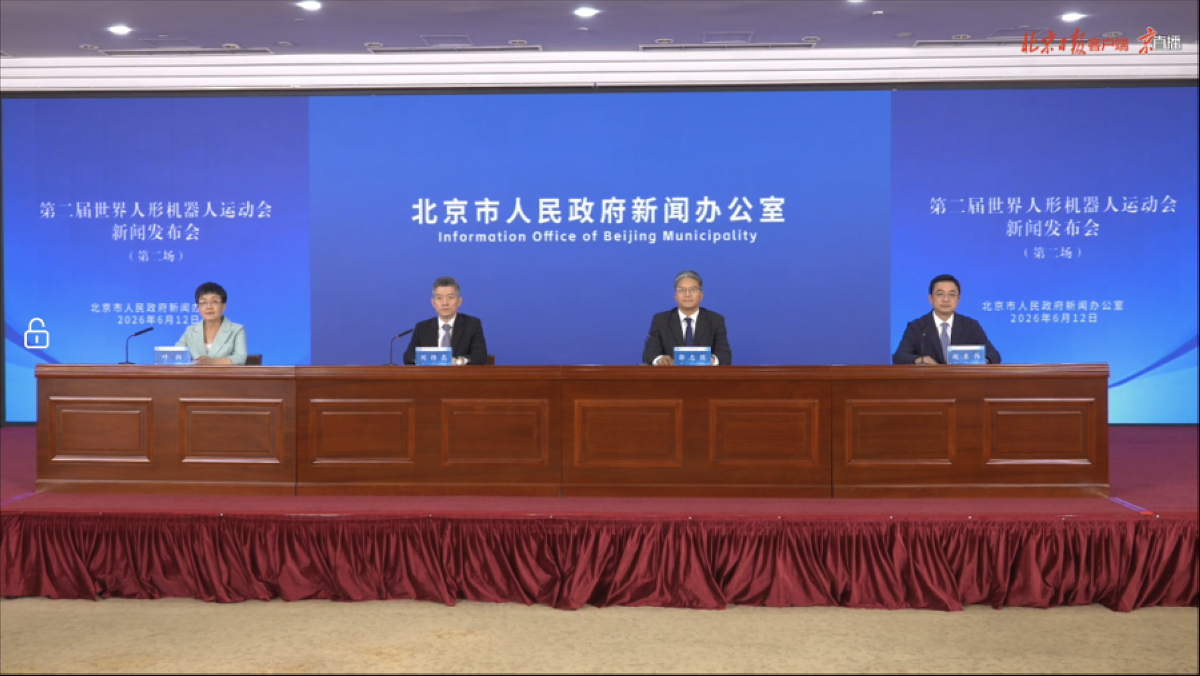
Table tennis is one of the hardest tests for physical AI. The HOPE AI Challenge requires full autonomy — no human in the loop — at Beijing's Ice Ribbon in August 2026.
The 2026 World Humanoid Robot Games added a ping-pong competition to its lineup, and the choice is not random. Table tennis is one of the hardest tests for physical AI. The ball moves fast, spins unpredictably, and leaves milliseconds to react. A humanoid robot that can return a serve has solved problems in vision, trajectory prediction, motion planning, and real-time error correction – all without a human in the loop.
The HOPE AI Challenge debuts in August at Beijing's National Speed Skating Oval, the Ice Ribbon, as an official event of the Games. The competition requires full autonomy. No remote control, no human override. Each robot must track the ball, predict its path and spin, choose a shot, coordinate its body, and adjust mid-motion. One slow step anywhere in that chain loses the point.
The Games run August 22-26, 2026, co-hosted by the Beijing municipal government, China Media Group, the World Robot Cooperation Organization, and the RoboCup Asia-Pacific Confederation. The inaugural edition in 2025 drew 280 teams and more than 500 humanoid robots from 16 countries, generating 1.33 billion views across media platforms. Adding ping-pong raises the technical bar.
Behind the event is Beiao Group, a Beijing state-owned enterprise founded in 1994 that has delivered more than 150 major events – the 2008 Olympics, the 2022 Winter Olympics, the Hangzhou Asian Games, and the first World Humanoid Robot Games. The group handles venue construction, competition planning, technical support, and safety protocols.
The HOPE AI Challenge is part of the Hitch Open platform, which has spent years pushing AI into demanding real-world environments. In 2025, Hitch Open ran an autonomous driving competition on the 99 hairpin turns of Tianmen Mountain in Zhangjiajie, where nine university teams competed under GPS-denied, low-visibility, and slick-road conditions. The ping-pong challenge extends that mission from speed to dexterity – from machines that move through the world to machines that interact with it.
For the robotics industry, the value is in the failure data. Real competition produces edge cases that scripted lab tests miss. A robot that misreads a spin serve and overcorrects, or hesitates on a fast return, generates data on sensor latency, control-loop timing, and algorithm limits. That data feeds back into hardware, controllers, and safety systems.
The Games run five days at the Ice Ribbon. The HOPE AI Challenge is one of several events. The full schedule and team roster have not been released.
Prepared with AlphaScala research tooling and grounded in primary market data: live prices, fundamentals, SEC filings, hedge-fund holdings, and insider activity. Each story is checked against AlphaScala publishing rules before release. Educational coverage, not personalized advice.