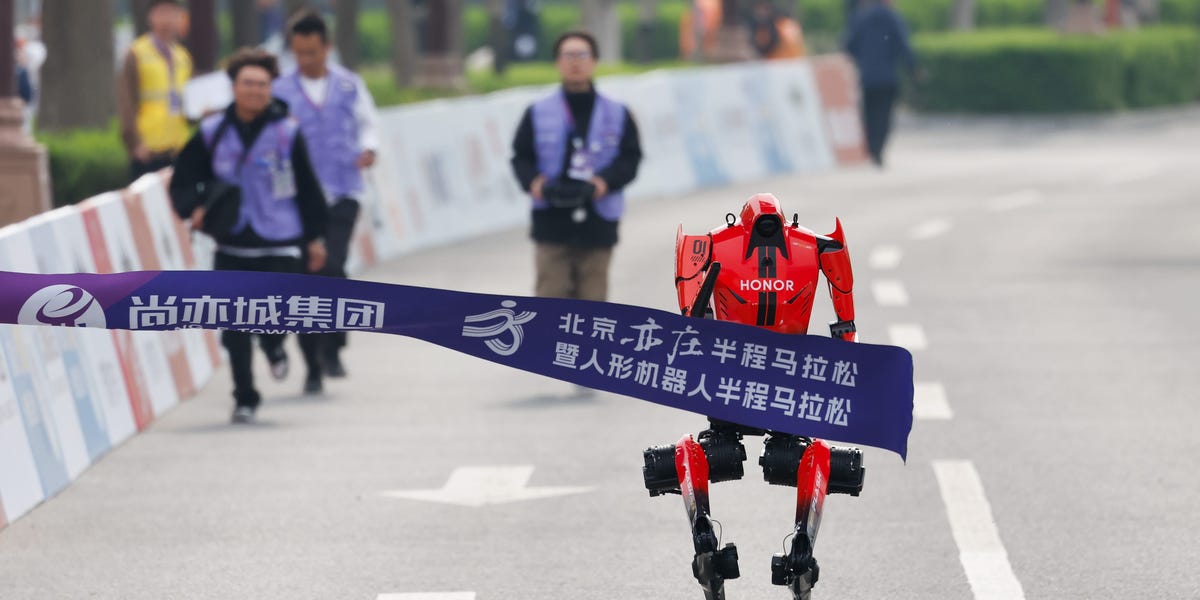
The recent half-marathon event for humanoid robots in China has moved the needle on industrial robotics capabilities by establishing a new speed record that surpasses human performance. While the event was characterized by technical failures and mechanical instability, the primary narrative shift centers on the transition of humanoid platforms from controlled laboratory environments to endurance-based, real-world navigation. This trial serves as a stress test for battery density, thermal management, and autonomous pathfinding under variable conditions.
Endurance and Mechanical Reliability Thresholds
The ability of a humanoid unit to complete a half-marathon distance highlights a significant advancement in actuator efficiency and power management. Previous industry benchmarks focused on static stability or short-burst locomotion. By extending the operational window to a long-distance format, developers are forced to contend with the degradation of components over time and the impact of heat accumulation on onboard processing units. The frequent tumbles observed during the race underscore the current gap between raw speed and environmental adaptability. These failures provide critical data points for developers regarding gait correction and center-of-gravity adjustments during sustained movement on uneven surfaces.
Sector Read-Through for Industrial Automation
The shift toward endurance-capable robotics carries implications for the broader automation sector. If humanoid platforms can reliably navigate complex, non-linear environments for extended periods, the potential for deployment in logistics and manufacturing increases. Current industrial robots are largely stationary or confined to rigid, pre-programmed tracks. The successful completion of a long-distance course suggests that the underlying software stacks for spatial awareness are maturing. This trajectory mirrors the evolution seen in other stock market analysis sectors where early-stage prototypes eventually transition into scalable infrastructure assets.
AlphaScala Data and Valuation Context
As the robotics sector matures, investors are increasingly looking for companies that can bridge the gap between experimental performance and commercial viability. For instance, companies like SM Energy Co maintain an Alpha Score of 50/100, reflecting the mixed nature of capital-intensive sectors as they integrate new automation technologies. Similarly, Agilent Technologies, Inc. holds an Alpha Score of 55/100, indicating a moderate outlook as the firm balances traditional healthcare instrumentation with the rising demand for high-precision robotic testing equipment. The valuation of firms in this space will likely hinge on their ability to translate these endurance milestones into reduced operational costs for end-users.
Future market assessments will focus on the next iteration of hardware durability. The next concrete marker for this sector will be the publication of standardized reliability metrics following these public trials. Developers must now demonstrate that these units can maintain performance consistency without the high failure rates observed in the recent half-marathon. The transition from novelty demonstrations to consistent, low-maintenance operation remains the primary hurdle for widespread adoption in commercial settings.