HTX Forces USD1-to-USDT Swap After World Liberty Freeze
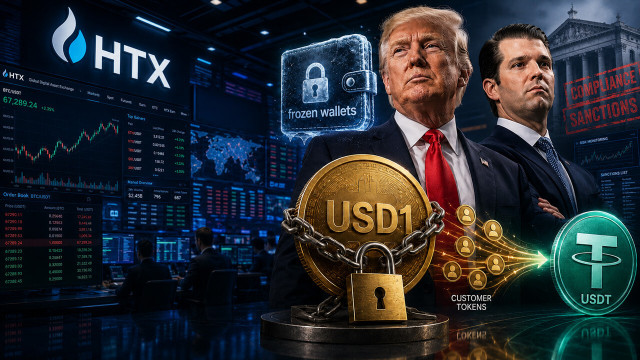
HTX will convert all retail USD1 balances into USDT starting June 7, following a wallet freeze tied to World Liberty Financial. The forced swap removes a key distribution channel for the Trump-backed stablecoin.
Alpha Score of 43 reflects weak overall profile with moderate momentum, weak value, weak quality. Based on 3 of 4 signals — score is capped at 90 until remaining data ingests.
Crypto exchange HTX will permanently remove World Liberty Financial's fiat-backed USD1 stablecoin from its trading platform. Beginning June 7, the exchange said it will systematically convert all eligible retail customer balances of the USD1 token into Tether (USDT) at a strict one-to-one valuation.
The delisting follows a broader freeze on World Liberty Financial wallets tied to President Donald Trump's family crypto venture. The move effectively severs one of the primary on-ramps for retail traders holding the token, forcing them into a competing stablecoin with a different issuer, reserve structure, and regulatory footprint.
Why the USD1 Delisting Hits a Liquidity Nerve
The conversion mechanism matters more than the delisting itself. HTX is not simply halting trading; it is executing a forced swap at par. That means any retail holder who did not exit before June 7 will receive USDT regardless of market conditions or personal preference. The one-to-one rate removes price discovery for USD1 on the exchange, effectively making the token illiquid there.
For World Liberty Financial, the delisting removes a key distribution channel. The project launched USD1 as a dollar-pegged token designed for payments and DeFi lending. Losing HTX as a listing venue limits the token's reach to retail users who might otherwise use it for remittances or yield farming. The timing also coincides with broader regulatory scrutiny of stablecoin issuers and their reserve backing.
The Wallet Freeze That Preceded the Delisting
The HTX announcement did not occur in isolation. Days earlier, multiple wallets associated with World Liberty Financial were frozen, reportedly due to compliance concerns tied to the Trump family's involvement. The freeze prevented holders from moving USD1 tokens to other exchanges or self-custody wallets, trapping liquidity inside the HTX ecosystem.
This sequence – wallet freeze followed by forced conversion – creates a precedent for how exchanges handle politically exposed tokens. Retail traders who bought USD1 expecting a stable, tradeable asset now face a mandatory swap into USDT, a token with its own regulatory history and counterparty risk.
What the USDT Conversion Changes for Holders
USDT is the largest stablecoin by market capitalization, with deep liquidity across dozens of exchanges. For most retail holders, the conversion is net neutral in dollar terms. The forced nature of the swap introduces execution risk. If HTX processes conversions slowly or if USDT trades at a slight discount during the transition window, holders could receive less than the nominal $1 per token.
More critically, the delisting signals that World Liberty Financial's USD1 may struggle to gain traction on other exchanges. If other platforms follow HTX's lead, the token could become a niche asset with limited utility. The project's reliance on political branding rather than technical differentiation leaves it vulnerable to exchange-level decisions driven by compliance teams.
The Broader Stablecoin Distribution Bottleneck
The USD1 delisting highlights a structural problem for new stablecoin issuers: distribution. Getting a token listed on major exchanges requires navigating compliance, legal, and business-development hurdles that incumbents like Tether and Circle have already cleared. For politically connected projects, the scrutiny is higher, not lower.
World Liberty Financial faces a chicken-and-egg problem. Without exchange listings, the token cannot build liquidity. Without liquidity, it cannot attract users. Without users, it cannot justify the compliance cost of maintaining exchange relationships. The HTX delisting may accelerate that cycle.
Next Decision Point for USD1 Holders
Holders who want to avoid the forced conversion have until June 7 to sell or transfer their USD1 tokens on HTX. After that date, the exchange will execute the swap automatically. The key variable is whether other exchanges – particularly those with lighter compliance frameworks – will list USD1 as an alternative.
For traders watching the story, the HTX action sets a precedent. If other exchanges delist USD1 or freeze related wallets, the token's viability as a stablecoin alternative diminishes. The next catalyst is any compliance action or exchange statement that confirms or reverses the pattern.
Drafted by a large language model from the source reporting linked above, then screened by automated publishing checks. It is not read by a journalist before publication. Some articles cite our Alpha Score. Verify prices and figures against the original source. Educational coverage, not personalized advice.