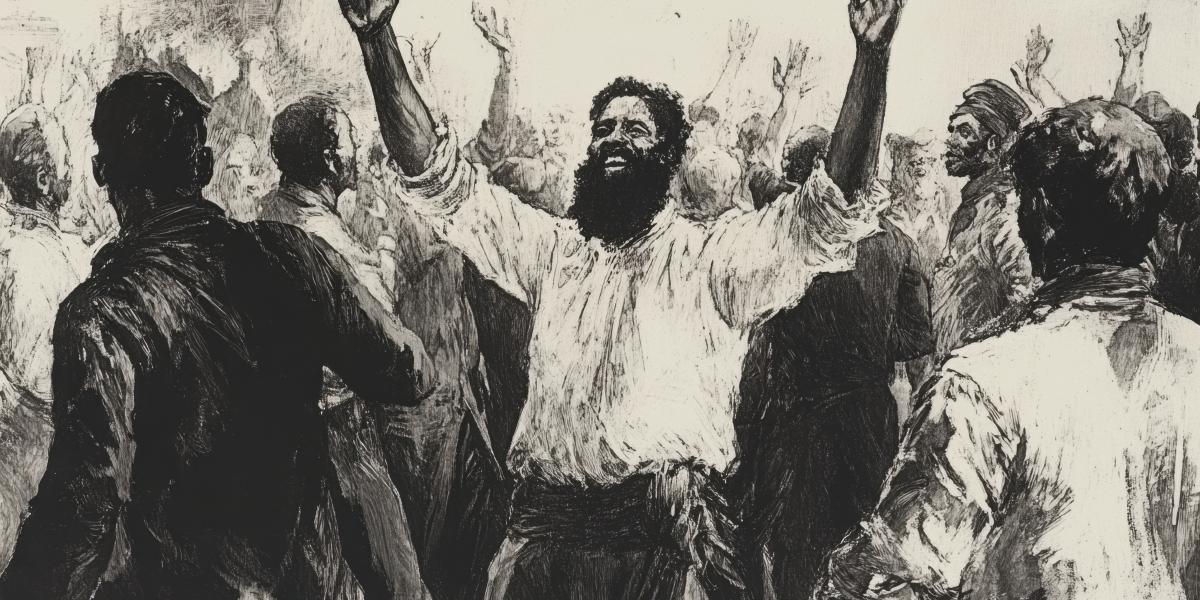
Nat Turner led an armed insurrection in Southampton County, Virginia, on August 21, 1831. The revolt killed about 60 white residents before it was suppressed within days. That event all but destroyed a flourishing abolitionist movement that had been operating openly across the South for decades.
Before the 1830s, more abolitionist organizations existed in the South than in the North. In North Carolina, a town commissioner named Moses Swain founded the North Carolina Manumission Society in 1816. Within ten years the society counted roughly 3,000 members across 14 chapters and 45 affiliated groups, according to historian John Marquardt. Some of its members held elected office. Similar societies operated in Virginia, Tennessee, and Kentucky. Their goal was gradual, peaceful emancipation through state legislation.
Turner's rebellion changed that calculus. The violence spared no one at Levi Waller's farm, where his wife and ten children were killed after word of the revolt arrived too late for an effective defense. Panic spread. Southern legislatures passed stricter slave codes. Public opinion turned against any organization that discussed abolition, even moderate ones.
Thomas Jefferson Randolph, a Virginia legislator and Thomas Jefferson's grandson, had been pressing the General Assembly for a gradual emancipation plan. After the revolt, the proposal died. By the mid-1830s the Southern abolitionist movement had collapsed, surviving only as scattered Underground Railroad stations, Marquardt notes.
The Northern abolitionist response compounded the damage. Starting around 1835, groups such as William Lloyd Garrison's sent tens of thousands of petitions to Congress denouncing Southern slaveholders as brutal sinners. South Carolina Senator John C. Calhoun rose on February 6, 1837 to object. "We, the representatives of twelve of these sovereign States against whom this deadly war is waged, are expected to sit here in silence, hearing ourselves and our constituents day after day denounced," he said. The petitions were seen by the South as a call to insurrection, not a plea for justice.
Two things follow from this history. First, the abolitionist movement in the South was real, organized, and politically connected before 1831. Second, the Turner revolt and the Northern petition campaign together removed any possibility of peaceful, state-led emancipation. Violent methods did not accelerate abolition. They pushed the timeline back by a generation.
Marquardt's data on the North Carolina Manumission Society membership and chapters provides a clear baseline. The decisive shift came after August 1831. By 1838 the House of Representatives adopted a "gag rule" that automatically tabled all anti-slavery petitions. The South's own abolitionists had been silenced three years earlier.