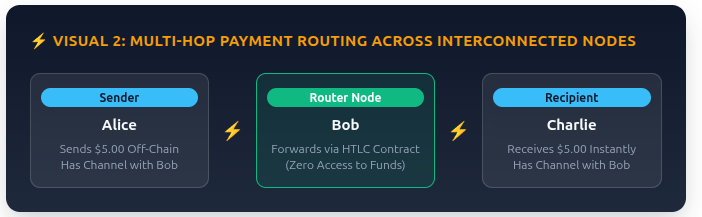
Lightning Network enables instant Bitcoin payments with near-zero fees by moving transactions off the main chain and settling only the opening and closing balances.
Bitcoin's base layer settles about seven transactions per second world-wide. That is fine for final settlement. It is useless for buying coffee. The Lightning Network, a second-layer protocol running on top of Bitcoin, changes the math.
Lightning opens payment channels between parties. Two users create a multi-signature address on the main chain and deposit funds. From that point, they can exchange an unlimited number of transactions off-chain, updating the balance between themselves. Only the opening and closing transactions touch the blockchain. The intermediate steps are cryptographically signed but never broadcast.
The result is near-instant settlement and fees measured in fractions of a cent. A $4 coffee no longer needs a 10-minute wait or a $2 fee.
Security comes from a penalty mechanism built into the channel. Each time the balance updates, the parties exchange a revocation key for the previous state. If one side tries to cheat by broadcasting an old, more favorable balance, the other side can use that key to claim all the channel funds. The incentive to play fair is absolute.
This layering mirrors how the internet works. TCP/IP handles routing and packets. HTTP and WebSockets handle the applications. Bitcoin's Layer 1 provides the ultimate settlement court. Lightning provides the high-speed commerce engine.
Developers describe Lightning as opening a bar tab. The customer runs a tab all night. Only the opening and closing charges hit the credit card. Everything in between is handled off the record, with trust enforced by the punishment mechanism.
Bitcoin's scaling dilemma has held back its use as cash. Lightning does not sacrifice security for speed. It moves the state updates to a second layer while keeping the final settlement anchored to the most secure blockchain in existence. That trade-off has made Lightning the standard for Bitcoin payments as adoption grows.
Drafted by a large language model from the source reporting linked above, then screened by automated publishing checks. It is not read by a journalist before publication. Some articles cite our Alpha Score. Verify prices and figures against the original source. Educational coverage, not personalized advice.