The latest consumer price index print landed hot, immediately resetting the timeline for Federal Reserve rate cuts and triggering a rapid repricing across asset classes. The S&P 500 and Nasdaq managed to close Monday in the green. The surface-level resilience, however, masks a more complex internal rotation that demands scrutiny. The transmission from a sticky inflation reading to real assets, volatility metrics, and geopolitical risk premiums is already underway. The next 48 hours, culminating in Thursday's meeting between President Trump and President Xi, will determine whether the soft-landing narrative can survive intact.
The CPI Shock: Rate-Cut Timeline Repriced
The inflation print did not merely come in above consensus; it reinforced the pattern of stalled disinflation that has dogged the first quarter. The immediate consequence was a sharp adjustment in the fed funds futures curve, with traders pulling forward the expected date of the first cut and reducing the total number of cuts priced for 2025. This is the first-order transmission: a hot CPI directly raises the bar for the Fed to ease, because the committee has repeatedly stated it needs sustained evidence of cooling price pressures before acting.
What the Hot Print Means for the Fed's Path
The repricing is not about a single data point. It is about the cumulative weight of three consecutive months where the inflation trajectory has refused to cooperate. The Fed's preferred supercore measure, which strips out shelter from core services, is likely to show persistent stickiness when the detailed tables are parsed. That puts the June meeting, previously seen as a live option for a cut, firmly back on the shelf. The market is now grappling with a scenario where the first cut arrives in September at the earliest, and even that depends on a rapid improvement in the next four prints.
Yield Curve Reaction: Short-End Repricing
The two-year Treasury yield, the most sensitive to policy expectations, bore the brunt of the move. A higher short-end yield flattens the curve further, tightening financial conditions without the Fed having to lift the terminal rate. For equity investors, the transmission runs through the discount rate applied to future earnings. Growth stocks with long-duration cash flows absorb the hit first, because their valuations are more sensitive to changes in the risk-free rate. The Nasdaq's ability to close in the green on Monday should not be read as immunity; it is more likely a temporary reprieve before the repricing fully catches up with the mega-cap tech complex.
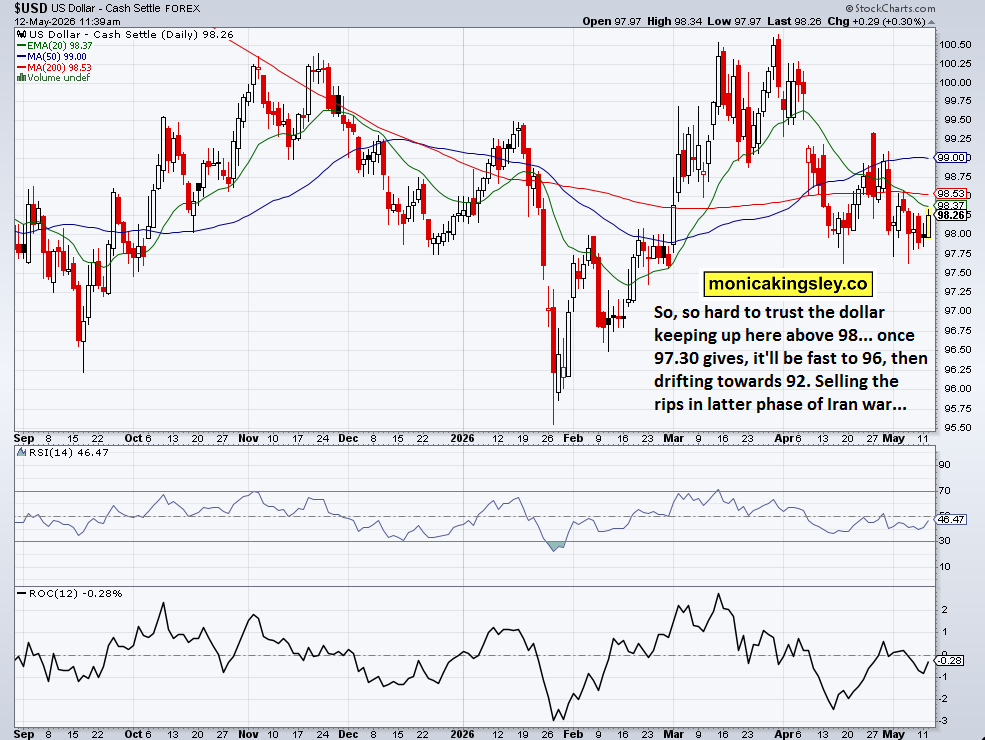
The U.S. dollar initially spiked on the hot print, as higher yields typically attract capital flows. The move faded quickly, however, because a sustained inflation overshoot erodes the real return on dollar holdings. This tug-of-war between nominal yield support and real purchasing power erosion is a defining feature of the post-CPI landscape. For emerging markets and commodities priced in dollars, a weaker greenback would amplify the inflation hedge trade.
Key insight: A hot CPI print without an accompanying growth scare is the worst outcome for rate-sensitive tech, because it forces the Fed to stay restrictive while earnings multiples remain stretched.
Equities: Monday's Green Mask and Internal Deterioration
Monday's session offered a textbook example of how a hot inflation print reshuffles equity leadership. The headline indices held up. The internals, however, told a different story. Defensive sectors, energy, and materials attracted bids, while the high-beta names that led the rally off the October lows began to leak. This rotation is not a one-day phenomenon; it is the logical consequence of a higher-for-longer rate regime colliding with crowded positioning in growth.
Monday's Gains Mask Narrow Leadership
The S&P 500's advance was narrow, driven by a handful of large-cap names that benefit from flight-to-safety flows or have pricing power that insulates them from input cost pressures. Beneath the surface, the equal-weight index underperformed the cap-weight benchmark, and the advance-decline line deteriorated. This is a classic warning that the market's foundation is weakening even as the headline number prints green. When fewer stocks participate in a rally, the index becomes vulnerable to a sharp reversal if the leaders stumble.
The rotation pattern was stark:
- Utilities and consumer staples drew defensive bids.
- Energy and materials rallied on the real-asset bid.
- Technology and consumer discretionary lagged as rate sensitivity bit.
- Small-caps underperformed, reflecting tighter financial conditions.
Volatility Metrics Flash Warning
The VIX term structure has begun to steepen, with front-month futures rising relative to deferred contracts. That inversion signals that options traders are pricing in elevated near-term risk, even as the spot VIX remains subdued by historical standards. The gap between realized volatility and implied volatility is narrowing, which often precedes a pickup in actual market swings. For traders, this means the cost of portfolio hedges is rising, and the margin for error in directional bets is shrinking.
Risk to watch: If the VIX breaks above the 20 level and holds, it would confirm that the macro regime has shifted from "buy the dip" to "sell the rip" for risk assets.
Real Assets: Gold, Miners, and the Inflation Hedge Trade
The most consequential transmission from a hot CPI is the reawakening of the real asset complex. Gold, silver, miners, oil, and copper all caught bids in the immediate aftermath of the print, and the question now is whether those moves have legs. The source of the bid is twofold: first, a hot CPI erodes the real yield advantage that has kept the dollar elevated and pressured commodities; second, it raises the probability that the Fed will tolerate a higher inflation regime rather than engineer a recession to crush prices.
Gold Breaks Correlation with Yields
Gold's reaction to the CPI print was instructive. The metal rallied even as nominal yields rose, breaking the typical inverse correlation. That divergence signals that the market is pricing in a loss of confidence in the Fed's ability to deliver real positive returns on cash over the medium term. When real yields fall because inflation expectations rise faster than nominal yields, gold becomes the primary beneficiary. The miners, which offer operating leverage to the gold price, followed suit with amplified gains. The dollar, meanwhile, struggled to hold its bid, because a hot CPI reduces the purchasing power of dollar-denominated assets over time.
Miners Amplify the Move
The gold miners, as a leveraged play on the metal, delivered outsized returns. The source noted that real asset moves brought "great gains to clients," reflecting the rapid repricing of inflation hedges. This sector often leads in the early stages of an inflation-regime shift, because it combines commodity price sensitivity with equity market beta. If the hot CPI is not a one-off, the miners could enter a sustained period of outperformance.
Silver, often a higher-beta play on gold, surged alongside the yellow metal. Copper, a barometer of global growth, also caught a bid, suggesting that the market is pricing in both inflation and resilient demand. This dual signal complicates the recession narrative and broadens the real-asset rally beyond a simple safe-haven trade.
Oil's Geopolitical Bid: Iran Tensions Add a Supply-Risk Premium
Crude oil received a double boost: the inflation print reinforced the commodity supercycle thesis, and a fresh geopolitical flare-up added a risk premium. The source text flagged Trump's disappointment over what he termed an "unacceptable" Iranian response, a development that raises the odds of renewed sanctions enforcement or military posturing in the Strait of Hormuz. (See Futures Dip on Iran Tensions, CPI Anxiety; PLUG, HIMS Active for the earlier market reaction.) Oil markets are structurally tight, with OPEC+ maintaining production cuts and global demand holding up better than expected. A supply disruption, even a small one, would send prices sharply higher, and that scenario is now being priced into the front of the curve.
The Iran Factor
Trump's characterization of the Iranian response as "unacceptable" injects a new layer of uncertainty. The market has learned that such rhetoric can precede executive orders or heightened naval activity. The Strait of Hormuz, through which roughly 20% of global oil passes, remains a chokepoint. Any disruption there would have an immediate and violent impact on crude prices. This geopolitical tail risk is now being layered on top of the inflation-driven bid, creating a potent cocktail for oil.
Structural Tightness Meets Geopolitics
Even without a supply shock, the oil market is undersupplied. OPEC+ discipline has held, and U.S. production growth is slowing. The combination of sticky inflation and geopolitical tension makes oil a compelling hedge. Energy equities, which had been consolidating, broke out on the combination of higher crude and geopolitical tension. The sector offers a direct play on the supply-risk premium without the roll-yield complexities of futures.
What this means: The real asset complex is now pricing in both a higher inflation regime and a geopolitical risk premium, a combination that has historically rewarded patient capital.
The Xi Meeting: A Binary Catalyst for Risk Appetite
Thursday's meeting between President Trump and President Xi Jinping introduces a binary risk event that could either amplify or reverse the macro transmission. The market has learned to treat these summits as potential inflection points for trade policy, tariff trajectories, and supply chain expectations. A constructive outcome that signals a phase-one deal or a tariff truce would likely spark a relief rally in risk assets, temporarily overshadowing the CPI concerns. A breakdown, however, would compound the stagflationary impulse: higher input costs from tariffs layered on top of sticky domestic inflation.
Tariff Scenarios and Market Impact
The baseline expectation appears to be that no major breakthrough will emerge. Both sides will likely agree to keep talking. That outcome would be neutral to slightly positive, removing a tail risk without adding a new catalyst. The danger scenario is an explicit threat of new tariffs, which would hit the industrial and tech sectors that rely on cross-border supply chains. The optimistic scenario is a concrete rollback of existing levies, which would lower input costs and ease the inflation pressure the Fed is fighting. Each of these paths has a distinct transmission into equities, currencies, and commodities, and the market is not positioned for any single one with conviction.
Options markets show elevated hedging activity ahead of the summit, with skew favoring upside calls in the event of a trade truce. The VIX futures curve has also steepened, reflecting the binary nature of the event. For traders, the meeting is not just a political headline; it is a direct input into the inflation-growth mix that will define the next leg for risk assets.
The hot CPI print has reset the macro landscape. It has not yet triggered a full-scale deleveraging. The next catalyst is the Trump-Xi meeting, which will either validate the rotation into real assets and defensives or revive the soft-landing trade that favors growth. Traders should monitor the two-year yield as the cleanest real-time gauge of rate expectations, and the gold-to-oil ratio as a cross-asset check on whether the inflation hedge trade is gaining institutional sponsorship. The S&P 500's ability to hold above its 50-day moving average will be the technical line in the sand; a break below would confirm that the transmission from a hot CPI to a risk-off regime is complete. For broader macro context, see market analysis.