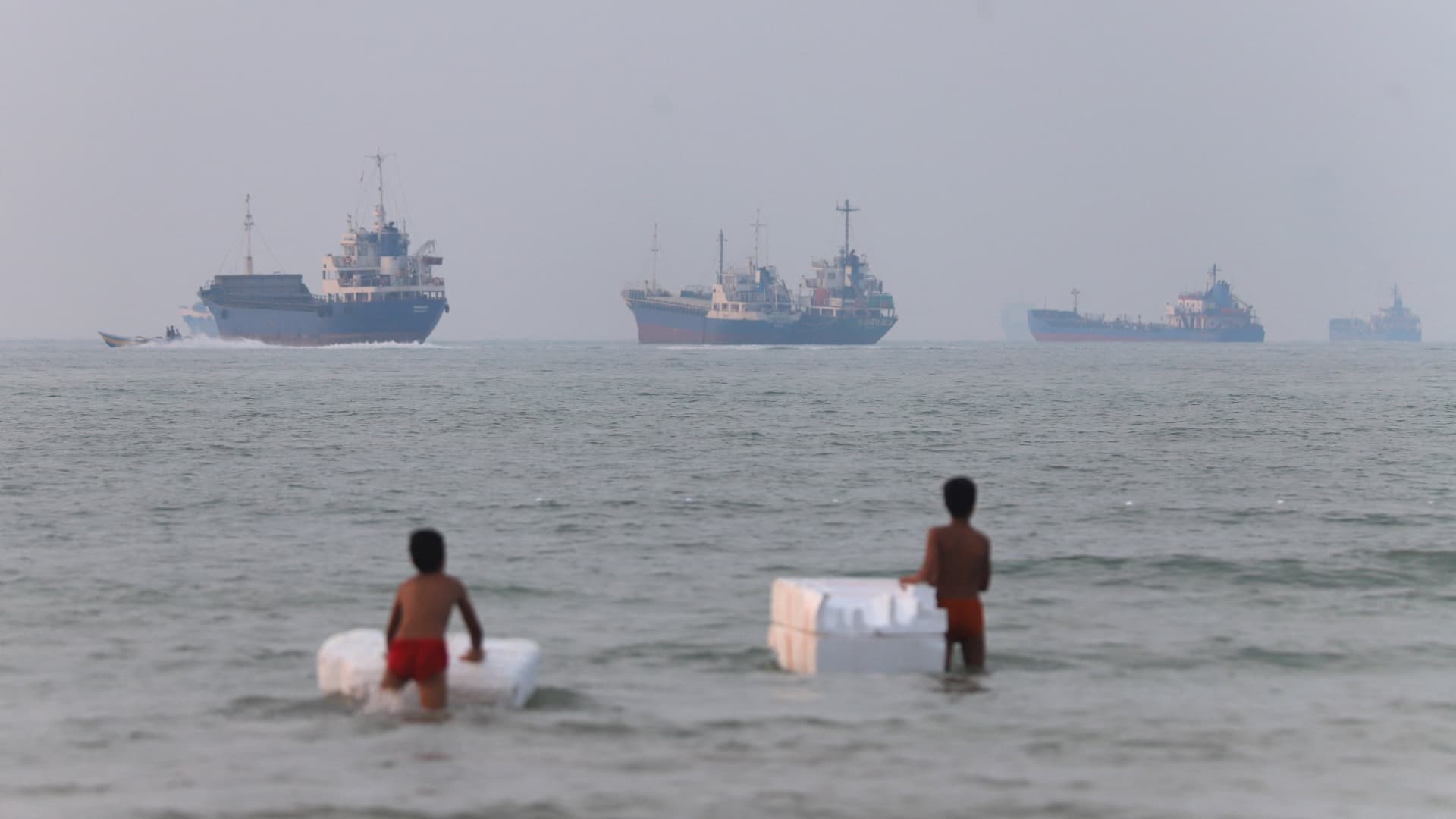
A vessel transiting the Strait of Hormuz was struck by a projectile Tuesday, killing one crew member and damaging the engine room, the United Kingdom Maritime Trade Operations Centre said. Oman's Coast Guard is assisting the remaining crew. No environmental damage has been reported.
President Donald Trump said hours after the attack that the waterway is "open and operating" and that "all water mines have been removed or detonated." U.S. Central Command referred CNBC to the White House when asked whether all mines have been cleared.
At least 17 mariners have been killed in 65 attacks on commercial vessels since the U.S.-Iran war began on Feb. 28, according to the International Maritime Organization, a United Nations agency.
Observed ship traffic through Hormuz has remained low. Ten crossings were recorded Monday and two on Sunday, according to trade intelligence firm Kpler. The five-day average for transits is about 10, the lowest since May 11, a CNBC analysis of Kpler data shows. About 130 vessels crossed the strait daily before the war.
Trump said the U.S. is not holding talks with Iran. A memorandum of understanding signed June 17 between Washington and Tehran to reopen Hormuz expired Monday without a final deal. Iran's parliamentary speaker Mohammad Bagher Qalibaf said Hormuz will remain closed until the U.S. meets its commitments under the MOU, according to state news agency Tasnim.
The U.S. and Iran have contested control of Hormuz since the MOU collapsed over conflicting interpretations. The U.S. military escorts ships through a southern route along Oman's coast. Iran demands vessels take a northern route through its waters or risk attack.
Crude oil exports through Hormuz have risen under U.S. military protection, according to maritime intelligence firm Windward. Exports reached about 5 million barrels per day in July, up from roughly 4 million bpd in June and 1.6 million bpd in May, said Michelle Wiese Bockmann, a maritime intelligence analyst at Windward. About 20 million bpd of crude and products, a fifth of global oil consumption, moved through the strait before the war.
"Transits have scaled up very quickly against a background of extreme risk," Bockmann said.
U.S. Energy Secretary Chris Wright said last week that oil exports through Hormuz had reached a seven-day average of nearly 9 million bpd, higher than most independent estimates. "Many private businesses undercount the number of ships leaving the Strait of Hormuz due to ships moving covertly through the waterway," Wright said in a social media post.
Tanker traffic remains constrained despite the export increase. The five-day transit average of roughly 10 vessels is far below the pre-war normal of 130.