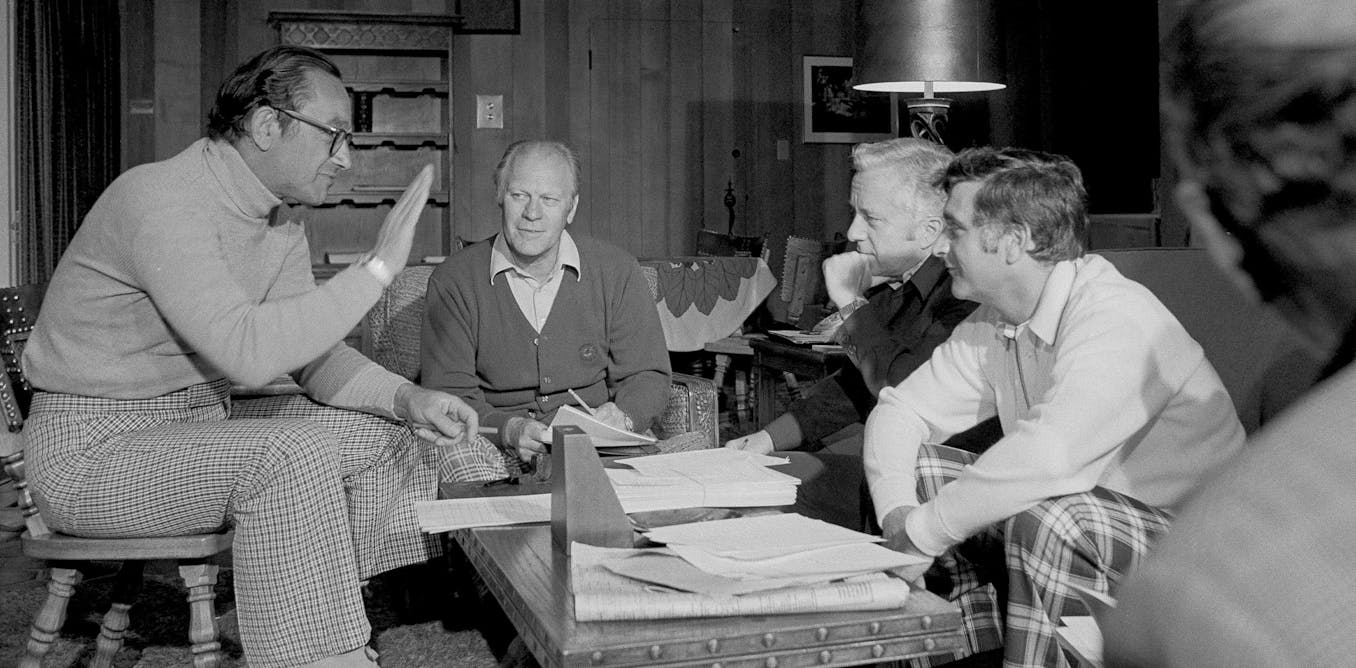
Greenspan called his three years under Ford more interesting than his Fed tenure. The experience, he said, turned him into a dedicated public servant and shaped his data-driven approach.
Alan Greenspan died June 22 at 100. The obituaries will run long on his 18 years running the Federal Reserve, the "Maestro" era, the 2008 crisis post-mortem. A shorter chapter matters more to understanding how he got there: his three years as chair of the Council of Economic Advisers under Gerald Ford.
Greenspan himself said that job was more interesting than his Fed tenure. "I saw Ford three or four times a week for one-on-one meetings," he recalled in a 2016 interview for a book on public service. "I would just do what I did for my clients before I got into the cauldron of politics. And he responded like a regular businessman."
Ford treated him as an equal, Greenspan said. "I've never run into anything like it before or since."
That was not the path anyone expected from the young clarinetist who studied at Juilliard, worked as a professional musician, and married abstract expressionist painter Joan Mitchell. Through the 1950s Greenspan ran in the inner circle of Ayn Rand, the novelist who preached radical individualism and laissez-faire capitalism. He was building an economics consulting firm at the same time.
His approach was never really ideological, despite the Rand association. "You begin with a conceptual framework of cause and effect," he said in the 2016 interview. "And then you observe reality, and try to anticipate what is going to happen in the future, even though you can never see beyond a certain horizon."
Data was central. "If you want to endeavor to try to lower the probabilities of forecasting mistakes in the future, the more information you have about the structure of the system, the better off you will be."
One early piece of academic work foreshadowed James Tobin's Q theory of investment, a tool for estimating whether a business or market is overvalued. Tobin's 1981 Nobel citation noted the insight.
Greenspan had qualms about joining the Nixon administration. He opposed the 1971 price and wage controls. He told Nixon's chief of staff, Al Haig, that he would quit if Nixon went too far. Nixon resigned before Greenspan took the CEA post.
Ford was different. "He always acted as though we were equals, which was quite remarkable," Greenspan said.
The Fed came in 1987. Greenspan served five consecutive terms under Ronald Reagan, George H.W. Bush, Bill Clinton and George W. Bush. His tenure coincided with rising U.S. prosperity, the fall of the Soviet Union, China's opening, and the shift from fiscal to monetary policy as the primary macroeconomic tool.
Central bankers became public figures. Greenspan seemed to relish the attention at first. Later he described it differently. "I did what I had to do, and I made decisions when I had to make them," he said in 2016. "I could argue with senators when I had to go up to Capitol Hill, and I held my own very well because I knew a lot more than anybody up there. It wasn't an enjoyable function since none of the people were analytical or conceptual. They had opinions without any reasoning."
His light regulatory hand in financial markets drew criticism after the 2008 crisis. Greenspan acknowledged the failure. "Each of us has a model in our heads; some of them work, and some of them don't," he said. "What you need to measure is continuously evolving. I know that because the Federal Reserve had an extraordinarily good and very sophisticated model, it did not capture what was wrong that led to the crisis in 2008."
Greenspan was often called arrogant. He described himself differently: an introvert, the "side man" in a dance band, reading scores written by other people. The whole world ended up trying to read him.
Prepared with AlphaScala editorial tooling from the source reporting linked above. Indexable analysis may include a cited Alpha Score value. Publishing checks screen each story before release. Educational coverage, not personalized advice.