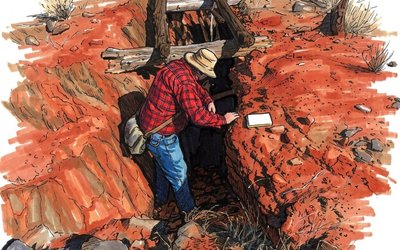
Great Boulder Resources (ASX: GBR) has initiated a strategic pivot toward near-term production through the acquisition of the Peak Hill gold project in Western Australia. By securing this asset from Westgold (ASX: WGX) subsidiary Aragon Resources, Great Boulder gains a historical high-grade site with a mineral resource estimate of 9.4 million tonnes at 1.6 grams per tonne for 481,000 ounces of contained gold. The deal structure is designed to minimize upfront capital expenditure by leveraging existing regional processing infrastructure, a move that distinguishes this project from traditional, capital-intensive mine development.
The Capital-Light Production Mechanism
The core of the strategy relies on an ore purchase agreement (OPA) with Westgold. Rather than constructing a standalone processing facility, which typically requires significant upfront investment and multi-year permitting timelines, Great Boulder will utilize Westgold’s established Bluebird, Fortnum, and Tuckabianna mills. This arrangement allows the company to focus its capital on extraction and resource expansion rather than heavy infrastructure. The proximity of Great Boulder’s existing 1Moz Side Well project, located 25 kilometres from the Bluebird facility, creates a regional hub-and-spoke model that enhances the economic viability of both assets.
Transaction Structure and Equity Dilution
The acquisition cost is set at $25 million in cash, with $1 million already paid as a deposit, supplemented by the issuance of 391.7 million GBR shares to Westgold. This equity component grants Westgold a 19.9% stake in Great Boulder, effectively aligning the interests of the major producer with the junior explorer. Westgold also retains a 1% net smelter royalty on gold produced from the Peak Hill tenements and gains the right to nominate a non-executive director to the Great Boulder board. To fund the cash portion of the deal and support exploration, Great Boulder is launching a $40 million two-tranche placement, issuing 470.6 million new shares at $0.085 per share. This pricing represents a 3.4% discount to the last traded price of $0.088 and a 13.6% discount to the 10-day volume weighted average price of $0.098.
Drilling and Resource Validation
Great Boulder has committed to a 60,000-metre multi-rig drilling program over the next six months to validate the existing resource and test brownfields potential. The campaign will target the Five Ways, Durack, Enigma, Harmony, Jubilee, Mt Pleasant, and Treasure deposits. Recent drilling by Westgold in 2025 provides a high-grade baseline for this effort, with notable intersections at the Treasure area including 19 metres at 13.34g/t gold from 104 metres, and 10 metres at 18.79g/t gold from 19 metres. The objective is to move the project to a mining-ready status within 12 months. For those tracking the broader sector, our commodities analysis provides further context on how regional toll-processing agreements are reshaping junior miner valuations.
Operational Risk and Execution Timeline
The primary risk for investors is the execution of the OPA and the ability to convert historical resources into economic ore. While the capital-light model reduces the barrier to entry, it increases reliance on Westgold’s operational capacity and the availability of mill space. Any disruption at the Bluebird, Fortnum, or Tuckabianna facilities could directly impact Great Boulder’s production timeline. Furthermore, the success of the 60,000-metre drilling campaign is critical; if the infill drilling fails to confirm the continuity of the high-grade zones identified in historical data, the project's economics could shift significantly. The appointment of former MACA managing director Chris Tuckwell to the board is a clear signal that the company is prioritizing operational experience as it transitions from exploration to production. Investors should monitor the upcoming resource estimate update and the progress of the two-tranche placement as the primary indicators of market confidence in this transition. Success will be confirmed if the company achieves mining-ready status within the 12-month window, while failure to meet the drilling targets or a decline in the grade of the inferred resources would weaken the thesis for near-term cash flow.