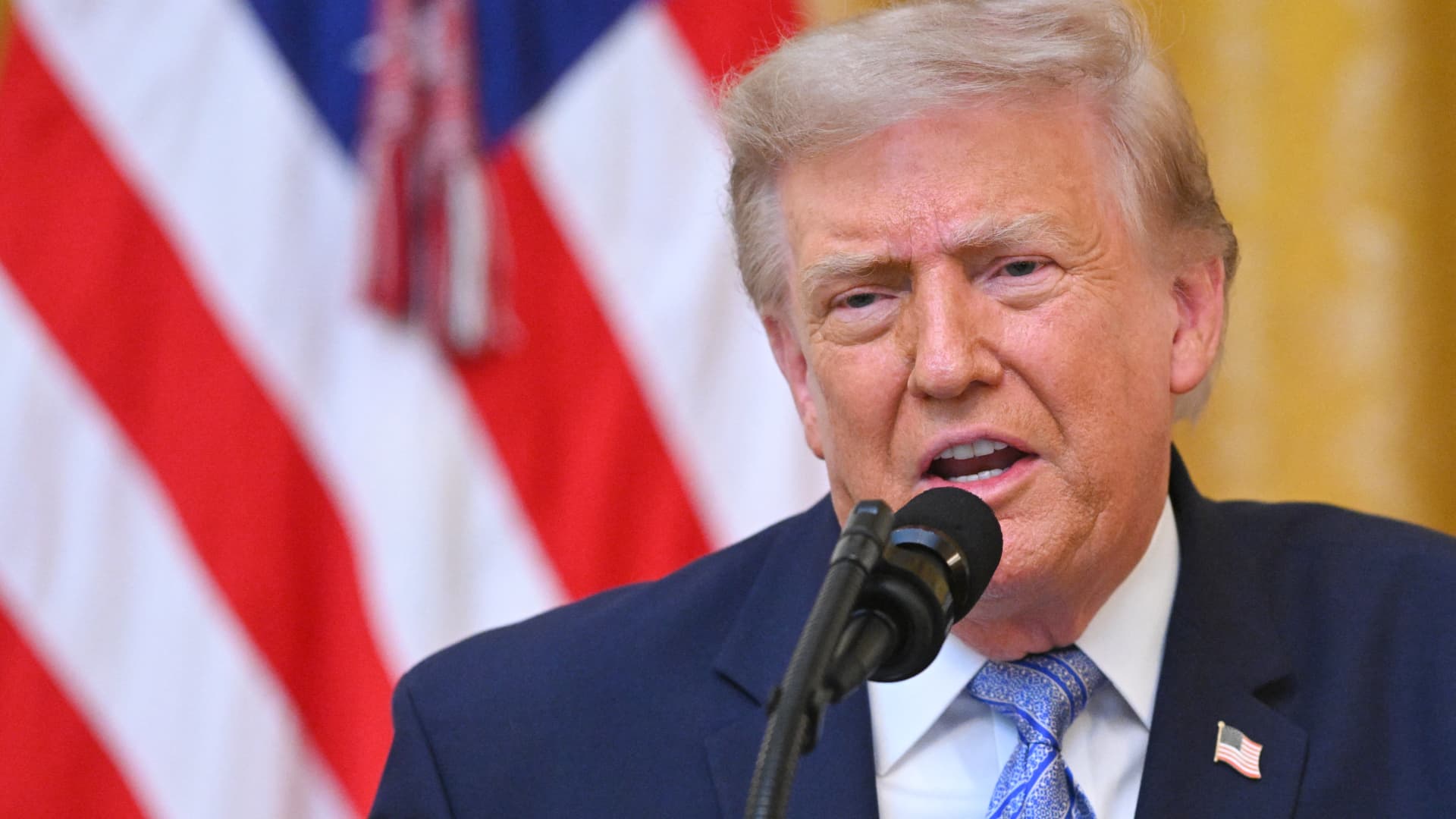
President Donald Trump's proposed tariffs on imported generic medicines give manufacturers two tariff-free years before duties rise to 100% and then 200%. The industry argues that timeline may not be enough, and that the margins on most generic drugs leave no room to absorb the cost.
"A 100-200% tariff on a product with single-digit margins is a market-exit notice," independent pharmaceutical consultant Salil Kallianpur told CNBC in an email.
Generic medicines account for about 90% of U.S. prescriptions but a small share of overall drug spending because they are cheap. Manufacturers compete on price, manufacturing efficiency and scale. Even a small increase in production costs can wipe out profit, industry representatives say.
John Murphy III, president and CEO of the Association for Accessible Medicines, said the industry supports expanding U.S. manufacturing but needs broader policy changes. "We need to understand more the specifics of the policy," he said in a statement. Murphy said the industry has expanded its U.S. footprint over the past two years but that problems with purchasing and reimbursement continue to discourage further domestic production.
Trump said Tuesday that imported generic medicines would face no tariffs for two years, then 100% for one year and then 200%. The proposal targets a global industry worth nearly $500 billion. The administration says the tariffs will bring pharmaceutical manufacturing back to the U.S.
Building a domestic generic drug manufacturing ecosystem takes four to five years, according to Namit Joshi, chairman of India's Pharmaceuticals Export Promotion Council (Pharmexcil). That suggests the two-year grace period may not be enough to meaningfully onshore production. Indian manufacturers operate on thin margins, Joshi told Indian news agency ANI. "We can only transfer that tariff. Or we can withdraw from the market."
Many generic medicines sold in the U.S. are made in India, while China supplies many of the active pharmaceutical ingredients used to make finished drugs. Those supply chains developed over decades around lower production costs.
The impact will vary by company. Analysts at Jefferies and Citi say manufacturers with substantial U.S. production – Amphastar Pharmaceuticals, ANI Pharmaceuticals, Hikma and Fresenius Kabi – appear better positioned if the tariffs are implemented largely as proposed. Companies including Teva, Viatris and Apotex have greater exposure because they manufacture a larger share of products sold in the U.S. overseas, the analysts cautioned.
One key unanswered question is whether the tariffs would apply only to imported finished medicines or also to drugs manufactured in the U.S. using imported active pharmaceutical ingredients. Sandoz, one of the world's largest generic drugmakers, told CNBC it was too early to assess the proposal because further details are still required. The Swiss company declined to comment on whether the announcement could affect its manufacturing footprint.
Kallianpur said investors appear to be treating the two-year implementation period as breathing room rather than an immediate disruption. Generic drugmakers had broadly expected the Trump administration to extend its pharmaceutical tariff strategy to generics after months of similar proposals targeting branded medicines, he added. "What's new here isn't the direction, it's the specificity," he said, pointing to the timeline of two tariff-free years followed by duties of 100% and then 200%.
Much now depends on how the administration defines domestic manufacturing and implements the policy. If the generic tariff follows the framework previously outlined for branded medicines, Kallianpur said, companies may only need to demonstrate that U.S. manufacturing projects are underway rather than fully operational before the deadline. That distinction could shape whether the proposal leads to a significant expansion of U.S. drug production or simply a wave of factory announcements.