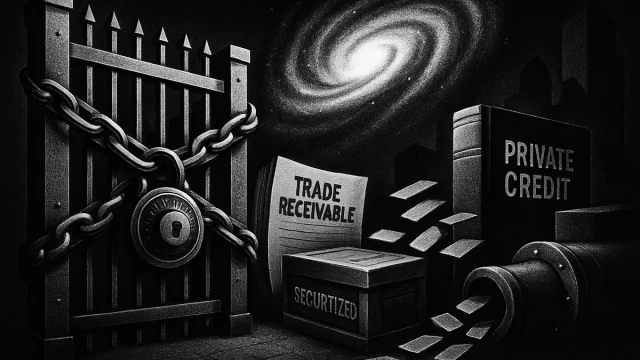
Fence, a startup building tokenized asset-backed finance infrastructure, closed a $20 million funding round led by crypto investment firm Galaxy. The capital is earmarked for an addressable market the team sizes at $6 trillion, a figure that extends far beyond the onchain government bonds and money market funds that have dominated tokenization volumes so far.
The simple read is that venture capital continues to flow into real-world asset tokenization. The better market read is that Galaxy’s involvement goes beyond a check. The firm operates trading desks, an asset management unit, and a balance sheet that routinely interacts with credit markets. Owning a stake in the infrastructure that tokenizes asset-backed securities creates a direct pipeline from origination to onchain liquidity. Galaxy can become both a user and a distributor: securities it structures or holds can be tokenized via Fence’s rails, then offered to DeFi liquidity pools or its own client base.
The Treasury Saturation and the Private Credit Gap
The current RWA narrative is concentrated in tokenized U.S. Treasury products. BlackRock’s BUIDL fund and similar vehicles have drawn billions in assets, offering a liquid, yield-bearing alternative to stablecoins. The mechanics are relatively straightforward: a government bond is a simple obligor promise with standardized risk, so custody, valuation, and redemption translate cleanly to a blockchain wrapper. Fence is betting that the next wave requires a different architecture altogether.
Asset-backed finance introduces multiple obligor layers, cash flow waterfalls, and default servicing that do not fit the pass-through model built for Treasuries. Fence’s infrastructure would need to encode credit tranches, repayment priority, and real-time collateral rebalancing into smart contracts that can interface with DeFi lending pools. Success here would mean a corporate borrower’s invoice could be tokenized, fractionalized, and posted as collateral on Aave or MakerDAO – a step change in collateral quality for protocols that currently rely on volatile crypto assets.
Galaxy’s In-House Demand Pipeline
Galaxy’s role extends beyond venture capital. The firm’s trading and asset management operations give it a direct use case for tokenized credit instruments. By funding Fence, Galaxy positions itself to originate and distribute asset-backed securities onchain, tapping into the crypto market analysis ecosystem’s growing need for higher-quality yield sources. Stablecoin rates from money market funds are compressing, and DeFi protocols have struggled to attract sustainable liquidity beyond speculative crypto collateral.
The arrangement mirrors the logic behind traditional banks funding fintech platforms that let them offload loans. In this case, the recipient of the liquidity is the DeFi ecosystem itself. A Galaxy-backed Fence could supply short-duration trade receivables – assets that already exist on corporate balance sheets and have never made it onto Ethereum (ETH) profile smart contracts at scale. The infrastructure bet is that private credit origination can be standardized enough to feed onchain pools without breaking the legal and compliance frameworks that govern these instruments.
DeFi Collateral Upgrade and Execution Risk
For DeFi protocols, tokenized asset-backed securities represent a potential upgrade in collateral durability. Unlike crypto-native assets, these instruments carry legal claim rights enforceable offchain. If a borrower defaults, the lender retains a contractual path to recovery – a feature absent in most overcollateralized DeFi loans. The catch is that enforcement depends on legal jurisdiction, not onchain slashing, so the smart contract must be paired with a robust offchain trustee framework.
Fence’s funding suggests that the capital markets side of crypto is ready to fund that legal scaffolding. The next concrete marker will be the rollout of a testnet pool with a live credit originator. Until that happens, the $20 million is an infrastructure bet, not a product delivery. Traders who have ridden the Treasury tokenization trade should note that Galaxy is now putting capital behind the higher-margin, higher-complexity segment of RWAs – the one that actually connects DeFi to private credit markets. If Fence delivers, the composition of collateral across lending protocols will shift from pure crypto to credit-enhanced instruments, altering risk profiles and available yields. The round itself does not change the timeline. The capital commitment from Galaxy signals that the largest crypto-native institutions are funding the engineering to make that shift happen.