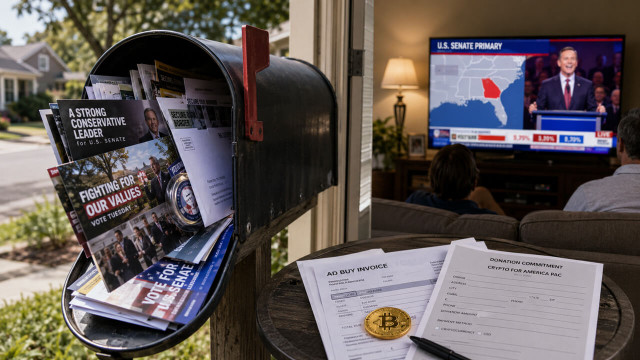
Fairshake, the crypto industry's flagship super PAC, put more than $12 million behind Barry Moore's run for an open Alabama Senate seat. On Tuesday, Moore won the Republican runoff with about 56% of the vote. In a deeply red state where no Democrat has won a Senate seat outside a single 2017 special election in three decades, that result hands him a near-certain seat in November.
The industry's campaign arm is sitting on nearly $150 million more in cash. It openly promises to build what its spokesman calls "the largest pro-crypto caucus in history." The one piece of legislation all of this money is meant to deliver, the market structure bill known as the CLARITY Act, is still parked on the Senate calendar with no floor vote scheduled.
The biggest contradiction of the 2026 midterms is straightforward: crypto has learned to win elections at a remarkable rate while the law it actually wants keeps slipping through its fingers. The Moore win fits a pattern the industry has been running all year. Fairshake and its affiliates concentrate spending inside party primaries, where turnout is low, local ad markets are cheap, and the winner of a safe-seat primary is close to a lock for the general election. A few million spent in a sleepy primary in a one-party district buys far more influence over Congress than the same sum spent in a swing-state general.
The industry spent more than $7 million on Andy Barr's Kentucky Senate primary, the race to replace retiring Republican leader Mitch McConnell. Barr won with more than 60% of the vote. That money came out of a roughly $20 million Southern spending blitz across Alabama, Kentucky, and Georgia. Most of those bets came home. According to Fairshake's own tally, the PAC went 6-0 across the May Southern primaries and 11 for 11 in June.
The money flows to both parties. Through its Democratic-leaning affiliate Protect Progress, the industry backed Christian Menefee in Houston's redrawn 18th District. Menefee defeated 21-year congressman Al Green in the May Democratic runoff with roughly 69% of the vote. The same affiliate put $1.5 million into ads opposing Green, a longtime critic the sector had graded hostile. The seat itself is safely Democratic, so Menefee is the strong favorite to hold it in November.
The machine does lose sometimes. In Illinois, Fairshake spent more than $10 million trying to stop Lt. Gov. Juliana Stratton in the state's Democratic Senate primary. She won anyway, which all but guarantees the next Senate will seat a member the industry spent heavily against. Those misfires are rare enough that they mostly serve to make the wins look more deliberate. They are a useful reminder that the spending tilts races but cannot control them outright.
What ties these contests together is leverage. To shape the committees that will write crypto laws, the industry only has to tip enough low-turnout primaries in safe districts. The winners then come to Washington owing most of their seats to crypto money. This is a shift from the last cycle's more defensive posture. The money now moves earlier, turning cash into nominees and nominees into seats that are settled long before Election Day.
Fairshake is chasing a legislative payoff. The PAC is mostly funded by Coinbase and the venture firm a16z, with additional backing from Ripple. Those backers have poured hundreds of millions into the effort across two cycles because the rules in question directly affect their businesses. Coinbase and Ripple both spent years tangled in SEC litigation over how their products should be classified. The legislation in front of Congress would settle much of that fight in their favor.
The GENIUS Act, which set federal rules for payment stablecoins, already became law last year. The bigger prize is the CLARITY Act. It would split oversight of digital assets between the SEC and the CFTC, giving the CFTC authority over most spot markets and resolving years of jurisdictional uncertainty. The bill passed the House in July 2025 by a wide bipartisan margin. Then it stalled in the Senate, cleared the Banking Committee in May, and landed on the Senate calendar on June 1. It is now waiting for floor time, with roughly eight weeks left before the summer recess and a long line of competing legislation ahead of it. An unresolved fight over whether stablecoin issuers can pay yield is one of the snags. The calendar may turn out to be the bigger obstacle than policy disagreements within the bill.
Every additional pro-crypto senator or representative the industry helps nominate this year will become a vote it can count on when market structure legislation finally reaches the floor. It also means friendlier committee members shaping how the SEC and CFTC police exchanges, token issuers, and how they approach DeFi platforms once the rules are written. The money buys margin in a closely divided Congress. That margin decides whether a bill survives a tight Senate window or dies waiting for floor time. The PAC's war chest, which topped $190 million entering the year, will keep that cushion growing through November and into the next session.
Moore's win, and the dozen or so like it, show that the industry has figured out how to assemble friendly lawmakers in advance, building a caucus before those candidates ever cast a vote. The question is whether the electoral firepower will finally push a digital asset law through a Senate the industry has already spent two cycles and hundreds of millions of dollars trying to shape. Until the CLARITY Act reaches the floor, crypto's political machine will keep proving it can win elections faster than it can win the law it is paying for.
Explore related reporting on crypto market analysis.