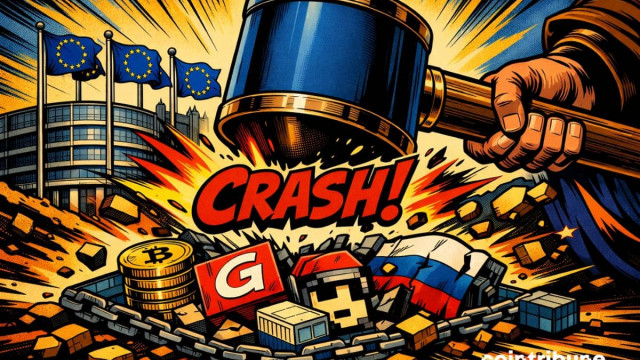
The European Union announced a total ban on crypto services for non-EU countries hosting platforms that help Russia circumvent sanctions, naming 20 entities including HTX.
The European Union announced its 21st sanctions package on June 9, 2026, targeting crypto platforms that help Russia circumvent restrictions. For the first time, the bloc proposes a total ban on crypto services for non-EU countries that host such platforms.
The European Commission named 20 third-party entities, including banks and crypto exchanges, involved in illicit transfers for sanctioned Russian actors. One of the named platforms is HTX, formerly Huobi, which the United Kingdom already sanctioned. The measure aims to deter third countries from tolerating these practices under threat of losing access to the European market.
Previous EU sanctions packages focused on traditional banking and trade restrictions. This one extends the net to the crypto ecosystem.
Illicit crypto addresses linked to Russia handled $154 billion in 2025, according to data cited in the proposal. A key part of that flow involves stablecoin A7A5, backed by Russian state assets, which generated $93.3 billion in volume last year. The proposal explicitly targets platforms that handle exchanges in digital rubles or stablecoins backed by Russian assets.
Centralized exchanges under European jurisdiction must freeze accounts and block suspicious crypto transactions. That requirement creates compliance costs for every exchange serving EU clients. Decentralized platforms operate outside that direct regulatory reach. They face their own legal risks.
Bitcoin remains the most used crypto for cross-border transfers. The proposal notes that Bitcoin liquidity in Europe could decline if platforms enforce the rules strictly. The compliance burden may reduce on-ramp liquidity for all crypto assets on European exchanges.
The sanctions package is expected to be formally adopted in the coming weeks. Implementation timelines and compliance requirements will follow.
Prepared with AlphaScala research tooling and grounded in primary market data: live prices, fundamentals, SEC filings, hedge-fund holdings, and insider activity. Each story is checked against AlphaScala publishing rules before release. Educational coverage, not personalized advice.