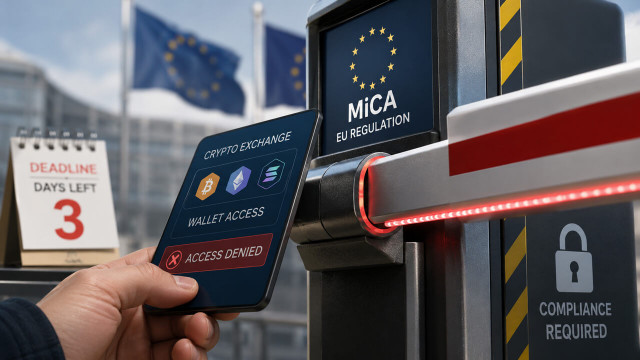
Europe's MiCA crypto law hits a hard cutoff on July 1. Companies that do not hold a full license lose the right to serve EU customers. That gives users less than three weeks to check their platform's status.
Law firm Hogan Lovells counted only 194 licensed crypto firms across the EU as of May, including banks. The market had more than 3,000 companies registered under older national regimes in 2024. Industry estimates put the share of older firms without a license at roughly 75%.
Getting a MiCA license takes months of review by a national regulator. Any company that does not already have one cannot be approved before the cutoff. For those firms, the next weeks are about closing down in an orderly way, handing customers over to a licensed competitor, or pulling out of Europe. ESMA, the EU's markets watchdog, has said those shutdown plans should have been ready before July 1.
What happens to users depends on the platform. An exchange that already holds a MiCA license or operates through a licensed European arm should continue working as before. Platforms that are moving customers to a licensed sister company will ask users to agree to new terms and re-verify their identities. EU rules require full identity and anti-money laundering checks before the deadline.
Platforms that have not been licensed will block new deposits and push users to withdraw their funds to wallets or other exchanges that hold a license. Users should check the EU's central register of licensed companies, not the app's appearance. A working website tells you a company is still up. The official register tells you whether it is actually allowed to serve you after the deadline.
The pressure is highest in France. The country's financial regulator, the AMF, told unlicensed firms they must stop operating from July 1. Ignoring the rule is a criminal offense under French law, carrying up to two years in prison and a €30,000 fine. The AMF can also issue a public blacklist, warn the public, and ask courts to block websites. At a press event in Paris on May 28, AMF president Marie-Anne Barbat-Layani said it had become urgent for companies to submit their applications, Reuters reported. She warned that firms still serving EU customers without a license could be taken to court.
Meeting MiCA's rules is expensive. The cost falls on banks, large exchanges, and well-funded platforms that can afford the lawyers, capital, and compliance staff the law demands. That effectively shrinks the market to a handful of licensed players. Poland alone had more than 1,400 of the older registered firms. The small, lightly regulated operators are the ones most likely to vanish first.
The political tension around MiCA has been driven by the passporting system. One license should earn a company the right to operate in all 27 EU countries. In practice, those licenses are issued by 27 separate national regulators working at different speeds and standards. Malta drew scrutiny from ESMA after questions about how such a small regulator could approve so many licenses so quickly. Barbat-Layani said France would be willing to reject licenses granted by countries it does not trust, calling a race to the bottom a serious collective failure it would rather avoid.
Stablecoins have already shown how the rules reshape the market. Tether's USDT never met MiCA's requirements. Coinbase, Kraken, Crypto.com, and Binance pulled USDT from their European platforms. Compliant tokens like Circle's USDC and its euro version, EURC, kept their place. Tether invested in compliant European issuers while leaving USDT unchanged. The same pressure is now reaching exchanges and brokers.
The weeks around July 1 are worth watching for big exchanges announcing moves to new European arms, regulators publishing warnings or blacklists, platforms cutting off services in France, Spain, Italy, or Germany, any last-minute approvals, and the wave of emails to users about withdrawal deadlines. Each signal is a clue about where the market is settling.
Users should check their platform's license status before July 1. The AMF said it will publish a public blacklist of unlicensed firms after the deadline. That list will show which platforms lost their right to operate.