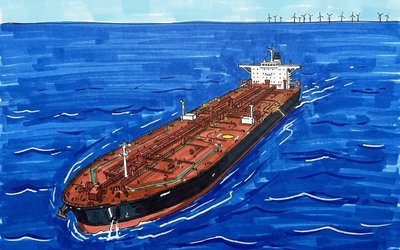
The global energy landscape has undergone a structural shift since the escalation of Middle East hostilities on February 28, 2026. With the Strait of Hormuz—a conduit for 20% to 35% of global seaborne oil and LNG—effectively constrained, the market is no longer pricing in a temporary supply bottleneck. Instead, it is grappling with the immobilization of approximately 20 million barrels per day of crude and LNG. This has forced a fundamental reassessment of risk, pushing Brent crude to US$126 per barrel in late April before a recent consolidation near US$107.74.
The Transmission of Energy Shocks to ASX Equities
The transmission path from energy volatility to the S&P/ASX 200 is direct and aggressive. Higher energy costs are acting as a tax on both corporate margins and consumer discretionary spending. The index has responded with an eight-day losing streak—the longest since 2018—and a 6% monthly decline as of early May 2026. The technical breach of the 200-day moving average signals a transition from a growth-oriented regime to one defined by defensive positioning and margin preservation.
Central banks are caught in a classic stagflationary trap. With Australian inflation at 4.6% in the March quarter, the Reserve Bank of Australia faces the May 5 meeting with expectations of a rate hike to 4.35%. Because monetary policy manages demand rather than supply-side energy shocks, the risk of over-tightening is acute. Investors must distinguish between companies that can pass through costs and those facing terminal margin compression.
Defensive Positioning: BWP, DRR, BSL, BGA, and MPL
In this environment, we prioritize companies with pricing power, low debt, and operational resilience. The following five names demonstrate the balance sheet strength required to navigate the current volatility:
Sector-Specific Resilience and Valuation
BWP Trust remains a defensive anchor. By internalizing management in late 2025 and securing 97.6% of income from high-quality tenants like Wesfarmers, the trust mitigates the volatility seen in smaller retail. Its 7.5-year weighted average lease expiry (WALE) provides an inflation hedge that is increasingly rare in the current rate environment.
Deterra Royalties offers a unique "inflation-protected" play. Because its revenue is tied to production volumes at Mining Area C rather than the operator's cost base, it is immune to the rising energy and labor costs plaguing traditional miners. With a net cash position of $7.2 million, it serves as a high-margin vehicle for resource exposure.
BlueScope Steel is leveraging its US expansion to benefit from onshoring trends. Despite energy-related margin pressure, its $240 million share buy-back program and focus on high-value-added coated products suggest management confidence. Similarly, Bega Cheese has successfully transitioned to a branded powerhouse, targeting FY2026 EBITDA of $215 million to $220 million by consolidating its manufacturing footprint.
Medibank Private rounds out the defensive cohort. As a low-beta stabilizer, its ability to maintain a 16.2% gross margin while growing its policyholder base by 1.9% highlights operational maturity. Its $453 million in cash and equivalents provides the liquidity necessary to weather further market dislocation.
Evaluating the Next Policy and Price Markers
The market's path forward depends on the resolution of the Strait of Hormuz disruption. Our base case assumes a reopening of shipping lanes by early June, which could stabilize oil near US$100 per barrel. However, a severe scenario—where the corridor remains closed—could push prices toward US$150, necessitating a further reduction in equity risk exposure. Investors should monitor the RBA's terminal rate projections, currently hovering near 4.85%, as the primary indicator of how much further the index must reprice to account for the tightening of financial conditions. Market analysis remains critical as we approach these decision points.