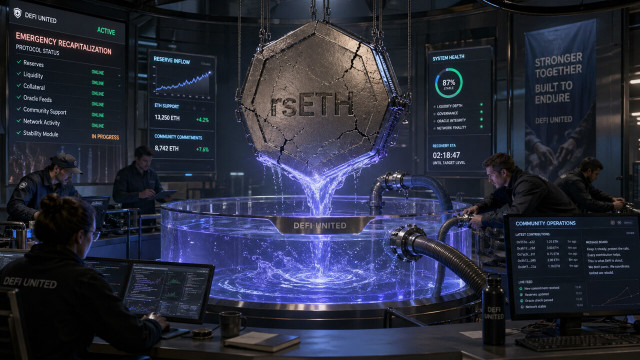
Decentralized finance protocols have faced a significant liquidity contraction this month, with total losses across the ecosystem reaching $13 billion. This capital flight highlights the fragility of automated market structures when faced with systemic stress. The recent intervention surrounding KelpDAO serves as the primary case study for how these networks manage insolvency without traditional institutional backstops.
The KelpDAO Recapitalization Mechanism
The KelpDAO rescue operation provides a template for how decentralized protocols attempt to restore backing for assets like rsETH. By utilizing the DeFi United platform, the protocol coordinated the recovery of 69,550 ETH. This capital was sourced from 222 distinct wallets through 1,623 individual transfers. This process effectively functioned as an ad hoc lender of last resort. Unlike traditional finance, where central banks or regulatory bodies dictate the terms of a bailout, this effort relied entirely on community-driven liquidity provision to restore the peg of a distressed asset.
The speed of this mobilization demonstrates the efficiency of smart contract-based coordination. However, the reliance on voluntary participation also exposes the inherent instability of DeFi during periods of high volatility. When liquidity providers lose confidence in the underlying collateral, the barrier to exit is low, often leading to cascading liquidations that exacerbate the initial loss of value. The KelpDAO event shows that while the industry can organize its own rescue, it remains vulnerable to the collective sentiment of its participants.
Systemic Exposure and Liquidity Contraction
The $13 billion in losses recorded this month underscores the broader risks associated with interconnected protocols. As assets move across different platforms, the failure of one component can trigger a chain reaction of margin calls and forced sales. This contagion effect is amplified by the lack of a formal regulatory framework, leaving protocols to navigate solvency crises through manual intervention or pre-programmed liquidation logic.
AlphaScala data currently tracks various sectors for volatility, including the consumer cyclical and industrial segments. For instance, Amer Sports, Inc. (AS stock page) holds an Alpha Score of 47/100, while SiteOne Landscape Supply, Inc. (SITE stock page) sits at 36/100. These scores reflect the broader market sensitivity to liquidity shifts, mirroring the caution seen in crypto market analysis as investors reassess the stability of decentralized yield-bearing assets.
Moving forward, the primary marker for the industry will be the sustainability of these ad hoc recovery models. The success of the KelpDAO effort may encourage other protocols to formalize their own emergency liquidity desks. However, the next test will be whether these mechanisms can withstand a sustained period of capital outflow or if they will require more robust, protocol-level safeguards to prevent future systemic failures. The industry is currently shifting its focus toward operational shifts in 2026 crypto mining economics to stabilize underlying network security, which remains a critical dependency for all DeFi applications.