Data for 13,689 Trezor Clients Exposed in Subcontractor Leak
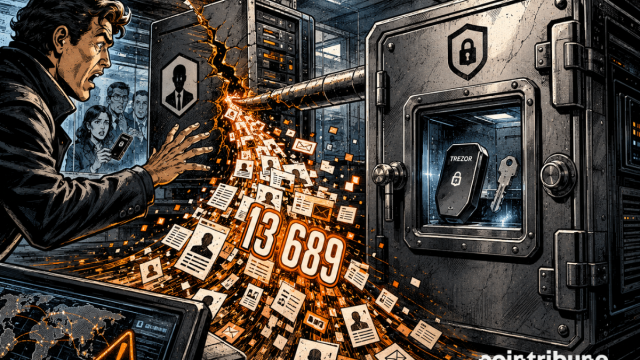
A shipping subcontractor exposed emails and phone numbers for 11,742 Trezor customers. No recovery phrases leaked; the follow-up is targeted phishing.
Trezor notified 13,689 customers that a logistics subcontractor leaked their personal data. The exposed records for 11,742 of those clients include names, delivery addresses, email addresses, and phone numbers. Another 1,947 had only their name and email address in the compromised files.
The affected orders were placed in the 90 days before Aug. 8. Customers in the United States, the United Kingdom, Sweden, Colombia, Brazil, Italy, and Portugal are among those exposed, the wallet maker said. Trezor is investigating the incident with the provider and has started contacting each affected client directly. The direct outreach gives those customers a reference point for any incoming message that claims to come from the company.
Recovery phrases and private keys were not among the leaked records. Trezor said the devices themselves remain secure. Personal details alone cannot move funds out of a hardware wallet. The recovery phrase can.
Hardware wallets exist to keep recovery phrases and private keys off internet-connected devices, and that promise still holds after this leak. Trezor had already warned customers about fake support emails before this incident. A recovery phrase is the master key to the wallet. Whoever holds it can rebuild the private keys and move the coins without touching the original device. Phishing is the tool built to extract it.
Fraudsters chose this group deliberately. They already hold crypto, and they have paid for a specialized device to protect it. An email address alone is enough to send a fake Trezor message. Add a name and a phone number, and the message turns personal. The delivery address confirms where the wallet went.
The smaller group of 1,947 clients had no phone number or address in the leak. They still had a name and an email address exposed. A name and an email are enough to build a personalized phishing email.
Fake support emails and urgent update notices are the standard pretexts. Trezor repeated its standing rule in the notification. The company never asks a customer for a wallet backup. A request for the phrase, whatever story it arrives with, is fraud.
Ledger customers went through the same sequence after a leak at its provider Global-e. Trust Wallet has also dealt with security incidents around its services. In each case the wallets were not the entry point. The systems around them were.
The delivery address carries a different kind of risk. No one can extract a private key from a street name. The address does reveal where a person who owns crypto lives, and that information has a long shelf life. For a wallet owner, the combination of a name and a location makes a fake support message harder to dismiss.
A hardware wallet's security does not stop at the hardware. The device can be perfectly protected and still travel through several companies between the order and the delivery. Between the purchase page and the doorstep, the order changes hands more than once. Each of those companies holds customer data. Trezor said it had imposed data retention rules on its partners, and the incident happened anyway.
Trezor is building an answer for future orders called "Anonymous Delivery." The feature is designed to reduce the personal information required to receive a device. The company has not disclosed how it will work. Reducing that information starts with the delivery address, the field in this leak that tied a customer to a physical location.
For the 13,689 affected customers, the crypto is safe. The keys never left their devices. What the customers lost is privacy, and the follow-up is phishing by email and text. The phone numbers were in the leak for 11,742 of them. Trezor's rule remains the test: no request for a wallet backup comes from the company.
Drafted by a large language model from the source reporting linked above, then screened by automated publishing checks. It is not read by a journalist before publication. Some articles cite our Alpha Score. Verify prices and figures against the original source. Educational coverage, not personalized advice.