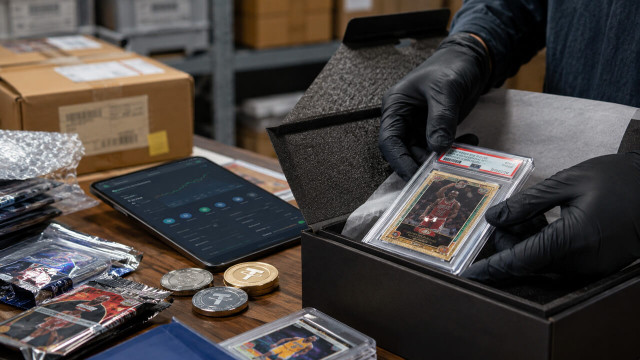
Collector Crypt has turned crypto's real-world asset debate into a measurable consumer experiment. The platform sells randomized digital card packs with USDC sellback, physical redemption, and CARDS token incentives. DeFiLlama's dashboard on June 24 showed $60.98 million in annualized fees and revenue, $15.15 million over 30 days, $4.16 million over 7 days, and $142.39 million in 30-day DEX volume.
Those numbers put Collector Crypt ahead of most tokenized Treasury products in on-chain activity. The dashboard breaks down pack sales, marketplace trades, and pack buybacks. The documentation describes a concrete loop: users purchase mystery packs, open randomized NFTs with verifiable randomness, can sell back to USDC immediately, or redeem the physical card through a submit-pay-burn flow.
The platform sits in a different corner of RWA than institutional products like Ondo or BlackRock's BUIDL. The asset is a collectible card. The user action is opening a pack. The liquidity path can bypass secondary markets entirely through the buyback endpoint.
That is why the risk profile diverges. Tokenized Treasuries depend on yield, counterparty, and regulatory clarity. Collector Crypt depends on attention cycles, incentive design, and the trust chain behind physical fulfillment.
The CARDS token adds a variable. At press time CARDS traded at $0.27, up 66% over the month but down 13% in the last week. Market cap is roughly $111 million. Circulating supply sits at 416 million tokens against a total supply of 2 billion. The float-to-total ratio leaves room for unlock pressure.
If users buy packs for the cards and redemption, CARDS is a utility token within a larger ecosystem. If attention shifts toward the token and rewards, the loop becomes more reflexive. Volume clusters around incentives, buybacks, social streaks, and unlock schedules rather than organic collector demand.
A June 11 release about Solflare Packs clarified the risk split. It described randomized packs with odds shown before purchase, 18+ gating, and language classifying the packs outside financial products. It also separated Solflare from any responsibility for sourcing, fulfillment, grading, storage, or redemption. Those disclaimers are candid about where the trust chain extends: warehouses, shipping partners, grading services, and buyer behavior.
Regulatory risk follows a different pattern than tokenized Treasuries. The New York Attorney General's February action against Valve targeted paid randomized rewards with monetary value and cash-out paths in a gaming context. Collector Crypt's paid randomization with immediate sellback and resale value shares that structural profile. No regulator has named the project. The analogy is a design risk, not an accusation.
Collector Crypt has passed one test that many consumer crypto apps fail: it generates visible, auditable on-chain activity outside its own marketing. DeFiLlama's protocol page, the gacha API documentation, the shipping API, and the CARDS market feed all point to a real product loop.
The unresolved question is what drives that loop. Durable consumer RWA would show users returning for cards, retaining or redeeming physical assets, trading because the collectibles have independent demand, and accepting transparent odds with less reliance on constant rewards. Reflexive gacha churn would show volume clustering around incentives, buybacks, social streaks, and attention spikes.
The next data points will distinguish these outcomes. Track repeat-user rates, redemption frequency, card retention, buyback spend relative to pack sales, and whether CARDS buyback mechanics are officially documented. Partner-pack expansion and CARDS behavior after the current attention cycle will also matter. The answers will determine whether Collector Crypt is building a consumer ownership market or a gacha flywheel.