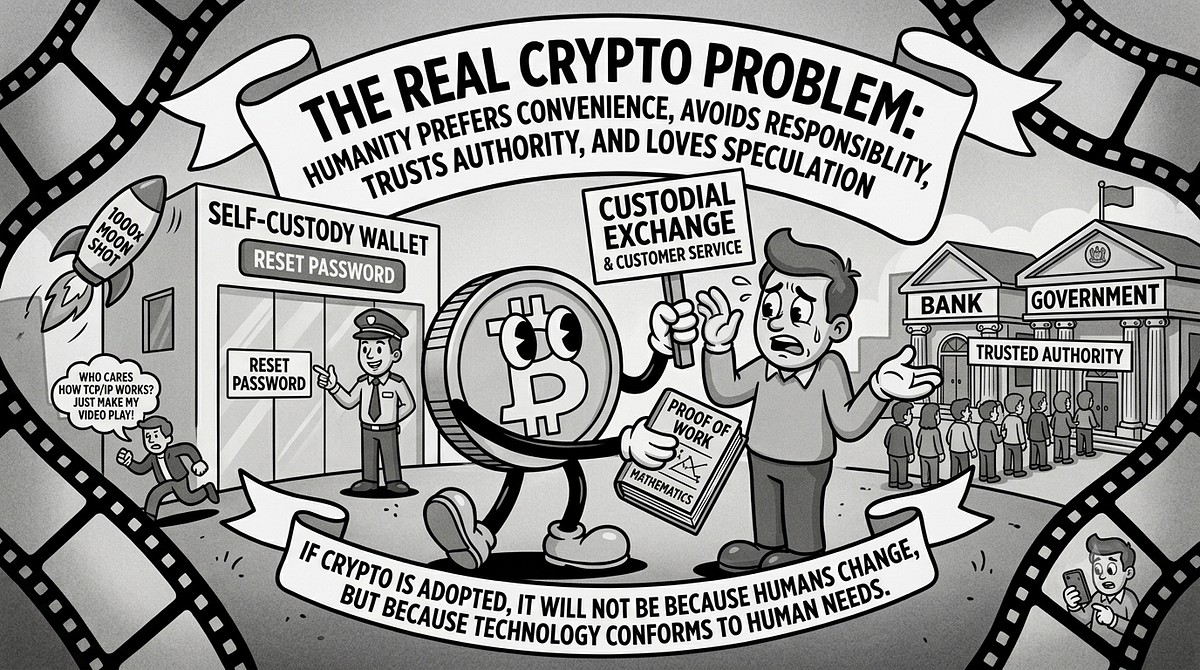
Crypto technology is ready, but users still want customer service and password resets. The industry's biggest risk may be human nature, not technical limitations.
The crypto industry has spent years optimizing blockchains for speed, cost, and scalability. A growing body of evidence suggests the real bottleneck is not technology but human behavior.
When a user sends funds to the wrong address, the money is gone. There is no customer service line, no chargeback, no password reset. For many people, that risk outweighs any benefit of decentralization. Industry surveys consistently show that ease of use ranks higher than decentralization in user priorities.
Most crypto users keep assets on exchanges rather than in self-custody wallets. They want someone to call when a transaction goes wrong. They want a password they can reset. The fear of full responsibility – of having no one to blame – is a basic human trait. In traditional banking, a mistaken transfer can be reversed. A credit card can be blocked. Crypto offers none of that.
This dynamic creates a structural risk for adoption. The very features that make crypto revolutionary – irreversibility, self-custody, pseudonymity – are the same features that deter mainstream users. Until the user experience matches the convenience of traditional finance, mass adoption may remain elusive.
The industry's biggest marketing successes have come during bull markets, when prices are rising and quick profits seem within reach. Decentralization, financial freedom, and global payment systems are secondary concerns for the majority of new entrants. The market responds by focusing on narratives, prices, and new tokens rather than real utility.
Perhaps the biggest problem with cryptocurrency is not low transactions per second, high fees, or poor user experience. It is that humans prefer convenience over freedom, trust institutions over mathematics, and are more interested in quick profits than in changing the financial system.
If crypto achieves mass adoption one day, it will likely not be because humans changed to follow the technology. It will be because the technology changed to follow humans.
Drafted by a large language model from the source reporting linked above, then screened by automated publishing checks. It is not read by a journalist before publication. Some articles cite our Alpha Score. Verify prices and figures against the original source. Educational coverage, not personalized advice.