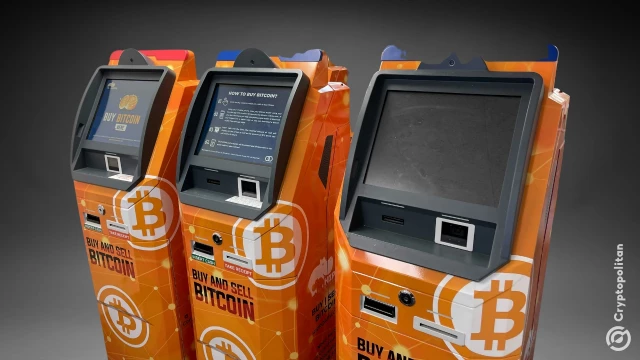
Arizona's attorney general recovered $171K for 35 scam victims under a 2025 refund law. Crypto ATM installations fell 31% globally and 44% in the U.S. as state, federal and international regulators tighten rules on cash-to-crypto kiosks.
Arizona's attorney general said her office recovered $171,332 in full refunds for 35 victims under the state's Cryptocurrency Kiosk License Fraud Prevention law, which took effect Sept. 26, 2025.
The law requires operators to reimburse new customers who report a fraudulent transaction within 30 days. It also caps daily transactions at $2,000 for new customers and $10,500 for existing ones, and mandates scam warnings, acknowledgment screens, and receipts showing the destination wallet address.
"My office is happy to help any victim of crypto ATM fraud receive a refund they are entitled to under Arizona law," Attorney General Kris Mayes said.
Arizona accounted for 460 complaints and losses of $14.53 million in 2025, according to FBI data. Nationwide, the FBI's Internet Crime Complaint Center logged more than 13,400 kiosk-related complaints last year with losses above $388 million, a 58% increase over 2024. More than half of those complaints came from people over 50, who lost $302 million.
The FBI described a specific fraud scheme where perpetrators tell victims to withdraw cash from bank accounts and deposit it at a crypto kiosk while keeping the phone line open. Older Americans are particularly vulnerable to that pattern, the bureau said.
The machines themselves tell the story. Coin ATM Radar data shows the number of crypto ATMs worldwide fell to 27,524 units as of Aug. 13, 2026, down 31.3% from the December 2022 peak of 40,072. The decline is steeper in the U.S., where installations dropped 43.6% from an August 2022 high of 35,037 to 19,754 units on Aug. 12.
Arizona is part of a broader regulatory push. Australia's AUSTRAC suspended Cryptolink's operations on Aug. 9 and shut down 96 machines. Germany's BaFin raided crypto ATMs nationwide in 2024. The UK's Financial Conduct Authority stopped 26 illegal machines in 2023.
Since 2023, 30 U.S. states have enacted laws covering crypto kiosks, with 13 adopted in 2026 alone, according to AARP. Indiana, Tennessee and Minnesota are pursuing outright bans. Other states have limited transactions, imposed licensing rules, or provided refund protections.
Hawaii takes effect Oct. 1, prohibiting crypto kiosks from accepting U.S. dollars in exchange for digital assets. In Congress, Representatives Sean Casten and Elvira Salazar introduced the bipartisan Stop Crypto ATM Scams Act, which would impose additional registration, anti-money-laundering and consumer-protection requirements on Bitcoin kiosk operators.
TRM Labs estimates illicit activity accounts for about 1.2% of cash-to-crypto volumes, nearly double its 0.63% estimate for the broader crypto industry. The firm says it has traced over $160 million in illicit funds through crypto ATMs since 2019. FinCEN issued its own warning in August 2025.
The shrinking ATM network is unlikely to jolt Bitcoin prices or global crypto liquidity directly. Crypto ATMs handle a small fraction of total digital-asset trading volume. The more significant effect is structural: physical on-ramps to cryptocurrency are contracting even as industry forecasts project growth.
Fortune Business Insights valued the global crypto ATM market at $356.72 million in 2025 and projects a 54.8% compound annual growth rate through 2034. North America contributed 88.7% of 2025 revenue, making U.S. regulatory direction critical for the industry's trajectory.
For operators, compliance costs are rising. For users who rely on cash rather than banks or centralized exchanges, the options to enter the digital-asset market are narrowing. The installation data suggests regulatory risk is no longer hypothetical for the physical ATM network; it is already reshaping it.
Drafted by a large language model from the source reporting linked above, then screened by automated publishing checks. It is not read by a journalist before publication. Some articles cite our Alpha Score. Verify prices and figures against the original source. Educational coverage, not personalized advice.