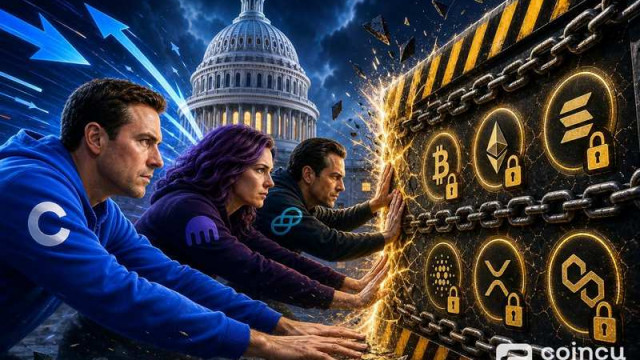
Three of the largest U.S. cryptocurrency exchanges are jointly pressing the Senate to remove restrictions on how digital tokens reach American traders. Coinbase, Kraken and Gemini have aligned on a shared position: current token listing requirements are too restrictive and risk pushing innovation to offshore venues. The coordinated lobbying targets lawmakers working on digital asset market structure legislation that has already passed through the Senate Banking Committee under Chairman Tim Scott.
The joint appeal marks a rare moment of alignment among exchanges that rarely coordinate on policy. Each operates under different business models and has historically pursued separate regulatory strategies. Their unified stance signals that listing restrictions now cut across competitive lines as a shared market structure problem.
What the Three-Exchange Coalition Is Asking For
Coinbase, Kraken and Gemini are not asking for a blanket deregulation. They are focused on specific provisions in the pending legislation that govern how exchanges decide which tokens to offer for trading. The most contested element is the so-called manipulation test applied to smaller tokens.
The manipulation test bottleneck
Current proposals require exchanges to conduct anti-manipulation testing on each token before listing. Larger tokens with deep liquidity and proven order books pass these tests easily. Small-cap tokens often fail or require disproportionate compliance cost. Coinbase has argued that the test effectively blocks legitimate projects from reaching U.S. trading venues.
Under the previous self-certification approach, Coinbase listed hundreds of tokens through a faster process. The proposed rules would slow that pipeline and raise the cost per asset. For an exchange that competes on breadth of offerings, that is a material drag on revenue and user acquisition.
Offshore competition angle
The exchanges argue that overly rigid listing rules create an uneven playing field. Offshore platforms operating outside U.S. jurisdiction face no such constraints. American users seeking access to tokens not available domestically may simply move to unregulated venues, stripping the regulated market of volume and fee income.
Key insight: The joint lobbying move signals that listing restrictions are now a market structure issue, not a compliance nuisance. When three rival exchanges speak with one voice, lawmakers face a unified industry position that carries more weight than individual lobbying efforts.
What Changes for Token Supply and Exchange Revenue
If the Senate adopts the exchanges' position, U.S. platforms could rapidly expand the number of tradable tokens. American traders would gain access to assets currently available only on offshore or decentralized exchanges. That shift would have direct consequences for exchange revenue and market share.
Coinbase, Kraken, Gemini divergent interests converge
Each of the three exchanges would benefit differently from looser listing rules. Coinbase has the largest U.S. customer base and the deepest liquidity pool. It would gain the most from a wider token menu because it can onboard new assets fastest through its existing infrastructure. Kraken and Gemini, with smaller loyal user bases, would use token breadth to defend against customer migration.
Together, the three platforms represent the majority of regulated U.S. crypto trading volume. Their joint position forces lawmakers to weigh the risk of losing that business to international competitors against the traditional investor-protection rationale for listing gatekeeping.
Second-order effect on listing fees and market share
Broader token availability would intensify competition among exchanges. Platforms that can onboard new assets fastest would gain a significant advantage, potentially reshaping market share dynamics. Smaller competitors without established compliance teams may struggle to keep pace, consolidating market power among the largest three.
AlphaScala's proprietary risk model gives Coinbase (COIN) an Alpha Score of 24/100, labeled Weak, reflecting the regulatory overhang that this legislative push aims to resolve. A move toward lower listing barriers would reduce one source of uncertainty for the stock, though broader macro and rates risks remain.
The Regulatory Timeline and Legislative Mechanics
The Senate Banking Committee has been actively working on comprehensive digital asset legislation. Chairman Scott led a historic markup of digital asset market structure legislation in late 2025, signaling that crypto regulation has moved from theoretical debate to active lawmaking.
Senate Banking Committee progress
A bipartisan Senate crypto bill introduced in late 2025 laid groundwork for the current legislative push. The bill advanced through committee with cross-party support. Specific provisions on token listing requirements remain contested. The exchanges' lobbying effort targets those contested provisions at the committee level before a floor vote.
The legislative mechanism in play
The listing restrictions appear in the market structure bill as conditions for an exchange to qualify for regulatory flexibility in other areas. Exchanges are essentially trading a promise of lighter oversight on other issues for tighter control over token selection. Coinbase, Kraken and Gemini want to unbundle that trade-off.
If the Senate adopts their position, the restrictions would be removed from the bill or substantially weakened. If the restrictions remain, exchanges will need to adapt to a slower listing process that benefits incumbents with existing compliance infrastructure.
Risk to Traders: Wider Access vs. Lower Quality
The most immediate consequence for traders would be a wider selection of tokens available on regulated U.S. exchanges. That access comes with a trade-off: reduced gatekeeping could increase exposure to lower-quality tokens with thin liquidity and higher manipulation potential.
Liquidity and manipulation risk after gatekeeping
Regulators have historically cited investor protection as the primary justification for listing gatekeeping. The manipulation test was designed specifically to catch tokens where price can be easily influenced by a small number of wallets. Without that test, smaller tokens with concentrated ownership could reach retail traders without adequate warnings.
Traders accustomed to the current screening standards may need to adjust their due diligence. The burden of evaluating token quality would shift from the exchange compliance team to the individual investor. Platforms that provide transparency around their expanded listing criteria could gain trust. Those that rush to list everything may face reputational risk.
Base ecosystem beneficiaries and conflict questions
Projects building on networks like Base, Coinbase's Layer 2, could be among the direct beneficiaries. Tokens native to ecosystems operated by the exchanges themselves would face a clearer path to listing. That raises questions about conflicts of interest in platform governance when an exchange controls both the underlying infrastructure and the listing decision.
For traders, the signal is straightforward: watch which tokens get listed first after any rule change. If the first wave is dominated by exchange-affiliated projects, that tells you something about the incentives at work.
What Would Confirm or Weaken the Thesis
For a trader building a watchlist around this event, the key is identifying when the legislative outcome becomes knowable and what price action would validate or invalidate the thesis.
Signs of legislative adoption
A committee vote to remove or weaken the listing restrictions would confirm that the exchanges' lobbying is working. Coinbase stock would likely rally on the news as the regulatory overhang lifts. Bitcoin and Ethereum would probably see correlated moves as the market prices in broader U.S. crypto access.
Tokens that are currently unlisted on U.S. platforms but have strong liquidity offshore would become speculative targets. Ethereum and Base ecosystem tokens with immediate listing paths would attract the most interest.
Counter-signals from regulators or investor protection groups
If investor protection advocates successfully pressure the Senate to keep listing restrictions, the exchanges' positions would be weakened. A bipartisan bill that maintains strong gatekeeping would confirm the current status quo, limiting upside for exchange tokens and COIN stock.
Another risk is a partial compromise: the Senate could keep restrictions for retail traders but loosen them for institutional or accredited investors. That outcome would benefit large-scale market making firms. The retail trading experience would remain unchanged, muting the impact for most readers of this analysis.
The Senate Banking Committee's next markup session will be the first concrete test of whether this lobbying effort gains traction. Traders should watch for amendments to the listing restriction language and for public statements from Chairman Scott's office.