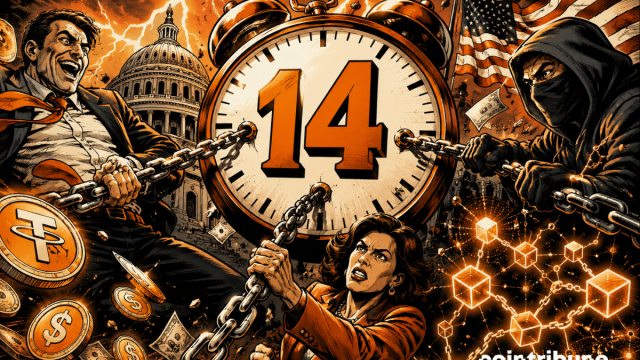
The Senate Banking Committee votes on the CLARITY Act this Thursday, May 14, a bill that could reshape the US digital asset market. Three unresolved issues threaten to fracture support: restrictions on stablecoin yields, ethics rules for elected officials who hold or promote crypto, and protections for decentralized finance (DeFi) developers. The outcome will set the regulatory path for stablecoin issuers, DeFi protocols, and platforms like Coinbase.
Stablecoin Yield: The Bank-Crypto Fault Line
The most immediate market risk centers on whether the bill will limit or ban yield on dollar-backed stablecoins. Traditional banks have pushed hard for restrictions, arguing that yield-bearing stablecoins divert deposits from insured savings accounts. The American Bankers Association has warned that such products could drain deposits from the banking system. Digital asset firms counter that these rewards programs already have a legal basis under the GENIUS Act and should remain accessible to the public.
The Tillis-Alsobrooks Compromise
A compromise offered by Senators Thom Tillis and Angela Alsobrooks attempts to split the difference. It would limit stablecoin rewards in certain cases while preserving them in others. The crypto sector has signaled support for this middle ground. Banking groups, however, see loopholes that could still erode their deposit base. The CLARITY Act arrives at the committee vote with a fragile balance on this point.
Market Exposure: Stablecoin Issuers and Exchanges
A yield ban would directly affect the business models of Circle (USDC) and Tether (USDT), which together command over $200 billion in market capitalization. It would also hit platforms that offer staking or yield products, including Coinbase. Coinbase distanced itself from the bill in January, fearing a bank-driven crackdown. The Tillis-Alsobrooks language reduces that tail risk. The final text remains uncertain. Any surprise restriction on yields could trigger a repricing of stablecoin-dependent DeFi protocols and exchange stocks.
Ethics Rules for Elected Officials: A Bipartisan Flashpoint
Several Democratic senators want to prohibit public officials from launching or promoting cryptocurrency-related products while in office. The push is widely seen as a response to initiatives associated with President Donald Trump. The White House has long opposed a ban that would target those ventures. This disagreement now threatens to derail the search for bipartisan support.
Committee Jurisdiction Dispute
Tim Scott, chairman of the Banking Committee, argues that ethics rules fall outside his panel’s jurisdiction and should be debated only at the final plenary vote. Pro-crypto Democrats, including Ruben Gallego, dispute that interpretation. Gallego has threatened to vote against the CLARITY Act in committee if the safeguards are absent. That stance matters because the bill will need at least seven Democratic votes to pass the full Senate later. A party-line committee vote is possible. A fractured Democratic caucus would complicate the floor count.
DeFi Developer Protections: The BRCA Amendment
The Blockchain Regulatory Certainty Act (BRCA) was annexed to the CLARITY Act last fall. It aims to shield developers of privacy tools and non-custodial software from being treated as money transmitters under federal law. Without that protection, coders could face liability for facilitating illegal fund transfers simply by writing open-source code.
Lummis-Grassley Agreement on Intent Language
Senators Chuck Grassley (Republican) and Catherine Cortez Masto (Democrat) have expressed national security reservations about creating an overly broad safe harbor. On Monday, Cynthia Lummis announced an agreement with Grassley to add a phrase specifying the required level of intent needed to qualify an operator as an illegal money transmitter. The revision clarifies the framework without removing the core protection for developers. This deal removes one obstacle to committee passage.
National Security Concerns
The intent language is designed to satisfy lawmakers who worry that the BRCA could shield mixers or other tools used to launder illicit funds. The compromise keeps the DeFi industry’s desired legal clarity intact while giving prosecutors a clearer path to pursue bad actors. For DeFi tokens, the BRCA language is a direct regulatory moat. A committee vote that preserves the Lummis-Grassley language would be a positive signal for the sector.
Timeline and Political Calculus
The May 14 committee vote is the first formal test of the bill’s political strength. Even if it passes along party lines, negotiators have several weeks before Congress’s summer recess to resolve the remaining disputes. The most likely path is a narrow committee approval, followed by a push to move the sensitive ethics debate to the floor.
What Would Reduce the Risk
A clean committee vote with broad Republican support and at least some Democratic votes would signal that a floor compromise is achievable. A clear statement from leadership that the ethics language will be addressed in plenary could keep Gallego and others on board. Final passage before the August recess would remove a major regulatory overhang for US crypto markets.
What Would Make It Worse
A fractured committee vote, especially one where pro-crypto Democrats defect over the ethics omission, would raise the probability of a floor failure. If the stablecoin yield language tilts toward a near-total ban, the market impact would be immediate: stablecoin redemptions, DeFi liquidity flight, and pressure on exchange stocks. A delayed or failed bill would leave the current patchwork of enforcement actions and state-level rules in place, prolonging uncertainty.
Assets Most Exposed to the Vote Outcome
Stablecoins are the most direct exposure. A yield ban would reduce demand for USDC and USDT, potentially shrinking the total stablecoin market cap and draining liquidity from DeFi lending pools. DeFi tokens tied to lending protocols and decentralized exchanges would react to the BRCA language. Strong developer protections are a tailwind; a watered-down safe harbor is a headwind.
Coinbase sits at the intersection of both fights. The company earns revenue from USDC reserves and from staking products that could be classified as yield-bearing stablecoin arrangements. The CLARITY Act draft already forced the market to price in some regulatory risk. The May 14 vote will either validate that discount or force a reassessment.
The CLARITY Act arrives at the Banking Committee with three live wires still exposed. The stablecoin yield compromise, the ethics jurisdiction fight, and the BRCA intent language each carry the potential to shift the regulatory landscape for digital assets. The vote outcome will give traders a concrete read on which risks are receding and which are about to intensify.