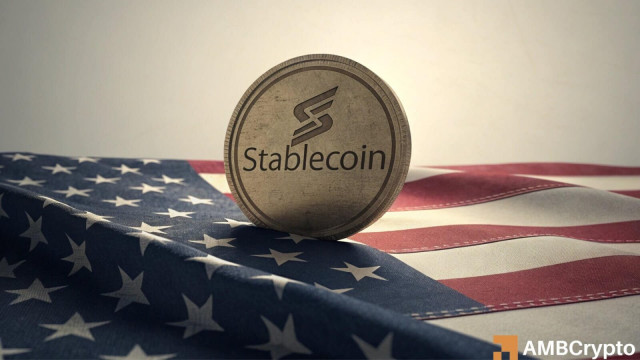
The probability of the CLARITY Act becoming law in 2026 has climbed above 75% on Polymarket, according to market data. The bill would bring crypto exchanges under anti-money-laundering compliance standards similar to those for banks. For months, the act seemed unlikely to pass. Jeremy Barnum, CFO of JPMorgan Chase, warned that yield-bearing stablecoins could create a parallel banking system without prudential safeguards. Yet the betting market now signals growing confidence in passage. The shift reflects a deeper reality: stablecoin regulation is no longer a domestic policy debate. It is a geopolitical race.
The CLARITY Act: From Unlikely to Inevitable
The naive read is that TradFi opposition killed the bill. Barnum’s warning was direct: “The creation of a parallel banking system that… has all the features of banking, including something that looks a lot like a deposit that pays interest, without… the associated prudential safeguards that have been developed over hundreds of years of bank regulation, is an obviously dangerous and undesirable thing.” That argument carried weight in 2024. It no longer dominates the conversation.
What changed is the scale of the stablecoin market. U.S. dollar-denominated stablecoins now hold a record $320 billion in market capitalization, roughly 12% of the $3 trillion crypto ecosystem. JPMorgan Global Research projects the market could expand to between $500 billion and $750 billion. The Chainalysis forecast is even more extreme: stablecoin transaction volume could reach $719 trillion by 2035, a 90,000% increase from current levels. Those numbers shift the calculus from risk management to strategic positioning.
The Better Market Read: Competition, Not Compliance
The better read is that the CLARITY Act is a response to global competition, not a concession to crypto advocates. President Donald Trump framed it that way: “The banks are hitting record profits, and we are not going to allow them to undermine our powerful crypto agenda that could otherwise move to China if we don’t get the CLARITY Act taken care of. The GENIUS Act was the U.S.’ first big step toward making America the crypto capital of the world, and getting the CLARITY Act done is the next step in finishing the job.” The European Central Bank recently published a report arguing that Europe must promote euro-denominated stablecoins or face digital dollarization. The U.S. is racing to lock in dollar dominance before other jurisdictions move.
The $320B Stablecoin Market and Institutional Entry
The current market cap of $320 billion is concentrated in USDT and USDC, new entrants are arriving. Fidelity Investments launched the FIDD stablecoin, describing it as a continuation of a 10-year commitment to digital assets. Western Union entered with its USDPT initiative. Solana processed a record $650 billion in stablecoin transactions in February 2026, showing that Layer 1 infrastructure is adapting to the volume.
| Metric | Value | Source |
|---|
| Current stablecoin market cap | $320B | CoinMarketCap |
| JPMorgan projection | $500B–$750B | JPMorgan Global Research |
| Chainalysis 2035 volume projection | $719T | Chainalysis |
| Solana Feb 2026 stablecoin volume | $650B | Solana |
JPMorgan Chase itself sits at the center of this debate. The bank’s Alpha Score on AlphaScala is 48/100 (Mixed), with a current price of $297.81, down 0.70% today. Its CFO’s public skepticism has not stopped the market from pricing in regulatory change. For more on JPMorgan’s positioning, see the JPM stock page.
Global Competition as the Real Catalyst
The ECB report frames stablecoin adoption as a necessity, not a choice. If the U.S. passes the CLARITY Act, it reinforces expectations that the dollar will remain dominant in the stablecoin era. Europe, China, and other regions are watching. The AI race analogy is overused, here it fits: stablecoins are becoming a financial arms race where first-mover regulatory clarity creates a structural advantage.
Europe’s
Europe’s Response
The ECB’s argument is blunt: without euro-denominated stablecoins, Europe loses monetary sovereignty. That pressure pushes the U.S. to act faster. The GENIUS Act was the first step. The CLARITY Act is the second. Together, they create a regulatory framework that attracts issuers and exchanges.
What This Means for TradFi and Crypto Exchanges
For TradFi institutions, the act means clearer compliance rules. For crypto exchanges, it means higher operational costs and legitimacy. The Polymarket odds reflect that the market sees passage as more likely than not. The key question is timing: 2026 is the target, the political calendar could shift.
Risk Scenarios: What Confirms or Weakens the Thesis
What would confirm the setup: a formal committee vote in the House or Senate, a public endorsement from the Treasury, or a spike in Polymarket odds above 90%. What would weaken it: a competing bill that stalls progress, a major stablecoin hack that triggers a regulatory backlash, or a shift in White House priorities.
The Hack Risk
The DeFi sector has seen repeated exploits. The Verus Bridge lost $11.58 million in May. A larger breach involving a regulated stablecoin issuer could slow the legislative timeline. The DeFi Lending Hack Losses analysis shows that losses average $3 per $10,000 deposited, a single large event can change the narrative. For more on recent hacks, see May's DeFi Hack Tally Grows: Verus: Verus Bridge Loses $11.58M.
The Execution Risk
Even if the CLARITY Act passes, implementation will take months. Exchanges must build AML systems. Regulators must staff up. The NCUA Stablecoin Rules provide a roadmap for credit unions, the broader framework is still being written. See NCUA Stablecoin Rules: Credit Unions Get a GENIUS Act Roadmap.
The Bottom Line for Traders
The CLARITY Act is not a crypto-friendly giveaway. It is a strategic move to maintain dollar dominance in a world where stablecoins are growing faster than anyone expected. The Polymarket odds are a useful signal, the real catalyst will be the legislative calendar. Watch for committee markups and Treasury statements. If the act passes, expect a wave of institutional issuance and a shift in the competitive landscape for Layer 1 networks like Solana and Ethereum.
For now, the market is pricing in inevitability. The question is whether the reality matches the odds. For broader crypto market context, see crypto market analysis.