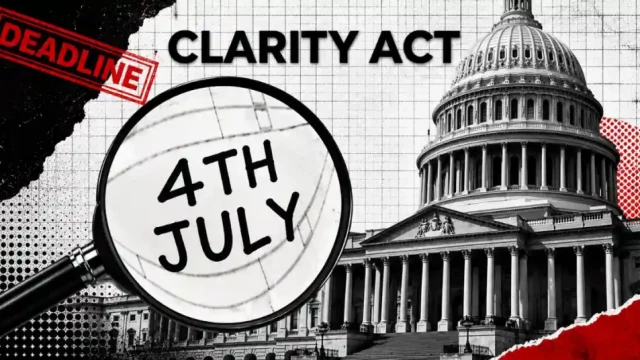
The White House is still aiming for a July 4 deadline on the CLARITY Act, the crypto regulatory bill that has been winding through Congress for months. Patrick Witt, executive director of the White House Crypto Council, told journalist Eleanor Terrett that negotiations are ongoing.
“We’re still making great progress,” Witt said. “Every day we’m making progress on all fronts.”
Witt said lawmakers and negotiators are working through concerns raised by Democratic senators. Discussions cover agriculture oversight, ethics provisions, and broader regulatory matters, with draft proposals being exchanged daily.
The House passed its version of the CLARITY Act in July 2025 with bipartisan support. The Senate opted to write its own bill instead. Since then, several proposals have surfaced: discussion drafts from Tim Scott and Cynthia Lummis, a 182-page draft from the Senate Banking Committee, and a separate framework backed by Senate Democrats.
Terrett also reported that US officials and crypto industry leaders held a 90-minute meeting on the bill. Sources described the legislation as being in its final negotiation phase before a potential Senate floor vote.
CFTC Chairman Mike Selig backed the effort. “The name CLARITY says it all,” he said. “For too long, crypto markets have operated under uncertainty and opaque rules.”
Senator Cynthia Lummis echoed that. “The rules for digital assets exist. We just have to make them law.”
More than 200 crypto companies and organizations – including Coinbase, Ripple, Kraken, Circle, and Binance.US – have signed an open letter urging the Senate to hold a vote.
The bill, if it advances, would be the most significant piece of crypto regulation the US has produced. The July 4 target gives negotiators roughly three weeks to resolve outstanding differences.