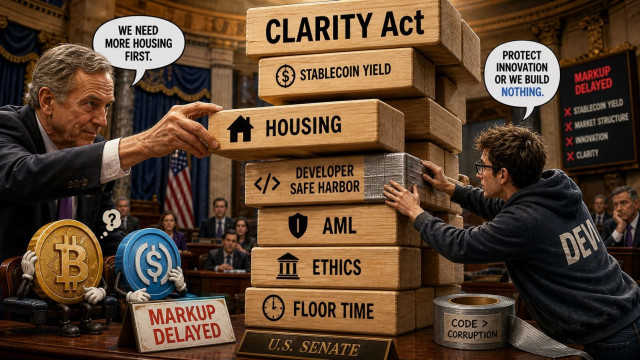
The CLARITY Act markup is stalled as Senate housing disputes and developer liability concerns delay progress. Watch for a revised committee vote schedule.
Alpha Score of 54 reflects moderate overall profile with moderate momentum, strong value, weak quality. Based on 3 of 4 signals — score is capped at 90 until remaining data ingests.
The legislative path for the CLARITY Act has hit a procedural bottleneck as the Senate Banking Committee shifts focus from stablecoin yield frameworks to broader housing policy debates. While the initial market narrative centered on the resolution of stablecoin yield structures, the markup process is now stalled by Senator John Kennedy’s intervention regarding housing regulations. This pivot introduces a new layer of uncertainty for digital asset firms that were pricing in a clear regulatory timeline for the current session.
Beyond the housing policy impasse, the committee remains deadlocked on the scope of liability protections for software developers. The current draft faces pushback from members concerned that the existing language does not sufficiently insulate open-source contributors from enforcement actions. For the industry, this is the primary point of execution risk. If the committee fails to carve out specific safe harbors for developers, the resulting bill may create a chilling effect on infrastructure development, regardless of the progress made on stablecoin oversight.
Market participants tracking the crypto market analysis should note that the legislative delay is not merely a matter of scheduling. Senate Banking Chair Tim Scott currently lacks the necessary Republican vote count to advance the bill to the floor. The current impasse suggests that the committee is struggling to balance the demands of fiscal conservatives with the need for a bipartisan consensus on digital asset oversight. This internal friction is a direct signal that the bill is unlikely to move forward without significant concessions on the housing provisions that have currently hijacked the agenda.
For those monitoring the Bitcoin (BTC) profile, the delay in the CLARITY Act removes a near-term catalyst that many traders expected to provide a definitive legal framework for the sector. The lack of a clear timeline for a committee vote means that firms operating within the U.S. jurisdiction must continue to navigate the existing regulatory gray area. The legislative process is now tethered to the broader Senate calendar, where housing policy is currently taking precedence over financial innovation.
Investors should look for the next concrete marker in the form of a revised committee calendar or a public statement from Chair Scott regarding a revised vote count. Until the housing dispute is resolved and the developer liability language is clarified, the CLARITY Act remains in a state of suspended animation. Any sudden movement on the committee floor will likely be preceded by a deal on the housing provisions, as this is the current gatekeeper for the entire markup process. Traders should adjust their expectations for a legislative win in the current session, as the window for bipartisan agreement is narrowing as the housing debate intensifies.
AI-drafted from named sources and checked against AlphaScala publishing rules before release. Direct quotes must match source text, low-information tables are removed, and thinner or higher-risk stories can be held for manual review.