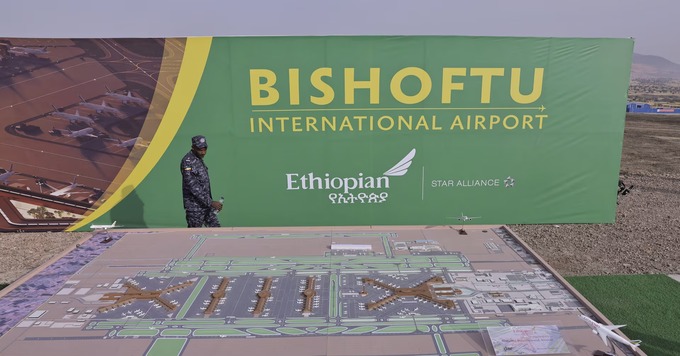
Chinese state-owned firms hold 15 of the 33 places on the shortlist for the four main construction packages at Ethiopia's Bishoftu International Airport, the airline's parent group said after completing prequalification in April, ch-aviation reported. The packages cover the main terminal, support facilities, airfield and infrastructure works, and offsite transport links.
No independent American contractor made the list. The only U.S.-linked entry is Lane Construction Corporation, a Connecticut firm owned by Italy's Webuild, appearing in three packages through a joint venture with Webuild and Turkey's IC Ictas. The Commerce Department has pressed for American participation. "The Commerce Department has closely engaged in pushing to secure strong U.S. participation," Mark Mitchell, deputy assistant secretary of commerce for the Middle East and Africa, said at a July 29 State Department briefing in Addis Ababa. The airport's expansion would mean more Boeing jets powered by GE Aerospace engines, he said. Ethiopian Airlines agreed in April to order six more Boeing 787-9s on top of 20 already on the books, The Reporter Ethiopia reported.
Chinese Firms Hold 15 of 33 Shortlist Spots
Ten Chinese groups appear as lead or joint-venture partners, including China Communications Construction Company, China Road and Bridge Corporation, China Civil Engineering Construction Corporation and Beijing Urban Construction Group. European and Middle Eastern names on the list include Webuild, Vinci Construction Grands Projets and Samsung C&T, Capital Newspaper reported.
Contractor selection was pushed from August 2026 to early January 2027 after bidders requested more time to prepare proposals and arrange financing, group chief executive Mesfin Tasew told the annual performance briefing on July 30. He said the change would not affect the overall schedule.
Funding Gap and Strategic Leverage
The project needs more than $9 billion in external funding. No loan agreement has been signed, Mesfin said. Lenders have signalled interest worth $8.5 billion. Each must complete its own evaluation, a process he expects to finish by March 2027. The African Development Bank, acting as mandated lead arranger, has indicated it will provide $500 million subject to appraisal, Capital Newspaper reported from Addis Ababa. Further interest has come from the U.S. International Development Finance Corporation, the U.S. Export-Import Bank and JPMorgan Chase.
Mesfin said in November 2025 that an unnamed China-based institution had pledged $500 million. A delegation from the airline and Ethiopia's finance ministry met Bank of China on March 31, days after a separate mission in Beijing engaged China Exim Bank, ICBC and China Development Bank.
Horn of Africa infrastructure has become a new front in U.S.-China competition, said Costantinos Berhutesfa Costantinos, professor of public policy at Addis Ababa University and a former UN policy adviser. Western defense planners view major transport hubs through logistics capability and intelligence security, he said, while Beijing treats them as nodes in its supply chain network.
Price will decide the outcome, said W. Gyude Moore, a distinguished fellow at the Energy for Growth Hub and Liberia's former public works minister. Fierce domestic competition in China means export earnings keep many Chinese contractors afloat, he told the South China Morning Post, so they will bid at levels American firms will struggle to match.
David Shinn, a China-Africa specialist and former U.S. ambassador to Ethiopia, said American companies have been largely absent from large African infrastructure projects in recent years and that the Trump administration views Bishoftu as an opportunity to re-enter the market.
Costantinos predicted Ethiopia would split the megaproject into separate packages, awarding heavy civil engineering to Chinese firms while reserving avionics, security and digital infrastructure for Western or Gulf partners. Bringing in Gulf capital gives Addis Ababa the leverage to keep the airport from becoming a zero-sum contest between Washington and Beijing, he said.
Ethiopian Airlines broke ground on Jan. 10 at Bishoftu, around 45 km southeast of Addis Ababa. The four-runway airport is designed to handle 60 million passengers a year when its first phase opens in 2030, rising to 110 million passengers and 3.73 million metric tons of cargo at full build-out. The carrier is funding 30% of the cost from its own balance sheet, with lenders covering the rest. Land grading and clearing that began in January is expected to be completed by January 2027, Capital Newspaper reported.
Addis Ababa Bole International Airport, which handles about 25 million passengers a year, is expected to reach capacity within two to three years. At $12.5 billion, Bishoftu is the most expensive aviation project ever undertaken in Africa, and Prime Minister Abiy Ahmed has called it the largest in the continent's history. Its planned capacity of 110 million passengers a year would exceed that of Atlanta's Hartsfield-Jackson International Airport, the world's busiest, which handled 106 million passengers in 2025, CNN reported.