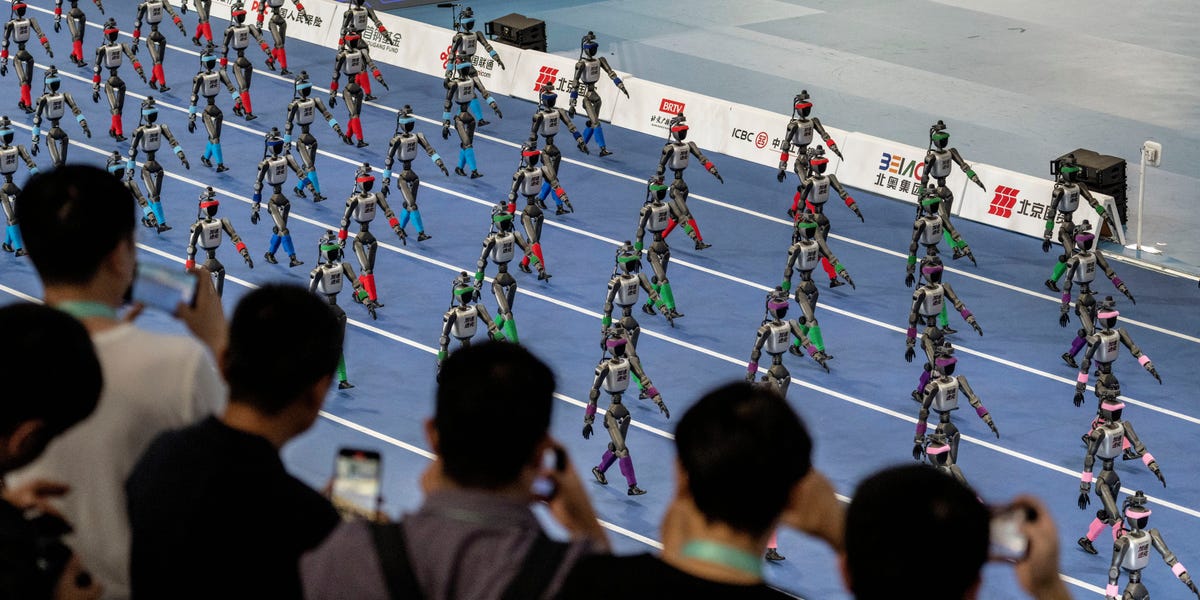
The World Humanoid Robot Games opened Saturday in Beijing with a test run that a humanoid named Lightning finished faster than Usain Bolt's 2009 world record, Chinese state media reported. The actual prelims were less polished.
A blue padded wall sat at the end of the 100-meter track. Several robots hit it at full speed. Some lost limbs on impact. A four-man stretcher crew carried them off. One machine briefly caught fire before a fire extinguisher put it out.
The five-day competition, hosted by the Beijing municipal government, includes 100-meter and 400-meter sprints, a seven-on-seven soccer match, and demonstrations of tennis, tug-of-war, weightlifting and traditional Chinese martial arts, according to state media. More than 2,000 robots are registered across the events.
The soccer match moved at a plodding pace. Robots occasionally stopped watching the ball and stood motionless while it rolled past. In one sequence, a blue-team robot kicked a defender, earning a yellow card. A human-versus-robot tennis point followed. The human won.
The flashy demos highlight a gap between ambition and real-world deployment. Humanoid robots have not achieved widespread use because the underlying AI systems remain limited. Both the Chinese and U.S. tech industries are pouring money into development as AI improves. Unitree, a Chinese robotics company whose shares surged 460% on their trading debut this week, dominates the nascent market alongside local rivals. Morgan Stanley analysts project the sector could be worth $7.5 trillion by 2050.
Robotics startups raised a record $15 billion globally in 2025 and another $18.8 billion so far this year, according to Crunchbase. Attendance at Actuate, a San Francisco conference for robotics builders, has tripled since its launch two years ago as Silicon Valley investors take greater notice.
U.S. robot innovation faces a hardware constraint. At Actuate, data vendors outnumbered machines. The FCC last month imposed restrictions on new foreign-made "advanced robotic devices," making it harder for U.S. firms to acquire cheap Chinese components.
Unitree's CEO said this week that the industry's "ChatGPT moment" could be a decade away. China is also hosting the 2026 World Robot Conference in the same city this week. The humanoid games run through Wednesday.